window.dataLayer = window.dataLayer || []; function gtag(){dataLayer.push(arguments);} gtag('js', new Date());gtag('config', 'UA-141884085-1'); gtag('config', 'AW-761820283');

What You Should Know About Cartesian Robots

If you read the DIY-Robotics blog or other robotics newsyou know that the number of factories incorporating robots is rising. Industrial robots streamline workflow by accelerating cycle times and eliminating bottlenecks. Task automation gets more straightforward with every successive generation of robots. End-users no longer need a degree in computer science to configure the robot’s features. The newest models boast unparalleled levels of user-friendliness with negligible backend-programming requirements. So, with the entire robotics industry booming, it’s essential to know what distinguishes one type of robot from another.  In this article, we’re going to look at Cartesian robots, where you might find one, and what makes them an excellent choice for some companies 

What is a Cartesian Robot? 

Machines that operate on Cartesian coordinate systems have been staples in factories for decades. 3D printers, laser-cutters, and CNC machines are examples of devices that use the same principle as Cartesian robots. What sets these robots apart from others is their construction. Cartesian robots are boxy, open, and their primary X-Y directional motion is regulated from above by a rectangular gantry. A lead screw or other linear actuator controls movement in the vertical, Z-direction. All Cartesian robots have this rectangular configuration, and as a result, they are sometimes called rectilinear robots or gantry robots. 

The Benefits: Strength, Precision, and Accuracy.  

Thanks to their rigid structure and boxy configuration, Cartesian robots can carry heavy loads. They are excellent at performing pick-and-place tasks, loading and unloading, material handling, and even high precision operations. 

When it comes to accuracy, howeverseveral factors determine how well a Cartesian robot will perform over time. If the drive system uses a rubber belt, for example, it may stretch or underperform with loads above a certain weight. Motor encoders, servos, and stepper motors improve travel accuracy as long as the material components are regularly checked or calibrated. Under optimal conditions, a Cartesian robot will exhibit superb accuracy in addition to its other qualities. However, do your due diligence before making a purchase and ensure the materials will withstand regular use.  

Work Envelope of a Cartesian Robot 

Cartesian robot’s work envelope is defined by its rectangular structure. Often there is a plate or work area within the boundaries of the X-Y plane. The operational height is bound by the vertical ceiling and the plate or work area. Within this area, there are no “dead zones.” The Cartesian robot has access to every part of the payload that is within this operational cube. 

The footprint of a cartesian robot is rectangular and compact. SCARA robots and six-axis robots have oblong work envelopes that create a lot of unusable space around them. Thanks to the predictable, measurable, and well-defined boundaries of the Cartesian robot, factories can incorporate them easily into their existing infrastructure without having to do a lot of calculating first. 

Whats the price of a Cartesian Robot? 

Due to their simplistic design, primary motor controller, and minimal moving parts, Cartesian robots provide savings over articulated robots. You will also save money by reducing downtime associated with start-up, programming, and troubleshooting. However, articulated robots are more flexible in the long-run. So while you’ll see a lower sticker-price on some Cartesian models, that discount comes at the cost of versatility.

For more information about Cartesian robots or any other types of robots, check out the DIY-Robotics forums and join a community of industrial robotics specialists and enthusiasts. Feel free to reach out to the team for a free consultation and a custom-tailored cost projection.  

Want to know more about Cartesian robotsJoin the DIY-Robotics forum for free and ask the community!

What You Need to Know About Articulated Robots

Articulated robots are the iconic mechanical denizens of the futuristic factory-floor. For decades, this image has seeped its way into our collective cultural consciousness and pervaded everything from cartoons to movies and even stock images. Also, though we’ve moved beyond the basic articulated design to some stunning, cutting edge machines, the image is so ingrained in our memories that the industrial robotics manufacturers continue to produce them to this day. But image alone isn’t enough to keep this reliable, not-yet-antiquated, style of robot around. What are the benefits provided by articulated robots? Why do so many factories choose to rely on this classic, iconic workhorse?

What’s an Articulated Robot?

Articulated robots are the most common types of industrial robots. Their resemblance to a human arm is perhaps one of the reasons they stand out so much in our minds. However, the mechanical benefits of this design are the real reason for their ubiquity and longevity. The arm design combines an extensive range of rotation motion and linear reach with the advantages of precision movement. Articulated arms are ideal for welding, material handling, pick-and-place operations, and dispensing. Their numerous axes and degrees of freedom mean that there is virtually no point in their work envelope that they cannot reach. This makes articulated robots one of the most versatile, flexible, and compact designs on the market.

Articulation of the Robot

The secret to the motion of articulated robots is their rotary joints. Joints can range from a two-axis configuration to something as complicated as ten or more axes. Articulated robots with six-degrees of freedom are the most common. Servo motors powering the joints act like bezel gears, changing the direction of motion by up to ninety-degrees while offering dial-in stops for precision programming and movement.

Work Envelope of an Articulated Robot

With any industrial robot, the work envelope is a significant factor in assessing its usefulness. Articulated arm robots can use a majority of their work envelope, which is one of their greatest advantages. The only part of the envelope they can’t use is the back where the cables are located. However, some modern designs feature internally routed power and data cables that eliminate this problem and let the articulated arm take advantage of its entire sphere of reach.

Regardless of how the cables are routed, even the most basic articulated robot can maximize the usable space for its footprint on the factory floor. This is a major advantage to factories that have to consider production flow, safety, and floor space.

Speed of an Articulated Robot

One of the drawbacks of articulated robots is their speed. They are not as efficient as other types of robots that can accomplish very high-speed tasks. Articulated robots, due to their numerous joints and degrees of freedom, require complex kinematics to govern their motion. They also have higher component mass, so there is an inertial barrier to overcome at every change in direction. If speed is a crucial component of a factory’s cost-benefit-analysis, then articulated robots may not be the ideal choice.

What’s the price of an Articulated Robot?

So, what will an articulated robot cost you? As with any factory upgrade, there are a few ways to answer this question. First, there is the upfront cost: what is the price of the actual unit? Then, there are operational and maintenance fees—these address the costs to operate and maintain the machines every month. However, if you also look at where you’ll see savings, you’ll get a better overall picture of your return on investment. Over time, the benefits of an articulated robot offset the upfront cost. For instance, factory automation improves the health and safety of workers by minimizing repetitive stress and limiting time in hazardous zones. Additionally, your company will produce products of more consistent quality. The result is increased productivity, which means that your investment will pay for itself down the road.

With so many factors constituting the “real cost” of robot upgrades, it’s best to consult the experts on DIY-Robotics.com for a full cost breakdown. In the meantime, you can build your own miniature/prototype robot and familiarize yourself with the mechanics and programming.

If you’d like to boost your factory’s productivity with a robot that is flexible, agile, and has a sizable work envelope, you should consider an articulated robotic arm. For more information about articulated robots or any other types of robots, check out the DIY-Robotics forum and join a community of industrial robotics specialists and enthusiasts. While you’ll find pricing for DIY-Robotics cells online, feel free to reach out to the team for a free consultation to better custom-tailor a cost projection.

Everything you Need to Know About SCARA Robots

Robots are evolving into an essential purchase for manufacturers. They can easily boost your productivity and simplify your automation processes. SCARA Robots, in particular, are popular. In this article, we’ll look at what SCARA robots are and why they may be one of the best choices for your facilities.

What is SCARA?

SCARA stands for Selective Compliance Articulated Robot Arm. They are robotic arms that have a versatile range of motion in the X-Y plane. The arms can move vertically as well, but the position of the vertical axis remains fixed. Thanks to the combination of rigid and dynamic axes, SCARAs are well suited to tackle a variety of material handling operations. They excel at pick-and-place tasks and rapid transportation processes. SCARA robots are at their best, however, when they are used to perform assembly applications. This includes anything from semiconductor handling to bio-med applications and packaging.

Articulation

The number of joints a robot has, combined with the number of axes in each joint, determines its degree of freedom. SCARAs are four-axis robots, with motion in the X-Y and Z planes, and 360-degree rotational movement about the Z-axis. Inverse kinematics and data interpolation allow the robot to move dynamically, quickly, and intelligently.

Work Envelope and Footprint

The work envelope (the area of space that a robot can physically reach) is a significant consideration. Often, when choosing between SCARA, Delta, or six-axis robots, the work envelope is the deciding factor. Due to their full rotation about the fixed Z-axis, SCARA robots have a cylindrical work envelope. In some applications, a SCARA’s work envelope is limited to the front and side. The rear may not be useable if cables and pneumatic hoses exit from the back. Still, having the ability to work in all, or mostly all, of their reach allows SCARA robots to maintain a minimal footprint while maximizing workspace.

Speed

Speed is an essential factor when choosing a robot. SCARAs are one of the fastest on the market. With four axes, they have fewer moving joints than their six-axis counterparts. Additionally, the reduction in joints simplifies inverse kinematic calculations, requiring less computational time. When cycle time is critical, SCARA robots present an ideal package.

So, How Much Should you Expect to Pay?

While Delta robots may be faster, SCARA robots are less expensive. When considering the cost per operation, SCARA robots are a better deal than most other configurations. Companies can expect to pay about $45,000 for a medium to large SCARA robot, but the price may vary depending on the number of extras and payload capacity. They can range from $25,000 and go up to $400,000.

So is the SCARA robot the right type for you? Hopefully, you now have a better idea of how they may meet your needs and expectations. They have many advantages, including if you are limited in space and need the maximum work-envelope to footprint ratio. For more information on SCARA and other robots, check out DIY-Robotics forum and join a community of industrial robotics specialists and enthusiasts.

Interpreting the Three Laws of Robotics

Isaac Asimov is not only a pioneer of the science fiction genre, but he is also the creator of one of the most popularized concepts in robotics and A.I. theory: The Laws of Robotics. It is safe to say that all science fiction written about robots or artificial intelligence centers around either the adherence to these laws or, more likely, some deviation from them. But these laws are not only the product of an artist’s imagination; they are practical, pragmatic guidelines for how roboticists should program these advanced tools. These laws already govern the operation of many machines and computer algorithms, and in some cases, they have already been neglected.

Asimov’s Three Laws of Robotics

Asimov Three Laws of RoboticsIsaac Asimov was a visionary. His stories contain parables, allegories, and prognostications about the inevitable path of humankind. Asimov (correctly) predicted that robots would become ubiquitous in homes and industry. He also knew that there was an inherent danger in handing over the decision making responsibilities to artificial creations. So, Asimov came up with the Three Laws of Robotics as a plot device to create tension in his stories, but also as a way to guide future generations in their development of smart, thinking, inorganic beings.

The Three Laws of Robotics are as follows:

  1. A robot may not injure a human being or, through inaction, allow a human being to come to harm.
  2. A robot must obey the orders given to it by human beings, except where such orders would conflict with the First Law.
  3. A robot must protect its own existence as long as such protection does not conflict with the First or Second Law.

And finally, Asimov extrapolated the Laws to all of humanity and derived the Zeroth Law of Robotics: A robot may not harm humanity or, through inaction, allow humanity to come to harm.

The Flaws of This Model

Like many forward thinkers, Asimov was not able to foresee all of the nuances of how the robotics and artificial intelligence industries would play out. There are numerous complexities involved with programming a computer to recognize what a human is. For example, how might a robot distinguish between a human and another robot that is designed to appear to be human? A simple task for us might be an unexpected challenge for an A.I.

Another problem, often referred to by the name given to it in the Terminator movies, is known as the “Skynet Problem.” What if robots become advanced enough to see the flaws in human thinking? Could robots override or ignore the Three Laws if they deem humans their own biggest threat? In other words, could robots reprogram themselves so that the Zeroth Law and Second Law supersede the first? Many worry that this outcome is not only a possibility, but probability. And we’re not talking about conspiracy theorists either. Notable leaders in technology and computer science such as Bill Gates, Elon Musk, and Alan Turing vocalized their concerns about the dangers of A.I. learning.

Technical Problems with The Three Laws of Robotics

Aside from the conceptual flaws, there are technical obstacles that prevent the Three Laws of Robotics from working successfully. For one thing, there is no standard model for what is “human.” We come in all shapes, sizes, and appearances. Some humans are in wheelchairs, while others have electronic devices, like pacemakers, embedded into them. How can a computer determine that someone who’s appearances or composition strays from the standard model is still human?

Attempts at Creating Valid Robotic Laws

determine realistic robot lawsSatya Nadella, a former CEO of Microsoft Corporation, told Slate magazine in 2016 what she thought might be a more realistic set of rules to govern intelligent robots and A.I. units:

  • “A.I. must be designed to assist humanity.”
  • Humans should know and be able to understand how A.I. units work.
  • A.I. must safely maximize efficiencies.
  • “A.I. must be designed for intelligent privacy,” meaning that it earns trust through guarding their information.
  • “A.I. must have algorithmic accountability so that humans can undo unintended harm.”
  • “A.I. must guard against bias” so that they must not discriminate against people.”

As technology evolves, ethical questions about A.I. and robotics become increasingly important. There will come a time when we will have to create real laws that govern the entire robotics industry and move past conceptual and philosophical thought-experiments. In the meantime, you can learn more about how robotics could help you in everyday industrial tasks by visiting DIY-Robotics and getting familiar with our friendly, safe robotics designed to work with just the right balance of autonomy and human control.

What IS the Best Programming Language for Industrial Robotics (Depending on Your Level of Skills)?

Numerous programming languages exist, each with its own advantages. Java is the most common programming language, and therefore the one your colleagues will likely be able to help you with the most. However, The C programming language and Python are both nearly as common, and all are highly regarded in the robotics industry. Visual programming languages, like LabVIEW, have made programming easy to understand and accessible to a variety of engineers. Depending on how well acquainted you are with programming, different languages offer different benefits. So, which one is right for you?

The Advanced Programmer

If you already have experience doing coding and developing for robotics, then chances are you are familiar with Java, C,  and Python. The C language, in particular, is used for embedded development and real-time high-level programming. This includes vision processing, control, and motion decision-making algorithms. They are the fast programming languages with better support to object-oriented programming, multi-threading, memory management and RAII.

Novice programmer

best programming language

If you know a little about programming but still need a fair amount of help and support, we suggest Java, MATLAB or LabVIEW. All three languages are popular, time-tested, and their online resources are abundant. Chances are, if you studied engineering in college, you have already used Java and MATLAB. LabVIEW is a refreshing alternative. This visual programming language is the proprietary software of National Instruments. It is built into products like myRIO and, formerly, cRIO. You may also be familiar with LabVIEW if you participated in Vex or FIRST Robotics in high school. While LabVIEW is great for beginners, it is powerful enough for novice programmers and pros alike.

Programming Newbie

If you have basic knowledge of programming, or you could use a refresher, Python, Arduino, and visual languages like LabVIEW are right up your alley. Python is easy to learn and a staple for applications like microcontrollers. However, Python is not suitable for applications requiring precise DOF control, iterative processes, or real-time vision processing. The trade-off is what you get in online libraries and support. Python experts offer some of the most thorough and fleshed-out resources. It is the ideal programming language for off-line programming.

Bonus Languages for AI

LISP

If you intend to work on AI and programming quite a bit, LISP would be a great option for you regardless of your skill level. LISP using list structure to represent data. Programs and data work with the same structure, so LISP programs can operate other systems as data. This means LISP programs are ideally suited for self-modifying or “learning” programs, i.e., artificial intelligence. Robust, simple, and internally reflexive, LISP is a great bonus language every roboticist should know.

Qt is another great bonus language worth picking up. This language allows programmers to develop software with the user interface in the foreground of their minds. Qt focuses on streamlining workflows and getting your product to market quickly and with a  professional, intuitive look and feel designed to hook your users and build brand loyalty.

Once you have chosen what language you want to code with, you can go ahead and download our ebook to learn more about how you can get started designing your own cell. The language you choose will be partly constrained by the application, but also by your comfort level. Make sure you choose a programming language that is compatible with your project but also versatile enough to work well with the knowledge base of the coder.

What kind of tasks can an industrial robotic arm do?

Industrial robotic arms are becoming more versatile with each successive generation. Major advances in encoders and motors and simplified programming environments let users task their robots with delicate motions and increased payloads, all while in smaller and more compact spaces. If you’re wondering how a robot could contribute to daily production in your company, then you need to keep reading to find out what an industrial robotic arm can do for you.

Tasks attributed to industrial robotic arms

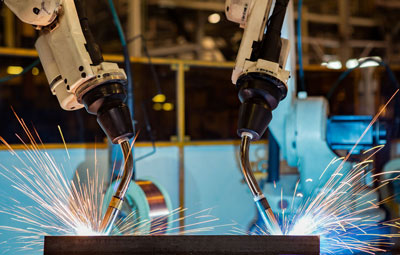
welding task industrial robotic arm

Pick-and-drop is the most common task a robot will perform. However, this is almost an underuse of your robot’s potential. Modern units come ready to be tasked with welding, cutting, routing and milling, assembly, machine tending, packaging and working with an injection press. In fact, if you look at the robot profiles on FANUC’s site, you’ll see the numerous tasks they have been designed to perform.

Modern robotic arms can perform complex and delicate tasks

Robots are helpful when it comes to simple, repetitive tasks. However, they now come programmed and designed to tackle complex tasks that would take a human a long time, pose a hazard, or require high torque in small spaces. Modern robots are capable of in-mold labeling, overmolding, insert loading, laser cutting. They are extremely versatile in material application and can handle everything from primer to plasma, and foam to tape. Precision, versatility, agility, and power allow these modern robots to outperform their progenitors by exponential bounds.

Reuse your robot to perform multiple tasks and extend its life

One of the biggest advantages of modern robotic arms is that they can be used for more than one task. You no longer have to purchase single-function robots that anchor to one place and are there virtually permanently. Nowadays, you have cobots and robotic cells that allow robots to be moved into other stages in the assembly process. Cells can be programmed to be useful for multiple tasks. Best of all, they are easy to move and even easier to integrate.

Freeing up personnel for parallel tasking

industrial robotic arm does parallel tasking

Robots eliminate or minimize the manual labor required of your staff. This is a significant benefit of having a reliable, versatile robotic arm in your assembly process. Humans are now free to accomplish other tasks and increase your overall productivity. Allowing robots and humans to parallel task ensures that all resources, human or mechanical, are in the optimal places on the factory floor. Humans do some tasks better, while others are carried out most efficiently by a robot. Having the best man/bot in the right place for the job will streamline your production line and cut down on interruptions, delays, and mistakes.

DIY-Robotics cells can do anything you want them to because you design them! Before you start building your cell, learn more about our process by consulting our Ultimate Guide to Build Your Own Industrial Robotics Cell.

add robots to your production line

DOWNLOAD NOW


28 FANUC robot programming error codes (and what they mean)

troubleshoot fanuc robot programming error codes

FANUC robots set the standard for quality, reliability, and efficiency. When you purchase a FANUC robot, you can expect everything to work seamlessly and to get quality results from your investment. However, you may occasionally come across programming error codes that you should be aware of to keep your machines operating at peak efficiency.

An error code may seem like a sign that something is wrong, but really they are alerts that can tell you that something needs to be changed before your robot is damaged. By correctly identifying and understanding your FANUC robot programming error codes, you can protect your investment and keep it performing at its best for years to come.

Error codes and descriptions

INTP-105 (%s,%d) Run request failed

The program cannot be started.

INTP-248 (%s, %d) MACRO failed

The macro command can not be executed.

INTP-250 (%s, %d) Invalid uframe number

The number of the work plan is not valid.

INTP-251 (%s, %d) Invalid utool number

The number of the work tool is invalid.

INTP-252 User frame number mismatch

The selected workbench is not valid.

INTP-253 Tool frame number mismatch

The selected work tool is not the same as the position tool.

INTP-447(%s,%d) Parentheses mismatch

Bad parenthesis combination.

JOG-007 Press shift key to jog

The robot’s manual movement key was pressed but the SHIFT key was not pressed.

JOG-010 Jog pressed before shift

This code means that one of the robot’s manual movement keys was pressed before the SHIFT key was pressed.

MACR-013 MACRO execution failed

The macro cannot be executed.

MACR-016 The macro is not completed

The execution of the macro has been interrupted.

MOTN-018 Position not reachable

The requested position is inaccessible.

MOTN-019 In Singularity

The requested position is close to the singularity (parallel J4 and J6).

MOTN-063 Position config change (G :)

This alarm indicates that the robot is unable to go to the requested position. It cannot execute the movement.

PROG-048 Shift released while running (prog)

The SHIFT key was released while the program was running in T1 or T2 mode.

SRVO-003 or SRVO-234 Deadman switch release

The yellow buttons on the back of the controller have been released while the programming the robot in T1 mode.

SRVO-062 BZAL alarm (G :x A :x) or SRVO-084 BZAL alarm

Encoder batteries have low voltage or the encoder cable is disconnected.

SRVO-080 OVC alarm

The RMS current calculated by the “servo-drive” exceeds the allowed value. This alarm protects the motor and amplifiers against thermal damage.

SRVO-160 Panel/external E-stop

The controller emergency stop button or the external emergency stop has been pressed.

SRVO-161 Fence open or Deadman switch released

This alarm appears when the “deadman” buttons are released, or the robot’s fence is open.

SRVO-162 Deadman/Fence or Panel/External E-stop

This code appears when the “deadman” buttons are released, when the protective envelope (fence) of the robot is open, or when one of the emergency stop buttons is pressed.

SRVO-230 or SRVO-231 Chain (1 or 2) abnormal

This alarm appears if there is a break in Channel 1 (24V) or Channel 2 (0V) of the emergency stop circuit.

SRVO-324 Disturbance excess

The torque limit of a specific joint is reached.

SYST-003 TP is enabled

The robot lever selector is ON.

SYST-009 Safety Fence is open

The requested operation could not be completed because the enclosure’s secure envelope is open.

SYST-017 Single-step operation effective

STEP mode is engaged.

SYST-043 TP disabled in T1/T2 mode

The Mode Selector is in T1 or T2 while the Robot Controller Selector is ON.

SYST-045 TP enabled in AUTO mode

The Robot Controller Selector is ON and set in AUTO.

As you can see, there are a lot of error codes that can occur when using a Fanuc robot. Fortunately, DIY-Robotics gives you the resources you need to keep moving forward when you face a problem like the ones listed above. Contact our professionals to hear how we can work together to make your DIY-Robotics cell project a reality.

Our 6 Favorite DIY Robotics Kits

favorite diy robotic kits

DIY Robotics kits have been the hot item on everyone’s gift list for the past few years. Building and programming a robot is fun, and it also helps to foster the development of creativity and logical thinking skills. If you are looking for a gift for a beginner or advanced hobbyist, or if you’re buying for a kit for yourself, here are our six favorite DIY robotics kits from 2019.

Best Starter Robot Kits

SunFounder Robot Raspberry PiCar 

SunFounder Robot Raspberry PiCar DIY Robotics

Raspberry Pis are increasingly popular and becoming more affordable every year. As a result, Raspberry Pi-based DIY kits are ubiquitous at any hobby shop or online robotics retailer; and the Raspberry PiCar by SunFounder is one of the most popular kits available. The kit comes with ultrasonic, light, and line sensors and is easily programmable with the Dragit visual programming interface. The cost of the kit, which includes the Raspberry Pi, is just $ 119.

Robo Bit Buggy

The Robo Bit Buggy is one of the easiest kits to program and a great introduction to using Python and MicroPython. It has a simple but elegant design and comes fully equipped with line following sensors, ultrasonic distance sensors, and an 8-element LED bar. This kit is a great bargain at only $ 42 + shipping (from the UK).

LEGO Boost Robot

The LEGO Boost Robot is easily one of the best STEM kits available for younger children. The LEGO robot comes with nearly 850 LEGO bricks, one motor, a light/IR sensor, and the LEGO Move hub, which features two built-in motors. The kit can be made to assemble five unique robot formations and operates with the easy to use Boost app, compatible with your iPad or Android tablet. While this is a perfect gift for younger children, the Boost is not suited for older children. This kit is designed for children aged 7 to 12 and costs $ 159.99.

Best Robotics Kits for Advanced Programmers 

Elegoo UNO Robot Car Kit V3.0

Elegoo UNO Robot Car Kit V3.0 DIY Robotics

Elegoo has created a fun, easy to build, easy to program robotic car powered by their own Arduino UNO clone microcontroller. The kit comes with motors, ultrasonic, and line following sensors. Since it is Arduino compatible it can be programmed through the Arduino IDE or by any C++ based environment. The kit comes with several pre-built applications such as obstacle avoidance and line following, but you can get really creative with everything that’s included. From Elegoo’s website, you can purchase this kit for $ 99.

Pololu Zumo Robot v1.2

The Zumo Robot by Pololu comes fully assembled and powered by an Arduino-programmable microcontroller. So what makes it so great? At just 10 cm x 10 cm, it’s tiny enough to qualify for the Mini Sumo competition. With two micro metal gears and a bulldozer style blade, you have a rugged and durable design. Where it really shines, though, is with its six infrared sensors, a three-axis accelerometer, a magnetometer, and a gyroscope. You will have your hands full programming the Zumo, so you’ll be happy they shipped it preassembled. At $ 99.95, it’s one of the best values on this list.

Makeblock “Ultimate 2.0” 10-in-1 Robot kit

Makeblock “Ultimate 2.0” 10-in-1 Robot kit DIY robotics

The Ultimate 2.0 is Makeblock’s flagship robot kit. With ten different pre-packaged projects, this kit will keep even the most experienced hobbyist busy for quite a while. You can program in a Scratch-based graphical environment, or with Arduino or Python if you want to take your skills to the next level. Wirelessly control the robot over Bluetooth via the Android and iOS apps. The rugged and durable 6061 aluminum framing will stand up to all of the projects included in the kit and most anything else you can think to design. The Makeblock will set you back $ 350, but that works out to a great value of just $ 35 per project!

If you are an engineer or a programmer who’s passionate about industrial robots and cobots, our DIY projects will stir your curiosity. At DIY-Robotics, we work alongside FANUC to provide you with the resources you need to design and build your own robotic cell. Teaming up with DIY-Robotics provides numerous benefits to your business. For more information, consult our Ultimate Guide to Build Your Own Industrial Robotics Cell.

3 Difficulties You Will Encounter With DIY Robotics Projects

difficulties encounter diy-robotics project robotic armIt comes as no surprise that building a DIY-Robotics industrial robot is a process that comprises unique challenges. You could face problems with design, construction, programming, or electronics and need to know how to troubleshoot a variety of sub-systems on the fly. In this article, we discuss three common problems you may face with your DIY-Robotics project and propose tools to overcome them.

Potential Problems

Programming the Robot

Programming a work cell requires an understanding of the physical limits and capabilities of the robot. The code must go hand-in-hand with the robot’s design and function. You have to consider the robot’s environment and mechanical constraints. On top of that, FANUC puts powerful tools at your disposal, and efficient, precise programming is necessary to make these tools as effective as possible.

Interfacing the Robot with External Machinery

Your robot may seem isolated in its protective work cell, but that is far from the case. You must configure your robot to interact fluidly with its environment. Properly configuring the robot’s inputs and outputs will be one of your primary tasks as you begin the setup process. There are a lot of variables to consider from the robot’s dimensions, workspace layout, proximity to other machinery, and payload.

Robot Movement

You will also want to consider how the robot’s movements are affected by different loads. This can change the robot’s center of mass, and moment of inertia. Once these values are calculated, you can move onto designing appendage tools, such as grippers and arms, that will facilitate the motions your robot will make, optimizing the process and cutting down cycle time.

DIY-Robotics Solutions

DIY-Robotics offers a variety of information sources that answer the questions of engineers and programmers and other industry professionals. Here are just a few possible solutions to help smooth over your DIY Project.

Documentation

Each robotic cell comes with a manual full of resources. Additionally, you have access to FANUC’s electronic reference documents and extensive programming library. Satellite, Comet and every other cell DIY-Robotics makes is delivered with a full catalog of documentation. You can even get help building your own cell!

problems diy robot project

Tutorials

FANUC’s website if full of e-classes, whitepapers, and other helpful documents to answer every question you may have about your work cell setup and integration. Their YouTube channel is a vital resource featuring numerous training videos and troubleshooting guides. Take part in a variety of webinars offered by FANUC that cover the basics, and not-so-basics, of owning and optimizing your FANUC robot cell.

Forum

Get help from users and professionals alike on the forum. You’ll find help for everything from programming issues to error codes. Learn from other users just like you who have tackled the same problems you are facing and have the solutions you need.

At DIY-Robotics, we care about fostering the collaboration between members of the engineering and programmer community. Working with us means having access to a maximum number of resources so you can implement efficient solutions for your DIY project challenges. Embark on the DIY-Robotics adventure and build your robotic cell now using all our online tools.

Access DIY Robotics Forum

ACCESS NOW


What to Expect when Becoming a Robotics Engineer

Growing up, you may have had the idea of robots taking over almost all our daily chores. Movies and the media promised us that robots would make our jobs easier and even become capable of making their own decisions and correcting their behavior. These days, more and more universities are offering robotics and robotics engineering as majors. The need for people to design automated systems is steadily on the rise. So, what should you expect when pursuing a path in robotic engineering?


Robotic engineeringOverall job description

As a robotics engineer, you are responsible for designing robotics systems. Typically, these systems are part of the automation processes found in factories and assembly lines. A robotic system can automate several tasks that humans used to have to do by hand. Multiple industrial robots may work in tandem, or individual robotic systems may be able to complete numerous operations on their own. For example, robotic systems are almost entirely responsible for filling, capping, labeling and stamping soda bottles. In the past, this job may have required several humans and would have only taken place during normal business hours. Now, however, the job can be accomplished by machines and can operate even with minimal human oversight.


Skills and areas of studyskills of a robotics engineer

Robotics engineers need to have excellent problem-solving skills and the ability to work well with a team. Attention to detail is critical. However, you absolutely need some mechanical skill. If you enjoy working on cars, rebuilding old machinery, or fixing up things around the house, then you will be very satisfied with the day-to-day requirements of your job as a robotics engineer. A background in electronics, programming, and CAD are commonplace for robotics engineers.


robot specialist projectsProjects

While working as a robotics engineer you may work on several projects ranging from designing, troubleshooting, prototyping and possibly programming new robotics systems. Robotics engineers are always looking for ways to speed up a process or increase efficiency. One week you may be looking at motors and analyzing their power curves to see if you can find a better option. Later, you might be designing a part in CAD, getting it ready to incorporate into your automation flow line. Robotics engineers are part mechanic, part designer, part programmer and part troubleshooter.


Salary

According to Glassdoor.com, robotics engineers in Detroit can expect to earn around $56K (U.S.) to start with the potential of doubling that with seniority. Robotics engineers are still not listed as an “in demand” job, but that is rapidly changing. Just look at all of the advances in the domains of computer science, AI, and Machine Learning. As our software advances by incredible measure, so too must our hardware. After all, the robotics systems are the testbed for these programs in the real world.


When considering a career in robotics engineering, look to industry before science fiction. While many of the dreams we had in the past about our robotic-assisted future are coming to life, these realizations will come out of the field of automation first before they ever make their appearance in the real world.

Written by: B.A. Durham

Consult DIY Robotics Forum

CHECK IT OUT