window.dataLayer = window.dataLayer || []; function gtag(){dataLayer.push(arguments);} gtag('js', new Date());gtag('config', 'UA-141884085-1'); gtag('config', 'AW-761820283');

DIY-Robotics

About DIY-Robotics

This author has not yet filled in any details.
So far DIY-Robotics has created 131 blog entries.

What You Need to Know About Articulated Robots

Articulated robots are the iconic mechanical denizens of the futuristic factory-floor. For decades, this image has seeped its way into our collective cultural consciousness and pervaded everything from cartoons to movies and even stock images. Also, though we’ve moved beyond the basic articulated design to some stunning, cutting edge machines, the image is so ingrained in our memories that the industrial robotics manufacturers continue to produce them to this day. But image alone isn’t enough to keep this reliable, not-yet-antiquated, style of robot around. What are the benefits provided by articulated robots? Why do so many factories choose to rely on this classic, iconic workhorse?

What’s an Articulated Robot?

Articulated robots are the most common types of industrial robots. Their resemblance to a human arm is perhaps one of the reasons they stand out so much in our minds. However, the mechanical benefits of this design are the real reason for their ubiquity and longevity. The arm design combines an extensive range of rotation motion and linear reach with the advantages of precision movement. Articulated arms are ideal for welding, material handling, pick-and-place operations, and dispensing. Their numerous axes and degrees of freedom mean that there is virtually no point in their work envelope that they cannot reach. This makes articulated robots one of the most versatile, flexible, and compact designs on the market.

Articulation of the Robot

The secret to the motion of articulated robots is their rotary joints. Joints can range from a two-axis configuration to something as complicated as ten or more axes. Articulated robots with six-degrees of freedom are the most common. Servo motors powering the joints act like bezel gears, changing the direction of motion by up to ninety-degrees while offering dial-in stops for precision programming and movement.

Work Envelope of an Articulated Robot

With any industrial robot, the work envelope is a significant factor in assessing its usefulness. Articulated arm robots can use a majority of their work envelope, which is one of their greatest advantages. The only part of the envelope they can’t use is the back where the cables are located. However, some modern designs feature internally routed power and data cables that eliminate this problem and let the articulated arm take advantage of its entire sphere of reach.

Regardless of how the cables are routed, even the most basic articulated robot can maximize the usable space for its footprint on the factory floor. This is a major advantage to factories that have to consider production flow, safety, and floor space.

Speed of an Articulated Robot

One of the drawbacks of articulated robots is their speed. They are not as efficient as other types of robots that can accomplish very high-speed tasks. Articulated robots, due to their numerous joints and degrees of freedom, require complex kinematics to govern their motion. They also have higher component mass, so there is an inertial barrier to overcome at every change in direction. If speed is a crucial component of a factory’s cost-benefit-analysis, then articulated robots may not be the ideal choice.

What’s the price of an Articulated Robot?

So, what will an articulated robot cost you? As with any factory upgrade, there are a few ways to answer this question. First, there is the upfront cost: what is the price of the actual unit? Then, there are operational and maintenance fees—these address the costs to operate and maintain the machines every month. However, if you also look at where you’ll see savings, you’ll get a better overall picture of your return on investment. Over time, the benefits of an articulated robot offset the upfront cost. For instance, factory automation improves the health and safety of workers by minimizing repetitive stress and limiting time in hazardous zones. Additionally, your company will produce products of more consistent quality. The result is increased productivity, which means that your investment will pay for itself down the road.

With so many factors constituting the “real cost” of robot upgrades, it’s best to consult the experts on DIY-Robotics.com for a full cost breakdown. In the meantime, you can build your own miniature/prototype robot and familiarize yourself with the mechanics and programming.

If you’d like to boost your factory’s productivity with a robot that is flexible, agile, and has a sizable work envelope, you should consider an articulated robotic arm. For more information about articulated robots or any other types of robots, check out the DIY-Robotics forum and join a community of industrial robotics specialists and enthusiasts. While you’ll find pricing for DIY-Robotics cells online, feel free to reach out to the team for a free consultation to better custom-tailor a cost projection.

Everything you Need to Know About SCARA Robots

Robots are evolving into an essential purchase for manufacturers. They can easily boost your productivity and simplify your automation processes. SCARA Robots, in particular, are popular. In this article, we’ll look at what SCARA robots are and why they may be one of the best choices for your facilities.

What is SCARA?

SCARA stands for Selective Compliance Articulated Robot Arm. They are robotic arms that have a versatile range of motion in the X-Y plane. The arms can move vertically as well, but the position of the vertical axis remains fixed. Thanks to the combination of rigid and dynamic axes, SCARAs are well suited to tackle a variety of material handling operations. They excel at pick-and-place tasks and rapid transportation processes. SCARA robots are at their best, however, when they are used to perform assembly applications. This includes anything from semiconductor handling to bio-med applications and packaging.

Articulation

The number of joints a robot has, combined with the number of axes in each joint, determines its degree of freedom. SCARAs are four-axis robots, with motion in the X-Y and Z planes, and 360-degree rotational movement about the Z-axis. Inverse kinematics and data interpolation allow the robot to move dynamically, quickly, and intelligently.

Work Envelope and Footprint

The work envelope (the area of space that a robot can physically reach) is a significant consideration. Often, when choosing between SCARA, Delta, or six-axis robots, the work envelope is the deciding factor. Due to their full rotation about the fixed Z-axis, SCARA robots have a cylindrical work envelope. In some applications, a SCARA’s work envelope is limited to the front and side. The rear may not be useable if cables and pneumatic hoses exit from the back. Still, having the ability to work in all, or mostly all, of their reach allows SCARA robots to maintain a minimal footprint while maximizing workspace.

Speed

Speed is an essential factor when choosing a robot. SCARAs are one of the fastest on the market. With four axes, they have fewer moving joints than their six-axis counterparts. Additionally, the reduction in joints simplifies inverse kinematic calculations, requiring less computational time. When cycle time is critical, SCARA robots present an ideal package.

So, How Much Should you Expect to Pay?

While Delta robots may be faster, SCARA robots are less expensive. When considering the cost per operation, SCARA robots are a better deal than most other configurations. Companies can expect to pay about $45,000 for a medium to large SCARA robot, but the price may vary depending on the number of extras and payload capacity. They can range from $25,000 and go up to $400,000.

So is the SCARA robot the right type for you? Hopefully, you now have a better idea of how they may meet your needs and expectations. They have many advantages, including if you are limited in space and need the maximum work-envelope to footprint ratio. For more information on SCARA and other robots, check out DIY-Robotics forum and join a community of industrial robotics specialists and enthusiasts.

The Top Six Types of Industrial Robots in 2020

The ubiquity of robots in factories and industry has led to a familiarity with robots as a tool of automation. Rapid technological advancements have allowed many manufacturing sectors to rely on robots for everyday tasks. PricewaterhouseCoopers estimates that up to 45% of work activities can be successfully automated. The impact robots can have on a company’s operation is well-established. By now, many executives have heard of SCARA or Polar robots, and they are aware that these advanced machines can increase their performance and production. What other robots are out there, and how can they benefit your business? In this article, we’ll take a look at the top six types of industrial robots currently on the market.

What are the Major Types of Industrial Robots in 2020?

All robots perform the same standard functions: They use sensors to detect changes in their environment and manipulators to interact with their surroundings. Robots typically perform two primary tasks: harvesting and positioning. How they do this, though, is as varied as the tasks to which they are assigned.

Articulated Robots

Articulated robots are the most common types of industrial robots. They comprise a mechanical configuration that resembles a human arm. With the use of articulated joints with multiple degrees of freedom, the arm provides a large range of movement. Articulated robots with six degrees of freedom are the most common. Other types may only have four degrees of freedom or even fewer.

Advantages: High speed, large work envelope for minimal floor space. Easy to align with multiple planes.

Disadvantages: Requires a dedicated robot controller, complicated programming, complicated kinematics.

Learn more about Articulated Robots >>

Cylindrical Robots

Cylindrical robots have at least one rotary joint at the base and at least one prismatic joint connecting the links.  With their pivoting shaft and extendable arm, they can move vertically and horizontally by sliding. They offer both linear movement and rotary movement about the vertical axis. The compact design of the effector allows the robot to reach tight workspaces without any loss of speed. Cylindrical robots are mostly used in simple applications, like pick-and-place, where rotary motions must be incorporated.

Advantages: Simple operation and installation. Minimal assembly. Robots can reach in 360-degrees from base. Requires minimal floor space and can handle heavy payloads.

Disadvantages: Doesn’t do well with obstacles. Low accuracy in direction of rotary motion.

Cartesian Robots

Cartesian robots are also called rectilinear or gantry robots and have a rectangular configuration. These types of industrial robots deliver linear motion by sliding on its three perpendicular axes (X, Y, and Z). Due to their rigid structure and configuration, they can carry heavy loads. They can also be used to perform pick-and-place tasks, loading and unloading, material handling, and even high precision operations. Most 3D printers operate on gantry systems.

Advantages: Provides high accuracy with simple operation. Easy to program offline and highly customizable. Able to handle heavy loads. Relatively inexpensive.

Disadvantages: Requires large operational and installation area. Complex assembly. Movement limited to only one direction at a time.

SCARA Robots

SCARA stands for Selective Compliance Assembly Robot Arm. These robots consist of two parallel joints that provide motion in one isolated plane. The rotary shafts are positioned vertically, and the end effector moves horizontally. SCARA robots excel in jobs that require precise lateral movements, and they are ideal for assembly applications. SCARA robots are suited to pick-and-place or assembly operations where high speed and high accuracy are required. SCARA robots move quickly and integrate into existing infrastructure more easily than cylindrical and cartesian robots.

Advantages: High speed, excellent repeatability, large workspace.

Disadvantages: Requires a dedicated robot controller, limited to planar surfaces, hard to program offline.

Learn more about Scara Robots >>

Polar Robots

Polar robots are the veterans of the robot world. They are one of the first types of robots developed and are still popular today. The axes of the robot are combined to form a polar coordinate system, which allows the robot to have a spherical work envelope. Polar robots are commonly used for die casting, injection molding, welding, and material handling.

Advantages: 360-degree range of motion. Large work volume. Require minimal floor space.

Disadvantages: Short vertical reach, low accuracy, and low repeatability in the direction of rotary motion. They require a sophisticated control system.

Delta Robots

Delta robots are also called parallel-link robots. They consist of parallel joint linkages connected to a common base. Delta robots are especially useful for direct control tasks and high maneuvering operations (such as fast pick-and-place jobs). Delta robots make clever use of the mechanical advantage of four-bar linkage systems.

Advantages: Very high speeds are attainable. High operational accuracy.

Disadvantages: Complicated operation and requires a dedicated robot controller.

As you can see, many industrial robot options exist on the market. In addition to the autonomous models listed, you might find collaborative robots fit your automation needs better. Collaborative robots come in the same basic types included in this article, but are designed to work directly with human operators.

The most important thing is to know before selecting your robot is what tasks you need it to perform, and how you want it to integrate into your existing infrastructure. For help selecting the best robot for you, check out some of our other articles on DIY-Robotics.com. Our robotic integrators will help you choose the right automation tools for your company.

Lights Out for COVID-19

We are facing an unprecedented global catastrophe. At the time of this article, the COVID-19 virus has infected millions of people worldwide and claimed the lives of a quarter of a million. Human ingenuity, creative problem-solving, and a lot of bravery have helped to keep us moving forward. Smart machines and artificial intelligence have played a significant role in maintaining factory operations with minimal human presence while the majority of us quarantine daily.

importance of automation processSo-called “Lights Out” factories, a key part of the Industry 4.0 revolution, are equipped to handle the crisis we find ourselves in today. And COVID-19 may be the necessary impetus for all companies to convert old practices into new, incorporated and networked solutions that can operate with little or no direct human intervention. Let’s look at how automation processes and robotics are helping the world to continue functioning during a global lockdown.

How COVID has affected industry and supply lines

In almost every grocery store, shelves are bare and vital items are out of stock. This isn’t just because people are hoarding; the real culprit is the disruption to inventory supply lines. Human workers are self-quarantining and complying with stay-at-home orders, and this has slowed down shipping and delivery. What can we do to minimize the impact of stay-at-home orders on our distribution chain? Luckily, the solution already exists in many factories: Industry 4.0.

Lights-Out Factories

Simply put, robotics and automation can protect us from COVID-19. Businesses that incorporate Industry 4.0 practices reduce the need for on-site human presence in factories and distribution centers. Humans workers can monitor and even calibrate machines from home. As the name “lights out factory” suggests, these facilities can be run entirely in the dark because humans are not needed on-site. By converting to a lights-out factory and utilizing other automation processes, engineers and technicians are able to work remotely. People are able to minimize contact with each other and potentially contaminated surfaces. By reducing the number of people in the same place at the same time, automation processes can protect us from transmitting COVID-19 and other communicable diseases.

Advantages of moving forward

what is industry 4.0Scientists and doctors predict that this current global crisis will likely reappear in the winter, coincident with flu season. Factories and industry leaders have an opportunity, and maybe even the responsibility to, build the infrastructure for automated facilities. They can take advantage of the products and methods already available to switch to Industry 4.0. In doing so, not only do factories protect their workers and preserve the integrity of production flow, but they take advantage of energy-saving and resource-saving measures that will improve the environment.
At DIY-Robotics, we offer autonomous robots and cells that will help you convert your factory into an automated, Industry 4.0-ready facility. Check out our website at www.DIY-Robotics.com for more information on how to get your business COVID-proof by incorporating cutting-edge, self-regulating products and machines.

What kind of tasks can an industrial robotic arm do?

Industrial robotic arms are becoming more versatile with each successive generation. Major advances in encoders and motors and simplified programming environments let users task their robots with delicate motions and increased payloads, all while in smaller and more compact spaces. If you’re wondering how a robot could contribute to daily production in your company, then you need to keep reading to find out what an industrial robotic arm can do for you.

Tasks attributed to industrial robotic arms

welding task industrial robotic arm

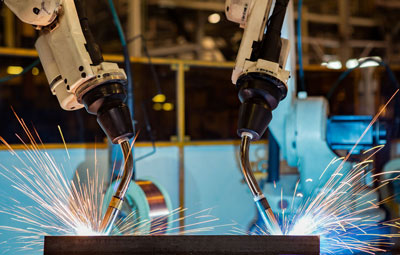
Pick-and-drop is the most common task a robot will perform. However, this is almost an underuse of your robot’s potential. Modern units come ready to be tasked with welding, cutting, routing and milling, assembly, machine tending, packaging and working with an injection press. In fact, if you look at the robot profiles on FANUC’s site, you’ll see the numerous tasks they have been designed to perform.

Modern robotic arms can perform complex and delicate tasks

Robots are helpful when it comes to simple, repetitive tasks. However, they now come programmed and designed to tackle complex tasks that would take a human a long time, pose a hazard, or require high torque in small spaces. Modern robots are capable of in-mold labeling, overmolding, insert loading, laser cutting. They are extremely versatile in material application and can handle everything from primer to plasma, and foam to tape. Precision, versatility, agility, and power allow these modern robots to outperform their progenitors by exponential bounds.

Reuse your robot to perform multiple tasks and extend its life

One of the biggest advantages of modern robotic arms is that they can be used for more than one task. You no longer have to purchase single-function robots that anchor to one place and are there virtually permanently. Nowadays, you have cobots and robotic cells that allow robots to be moved into other stages in the assembly process. Cells can be programmed to be useful for multiple tasks. Best of all, they are easy to move and even easier to integrate.

Freeing up personnel for parallel tasking

industrial robotic arm does parallel tasking

Robots eliminate or minimize the manual labor required of your staff. This is a significant benefit of having a reliable, versatile robotic arm in your assembly process. Humans are now free to accomplish other tasks and increase your overall productivity. Allowing robots and humans to parallel task ensures that all resources, human or mechanical, are in the optimal places on the factory floor. Humans do some tasks better, while others are carried out most efficiently by a robot. Having the best man/bot in the right place for the job will streamline your production line and cut down on interruptions, delays, and mistakes.

DIY-Robotics cells can do anything you want them to because you design them! Before you start building your cell, learn more about our process by consulting our Ultimate Guide to Build Your Own Industrial Robotics Cell.

add robots to your production line

DOWNLOAD NOW


4 Frequently Asked Questions About Cobots

The industrial robotics market is booming, and more than ever before companies are automating their production process using cobots. But what exactly are cobots? What makes them different from regular industrial robots? What advantages do they have? And what are their limitations? DIY-Robotics will help you decide if a cobot is right for your company by answering four frequently asked questions about collaborative robots.

What is a cobot?

questions about cobot safety

A collaborative robot, or a cobot, is engineered to cooperate with humans in a shared workspace. This is in contrast with standard robots, which are designed to operate autonomously, or with limited guidance in a closed-off robot cell. Cobots can sense and react to humans to prevent injury. By eliminating the need for a safety zone, factories can reclaim floor-space because cobots effectively have a smaller footprint than typical robots.

How do cobots work?

Cobots are notably easy to program. Simple tasks, such as pick-and-place, can be programmed with little knowledge of coding, often on a tablet. At the same time, cobots can be as robust and advanced as a traditional industrial robot. When connecting cobots to other machines, advanced programming can exponentially increase their usefulness.

questions about how cobot works

Cobots can easily adapt to different environments and can easily be assigned new tasks and configurations. As is the case with traditional industrial robots, the work done by cobots and humans working together is more consistent and accurate than what humans can do alone.

Can my company afford to buy a cobot?

The price of a cobot depends on many variables. Payload and intended use are the top indicators of price. Specific configurations, compatibility with other machines, and ability to be repurposed for multiple tasks are examples of elements that contribute to the variation of the price. Consider, however, that the return on investment is relatively fast. Decreases in workplace injuries, an increase in production, and round-the-clock manufacturing guarantee a return on investment. As one of the largest FANUC robotic arm integrators in Canada, DIY-Robotics offers a high-quality robotic cell, with the robot included, very close to the retail price of the robot alone!

Which cobot should I choose for my business?

Before you start automating, you need to ask yourself which robot is the best choice for your business. Ask yourself and your team the following questions: What long term flexibility do you need? How easy are the programming, installation, and setup? Is the end-of-arm tool optimally designed for your needs? What are the safety advantages of each specific model? What are the operational ranges (payload, reach, etc.)? If that still doesn’t narrow it down for you, check out DIY-Robotics’ online tool to help you design a robotic cell specifically for your company’s needs.

If you plan to buy an industrial robotic cell, we invite you to visit the DIY-Robotics forum. Our certified integrators will be happy to answer your questions and help you build the right cell for your company.

add robots to your production line

DOWNLOAD NOW


28 FANUC robot programming error codes (and what they mean)

troubleshoot fanuc robot programming error codes

FANUC robots set the standard for quality, reliability, and efficiency. When you purchase a FANUC robot, you can expect everything to work seamlessly and to get quality results from your investment. However, you may occasionally come across programming error codes that you should be aware of to keep your machines operating at peak efficiency.

An error code may seem like a sign that something is wrong, but really they are alerts that can tell you that something needs to be changed before your robot is damaged. By correctly identifying and understanding your FANUC robot programming error codes, you can protect your investment and keep it performing at its best for years to come.

Error codes and descriptions

INTP-105 (%s,%d) Run request failed

The program cannot be started.

INTP-248 (%s, %d) MACRO failed

The macro command can not be executed.

INTP-250 (%s, %d) Invalid uframe number

The number of the work plan is not valid.

INTP-251 (%s, %d) Invalid utool number

The number of the work tool is invalid.

INTP-252 User frame number mismatch

The selected workbench is not valid.

INTP-253 Tool frame number mismatch

The selected work tool is not the same as the position tool.

INTP-447(%s,%d) Parentheses mismatch

Bad parenthesis combination.

JOG-007 Press shift key to jog

The robot’s manual movement key was pressed but the SHIFT key was not pressed.

JOG-010 Jog pressed before shift

This code means that one of the robot’s manual movement keys was pressed before the SHIFT key was pressed.

MACR-013 MACRO execution failed

The macro cannot be executed.

MACR-016 The macro is not completed

The execution of the macro has been interrupted.

MOTN-018 Position not reachable

The requested position is inaccessible.

MOTN-019 In Singularity

The requested position is close to the singularity (parallel J4 and J6).

MOTN-063 Position config change (G :)

This alarm indicates that the robot is unable to go to the requested position. It cannot execute the movement.

PROG-048 Shift released while running (prog)

The SHIFT key was released while the program was running in T1 or T2 mode.

SRVO-003 or SRVO-234 Deadman switch release

The yellow buttons on the back of the controller have been released while the programming the robot in T1 mode.

SRVO-062 BZAL alarm (G :x A :x) or SRVO-084 BZAL alarm

Encoder batteries have low voltage or the encoder cable is disconnected.

SRVO-080 OVC alarm

The RMS current calculated by the “servo-drive” exceeds the allowed value. This alarm protects the motor and amplifiers against thermal damage.

SRVO-160 Panel/external E-stop

The controller emergency stop button or the external emergency stop has been pressed.

SRVO-161 Fence open or Deadman switch released

This alarm appears when the “deadman” buttons are released, or the robot’s fence is open.

SRVO-162 Deadman/Fence or Panel/External E-stop

This code appears when the “deadman” buttons are released, when the protective envelope (fence) of the robot is open, or when one of the emergency stop buttons is pressed.

SRVO-230 or SRVO-231 Chain (1 or 2) abnormal

This alarm appears if there is a break in Channel 1 (24V) or Channel 2 (0V) of the emergency stop circuit.

SRVO-324 Disturbance excess

The torque limit of a specific joint is reached.

SYST-003 TP is enabled

The robot lever selector is ON.

SYST-009 Safety Fence is open

The requested operation could not be completed because the enclosure’s secure envelope is open.

SYST-017 Single-step operation effective

STEP mode is engaged.

SYST-043 TP disabled in T1/T2 mode

The Mode Selector is in T1 or T2 while the Robot Controller Selector is ON.

SYST-045 TP enabled in AUTO mode

The Robot Controller Selector is ON and set in AUTO.

As you can see, there are a lot of error codes that can occur when using a Fanuc robot. Fortunately, DIY-Robotics gives you the resources you need to keep moving forward when you face a problem like the ones listed above. Contact our professionals to hear how we can work together to make your DIY-Robotics cell project a reality.

What is the Price of an Industrial Robotic Arm?

When you are investing in an industrial robotic arm, there is more to consider than the sticker price. For instance, how quickly you’ll see a return on your investment? Is the arm you’re considering versatile enough to handle multiple tasks or integrate with various stages of the automation process? How much will it cost to maintain the robot to keep your investment running in optimal condition? In this article, we’ll look at the true cost of a robotic arm and help you decide if it’s the right investment for your company.

How is the price of a robot determined?

cost industrial robotic arm

Payload capacity often determines the price of a robot. The more the robot can handle, the more engineering went into its design. As a rule of thumb : the bigger it is, the more expensive it becomes. However, complexity and versatility also factor heavily into the price. Through how many axes does the robot operate? How many degrees of freedom does the arm have? A 6-axis robot may be more expensive than a 4-axis, but if you’re in the business of packaging, for example, a 4-axis robot is likely sufficient.

Is it worth buying an industrial robotic arm for my business?

Industrial robotic arms offer many advantages that justify their price over their lifetime. For one thing, they are less likely to make errors than humans who can become fatigued or distracted. They are not prone to repetitive stress injuries like humans are. Robots do not require breaks and can work around the clock, potentially doubling (or more!) your production. Robot movements are more precise and consistent, reducing the number of recalled products or returned defective parts.

fanuc industrial robotic arm cost

Robots can also be repurposed for new tasks and reintegrated into the production line at different stages. With humans, there is a learning curve that can slow down the entire process. With robots, if they are properly programmed, they can move seamlessly from one job to the next without much adjustment.

How much does a DIY-Robotics cell cost?

Based in Quebec, DIY-Robotics is one of the largest FANUC robotic arm integrators in Canada. By integrating FANUC robots exclusively, we offer high-quality robotic cells at a competitive price. In many cases, we can get the price of your cell, including the robot, close to the retail cost of the robot alone! Contact one of our sales representatives for a quote.

Now that you understand how the price of a robotic arm is determined, it’s time to see how your automation project could become a reality. By working with DIY-Robotics to build your robotic cell, you’ll know you’re getting the best deal because you help design the robot cell according to your specific needs. Download our Ultimate Guide to Build Your Own Industrial Robotic Cell and get ready to enter into the Industry 4.0.

Our 6 Favorite DIY Robotics Kits

favorite diy robotic kits

DIY Robotics kits have been the hot item on everyone’s gift list for the past few years. Building and programming a robot is fun, and it also helps to foster the development of creativity and logical thinking skills. If you are looking for a gift for a beginner or advanced hobbyist, or if you’re buying for a kit for yourself, here are our six favorite DIY robotics kits from 2019.

Best Starter Robot Kits

SunFounder Robot Raspberry PiCar 

SunFounder Robot Raspberry PiCar DIY Robotics

Raspberry Pis are increasingly popular and becoming more affordable every year. As a result, Raspberry Pi-based DIY kits are ubiquitous at any hobby shop or online robotics retailer; and the Raspberry PiCar by SunFounder is one of the most popular kits available. The kit comes with ultrasonic, light, and line sensors and is easily programmable with the Dragit visual programming interface. The cost of the kit, which includes the Raspberry Pi, is just $ 119.

Robo Bit Buggy

The Robo Bit Buggy is one of the easiest kits to program and a great introduction to using Python and MicroPython. It has a simple but elegant design and comes fully equipped with line following sensors, ultrasonic distance sensors, and an 8-element LED bar. This kit is a great bargain at only $ 42 + shipping (from the UK).

LEGO Boost Robot

The LEGO Boost Robot is easily one of the best STEM kits available for younger children. The LEGO robot comes with nearly 850 LEGO bricks, one motor, a light/IR sensor, and the LEGO Move hub, which features two built-in motors. The kit can be made to assemble five unique robot formations and operates with the easy to use Boost app, compatible with your iPad or Android tablet. While this is a perfect gift for younger children, the Boost is not suited for older children. This kit is designed for children aged 7 to 12 and costs $ 159.99.

Best Robotics Kits for Advanced Programmers 

Elegoo UNO Robot Car Kit V3.0

Elegoo UNO Robot Car Kit V3.0 DIY Robotics

Elegoo has created a fun, easy to build, easy to program robotic car powered by their own Arduino UNO clone microcontroller. The kit comes with motors, ultrasonic, and line following sensors. Since it is Arduino compatible it can be programmed through the Arduino IDE or by any C++ based environment. The kit comes with several pre-built applications such as obstacle avoidance and line following, but you can get really creative with everything that’s included. From Elegoo’s website, you can purchase this kit for $ 99.

Pololu Zumo Robot v1.2

The Zumo Robot by Pololu comes fully assembled and powered by an Arduino-programmable microcontroller. So what makes it so great? At just 10 cm x 10 cm, it’s tiny enough to qualify for the Mini Sumo competition. With two micro metal gears and a bulldozer style blade, you have a rugged and durable design. Where it really shines, though, is with its six infrared sensors, a three-axis accelerometer, a magnetometer, and a gyroscope. You will have your hands full programming the Zumo, so you’ll be happy they shipped it preassembled. At $ 99.95, it’s one of the best values on this list.

Makeblock “Ultimate 2.0” 10-in-1 Robot kit

Makeblock “Ultimate 2.0” 10-in-1 Robot kit DIY robotics

The Ultimate 2.0 is Makeblock’s flagship robot kit. With ten different pre-packaged projects, this kit will keep even the most experienced hobbyist busy for quite a while. You can program in a Scratch-based graphical environment, or with Arduino or Python if you want to take your skills to the next level. Wirelessly control the robot over Bluetooth via the Android and iOS apps. The rugged and durable 6061 aluminum framing will stand up to all of the projects included in the kit and most anything else you can think to design. The Makeblock will set you back $ 350, but that works out to a great value of just $ 35 per project!

If you are an engineer or a programmer who’s passionate about industrial robots and cobots, our DIY projects will stir your curiosity. At DIY-Robotics, we work alongside FANUC to provide you with the resources you need to design and build your own robotic cell. Teaming up with DIY-Robotics provides numerous benefits to your business. For more information, consult our Ultimate Guide to Build Your Own Industrial Robotics Cell.

3 Difficulties You Will Encounter With DIY Robotics Projects

difficulties encounter diy-robotics project robotic armIt comes as no surprise that building a DIY-Robotics industrial robot is a process that comprises unique challenges. You could face problems with design, construction, programming, or electronics and need to know how to troubleshoot a variety of sub-systems on the fly. In this article, we discuss three common problems you may face with your DIY-Robotics project and propose tools to overcome them.


Potential Problems

Programming the Robot

Programming a work cell requires an understanding of the physical limits and capabilities of the robot. The code must go hand-in-hand with the robot’s design and function. You have to consider the robot’s environment and mechanical constraints. On top of that, FANUC puts powerful tools at your disposal, and efficient, precise programming is necessary to make these tools as effective as possible.

Interfacing the Robot with External Machinery

Your robot may seem isolated in its protective work cell, but that is far from the case. You must configure your robot to interact fluidly with its environment. Properly configuring the robot’s inputs and outputs will be one of your primary tasks as you begin the setup process. There are a lot of variables to consider from the robot’s dimensions, workspace layout, proximity to other machinery, and payload.

Robot Movement

You will also want to consider how the robot’s movements are affected by different loads. This can change the robot’s center of mass, and moment of inertia. Once these values are calculated, you can move onto designing appendage tools, such as grippers and arms, that will facilitate the motions your robot will make, optimizing the process and cutting down cycle time.

DIY-Robotics Solutions

DIY-Robotics offers a variety of information sources that answer the questions of engineers and programmers and other industry professionals. Here are just a few possible solutions to help smooth over your DIY Project.

Documentation

Each robotic cell comes with a manual full of resources. Additionally, you have access to FANUC’s electronic reference documents and extensive programming library. Satellite, Comet and every other cell DIY-Robotics makes is delivered with a full catalog of documentation. You can even get help building your own cell!

problems diy robot project

Tutorials

FANUC’s website if full of e-classes, whitepapers, and other helpful documents to answer every question you may have about your work cell setup and integration. Their YouTube channel is a vital resource featuring numerous training videos and troubleshooting guides. Take part in a variety of webinars offered by FANUC that cover the basics, and not-so-basics, of owning and optimizing your FANUC robot cell.

Forum

Get help from users and professionals alike on the forum. You’ll find help for everything from programming issues to error codes. Learn from other users just like you who have tackled the same problems you are facing and have the solutions you need.

At DIY-Robotics, we care about fostering the collaboration between members of the engineering and programmer community. Working with us means having access to a maximum number of resources so you can implement efficient solutions for your DIY project challenges. Embark on the DIY-Robotics adventure and build your robotic cell now using all our online tools.

Access DIY Robotics Forum

ACCESS NOW