window.dataLayer = window.dataLayer || []; function gtag(){dataLayer.push(arguments);} gtag('js', new Date());gtag('config', 'UA-141884085-1'); gtag('config', 'AW-761820283');

Guarana-DIY

About Guarana-DIY

This author has not yet filled in any details.
So far Guarana-DIY has created 4 blog entries.

Interpreting the Three Laws of Robotics

Isaac Asimov is not only a pioneer of the science fiction genre, but he is also the creator of one of the most popularized concepts in robotics and A.I. theory: The Laws of Robotics. It is safe to say that all science fiction written about robots or artificial intelligence centers around either the adherence to these laws or, more likely, some deviation from them. But these laws are not only the product of an artist’s imagination; they are practical, pragmatic guidelines for how roboticists should program these advanced tools. These laws already govern the operation of many machines and computer algorithms, and in some cases, they have already been neglected.

Asimov’s Three Laws of Robotics

Asimov Three Laws of RoboticsIsaac Asimov was a visionary. His stories contain parables, allegories, and prognostications about the inevitable path of humankind. Asimov (correctly) predicted that robots would become ubiquitous in homes and industry. He also knew that there was an inherent danger in handing over the decision making responsibilities to artificial creations. So, Asimov came up with the Three Laws of Robotics as a plot device to create tension in his stories, but also as a way to guide future generations in their development of smart, thinking, inorganic beings.

The Three Laws of Robotics are as follows:

  1. A robot may not injure a human being or, through inaction, allow a human being to come to harm.
  2. A robot must obey the orders given to it by human beings, except where such orders would conflict with the First Law.
  3. A robot must protect its own existence as long as such protection does not conflict with the First or Second Law.

And finally, Asimov extrapolated the Laws to all of humanity and derived the Zeroth Law of Robotics: A robot may not harm humanity or, through inaction, allow humanity to come to harm.

The Flaws of This Model

Like many forward thinkers, Asimov was not able to foresee all of the nuances of how the robotics and artificial intelligence industries would play out. There are numerous complexities involved with programming a computer to recognize what a human is. For example, how might a robot distinguish between a human and another robot that is designed to appear to be human? A simple task for us might be an unexpected challenge for an A.I.

Another problem, often referred to by the name given to it in the Terminator movies, is known as the “Skynet Problem.” What if robots become advanced enough to see the flaws in human thinking? Could robots override or ignore the Three Laws if they deem humans their own biggest threat? In other words, could robots reprogram themselves so that the Zeroth Law and Second Law supersede the first? Many worry that this outcome is not only a possibility, but probability. And we’re not talking about conspiracy theorists either. Notable leaders in technology and computer science such as Bill Gates, Elon Musk, and Alan Turing vocalized their concerns about the dangers of A.I. learning.

Technical Problems with The Three Laws of Robotics

Aside from the conceptual flaws, there are technical obstacles that prevent the Three Laws of Robotics from working successfully. For one thing, there is no standard model for what is “human.” We come in all shapes, sizes, and appearances. Some humans are in wheelchairs, while others have electronic devices, like pacemakers, embedded into them. How can a computer determine that someone who’s appearances or composition strays from the standard model is still human?

Attempts at Creating Valid Robotic Laws
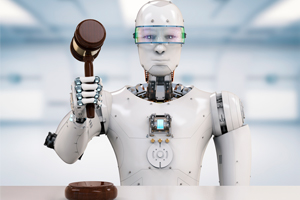
determine realistic robot lawsSatya Nadella, a former CEO of Microsoft Corporation, told Slate magazine in 2016 what she thought might be a more realistic set of rules to govern intelligent robots and A.I. units:

  • “A.I. must be designed to assist humanity.”
  • Humans should know and be able to understand how A.I. units work.
  • A.I. must safely maximize efficiencies.
  • “A.I. must be designed for intelligent privacy,” meaning that it earns trust through guarding their information.
  • “A.I. must have algorithmic accountability so that humans can undo unintended harm.”
  • “A.I. must guard against bias” so that they must not discriminate against people.”

As technology evolves, ethical questions about A.I. and robotics become increasingly important. There will come a time when we will have to create real laws that govern the entire robotics industry and move past conceptual and philosophical thought-experiments. In the meantime, you can learn more about how robotics could help you in everyday industrial tasks by visiting DIY-Robotics and getting familiar with our friendly, safe robotics designed to work with just the right balance of autonomy and human control.

What IS the Best Programming Language for Industrial Robotics (Depending on Your Level of Skills)?

Numerous programming languages exist, each with its own advantages. Java is the most common programming language, and therefore the one your colleagues will likely be able to help you with the most. However, The C programming language and Python are both nearly as common, and all are highly regarded in the robotics industry. Visual programming languages, like LabVIEW, have made programming easy to understand and accessible to a variety of engineers. Depending on how well acquainted you are with programming, different languages offer different benefits. So, which one is right for you?

The Advanced Programmer

If you already have experience doing coding and developing for robotics, then chances are you are familiar with Java, C,  and Python. The C language, in particular, is used for embedded development and real-time high-level programming. This includes vision processing, control, and motion decision-making algorithms. They are the fast programming languages with better support to object-oriented programming, multi-threading, memory management and RAII.

Novice programmer

best programming language

If you know a little about programming but still need a fair amount of help and support, we suggest Java, MATLAB or LabVIEW. All three languages are popular, time-tested, and their online resources are abundant. Chances are, if you studied engineering in college, you have already used Java and MATLAB. LabVIEW is a refreshing alternative. This visual programming language is the proprietary software of National Instruments. It is built into products like myRIO and, formerly, cRIO. You may also be familiar with LabVIEW if you participated in Vex or FIRST Robotics in high school. While LabVIEW is great for beginners, it is powerful enough for novice programmers and pros alike.

Programming Newbie

If you have basic knowledge of programming, or you could use a refresher, Python, Arduino, and visual languages like LabVIEW are right up your alley. Python is easy to learn and a staple for applications like microcontrollers. However, Python is not suitable for applications requiring precise DOF control, iterative processes, or real-time vision processing. The trade-off is what you get in online libraries and support. Python experts offer some of the most thorough and fleshed-out resources. It is the ideal programming language for off-line programming.

Bonus Languages for AI

LISP

If you intend to work on AI and programming quite a bit, LISP would be a great option for you regardless of your skill level. LISP using list structure to represent data. Programs and data work with the same structure, so LISP programs can operate other systems as data. This means LISP programs are ideally suited for self-modifying or “learning” programs, i.e., artificial intelligence. Robust, simple, and internally reflexive, LISP is a great bonus language every roboticist should know.

Qt is another great bonus language worth picking up. This language allows programmers to develop software with the user interface in the foreground of their minds. Qt focuses on streamlining workflows and getting your product to market quickly and with a  professional, intuitive look and feel designed to hook your users and build brand loyalty.

Once you have chosen what language you want to code with, you can go ahead and download our ebook to learn more about how you can get started designing your own cell. The language you choose will be partly constrained by the application, but also by your comfort level. Make sure you choose a programming language that is compatible with your project but also versatile enough to work well with the knowledge base of the coder.

How Can AI Optimize your Robotic Process Automation?

As robots become increasingly ubiquitous, so does the demand for artificial intelligence. A robot workforce provides the biggest advantages when it can think, adapt, change, and learn all on its own. This necessarily leads to decreased human involvement and intervention. Factory owners can expect the field of AI to continue to evolve rapidly, and robots may soon possess computational skills that rival our own intellectual abilities.

ai robotics factoriesThe connection between the technologies

The goal of AI is to recreate the human thought process. So, it makes sense that if companies are implementing robotic automation to replace human workers in their factories, then AI has a key role in developing a superior automated process. In fact, this is already taking place. AI is responsible for making modern robots more flexible than their rigid predecessors. Individual units can be reprogrammed and repurposed for many tasks and several points in the assembly process. Like a human, AI allows these machines to learn how to perform these tasks more efficiently. Unlike a human, however, a robot with AI learns quickly and does not need retraining.

Industry Applications

Numerous industries already benefit from robotic automation. These same industries can compound those benefits with AI-powered process automation. Assembly, packaging, sorting, and machining factories are just some of the applications that can be leveled up by AI. But impressive hardware is only half of the solution. For example, AI is beneficial in adaptive vision systems for inspection. Accuracy, speed, and efficiency will improve when AI governs vision processing. Companies need to incorporate smart learning software too if they want to take full advantage of the 21st Century automated factory.

Chatbots

AI isn’t limited to the factory floor. Chatbots are already in use in our daily lives. From Siri and Alexa to intelligent phone systems that can redirect customers to the person best able to help them, chatbots have been quietly seeping into our culture for years. Like their factory floor counterparts, Chatbots handle the repetitive processes that do not require a human, and in some cases make the process smoother for all parties involved. Humans are great at jobs that require judgment calls. But if their just patching customers to the correct extension, they aren’t living up to their potential and the entire business loses out on having them in a more ideal position.

Are you frustrated with the AI phone system at your phone company? Think you could improve on it? Why not try this kit to see just how challenging it can be to create the perfect human analog.

Other Ideas for AI Applications

ai optimisationAre you set on implementing more AI in your business? Want some more creative ideas for applications? Not a problem. There are numerous resources. ElectronicsForU.com is just one of many places that provide ideas for neat little projects you can try at home. Tinker around with some of the most basic applications, and using this sandbox-method of brainstorming, who knows what you’ll be able to come up with? You can find tons of ideas on their website here.

New ideas are surfacing every day when it comes to how to merge AI and robotics. DIY-Robotics knows the marriage of these two fields is as promising as it is inevitable. For more ideas on how to implement versatile, dynamic robotic cells into your workflow, check out the resources at DIY-Robotics.com.

The Top 3 Best Robotic Automation Process Tools

Robotic process automation (RPA) provides numerous benefits over using humans to perform similar tasks. Among the advantages are improved standardization of workflow, reduced error rate, and superior management of repetitive tasks. Several RPA tools number among the best and most reputable on the market. So, how do you know which one to choose? Let DIY-Robotics walk you through some of the top robotic automation process tools and help you decide on the right one for your operational needs.

Another Monday

When you need complete automation from beginning to end, Another Monday is one of your best bets. This RPA tool features an intuitive, easy to navigate user interface built around the Muse drag and drop workflow configuration. This highly accurate analyzation tool minimizes information loss between the process user and the analyst. Another Monday features quick scaling that pulls tasks from a database and collects data along the way. With little idle time, Another Monday promises reliable, consistent process automation that no human workforce can match. Free up resources, eliminate errors, and preserve information integrity with one of the most trusted names on the market.

Linx

Linx is your top choice if you need automation quickly and with little setup. This no-code RPA is perfect for those who want an integrated development environment designer that can speed up development. With over 100 pre-built actions and automations, you’ll find Linx to be an out of the box solution. The cloud-based service is crucial for speedy deployment on any device. Easily integrate databases and systems, automate tasks and workflows, even create and host APIs. Develop apps that require triggering and processing requests from multiple systems. Build applications that require storing, querying and manipulation of data stored in NoSQL databases. Linx is fast, simple, and instantly deployable with the click of a button.

WinAutomation

WinAutomation turns your Windows desktop into an automation juggernaut. The Macro Recorder is a virtual autopilot that allows WinAuto to automate any repetitive task on your computer. Versatile, dynamic, and intuitive, WinAutomation reliably automates even web-based tasks. This RPA is fully compatible with Internet Explorer, Firefox, and Chrome. It boasts over 300 pre-build actions to help you get set up quickly and with no fuss. Send, receive, and process email automations; WinAutomation supports SMTP/IMAP exchange server protocols. If you want compatibility, user-friendliness, and a program you know will work with your existing workstation infrastructure, WinAutomation is your clear winner.

Robotic process automation is essential for companies looking to take the burden off of their human task force while simultaneously increasing productivity and eliminating errors. Put your most valuable resources where you need them the most, and leave the repetitive, menial tasks to the machines. Save time and money by automating ongoing processes with the software that is easy to set up, works with your software architecture, and makes the most sense for your company. Using the tools discussed here, you’re in the right direction to start programming your bot. Download our ebook to get started with your own RPA cell.