window.dataLayer = window.dataLayer || []; function gtag(){dataLayer.push(arguments);} gtag('js', new Date());gtag('config', 'UA-141884085-1'); gtag('config', 'AW-761820283');

Blog

This Month in Robotics – July 2019

In this segment, DIY-Robotics will take you through the world of robotics to explore new innovative products out on the market. We’ll look at everything from industrial to military to hobby robots as well as everything in between. We’ll dive into the technology, the programming, and the design features and what they might mean for the automation industry. In segment 1 we present two bionic robots from pneumatics and automation giant FESTO.


Why Bionic Robots matter

Nature has had billions of years on this planet to adapt every species to fit a specific environmental niche. While this occasionally results in vestigial limbs and organs, the majority of the time biological adaptations show energy efficient time-tested developments. So, how does this benefit your company and factory? Well, these bionic robots, simply put, make sense. They behave in ways we would expect. They move and operate in ways programmers, engineers and operators can understand. As robots become more ubiquitous, and automation leans toward incorporating more robots, these machines are going to need to act in ways that make sense to everyone at all levels of production, not just the engineers. As designers learn to mimic the movements of nature, they will be able to anticipate the movement of robot handlers and operators. Understanding the laws that govern biological motion is vital to creating robots that seamlessly fit into our natural environment.


Bionic RobotBionic Flying Fox

At first glance, you might think this is a sugar glider or a bat. A friendly face sits below a cigar-shaped body that houses most of the drive system. The wings are an elastic material that consists of both epidermis and dermis layers. Four-bar linkages connect the body to the fingers and foot joints. When the robot releases from its perch, it falls and the wings unfold, turning the robot over into a flying position. Slow-motion shows the wings moving with remarkably avian motion and grace. At first, you might think it is just fluttering to the ground, slowing the descent to a manageable velocity. But then you realize it’s actually flying, making circles around the corridor and effortlessly keeping itself in flight.Festo Robot

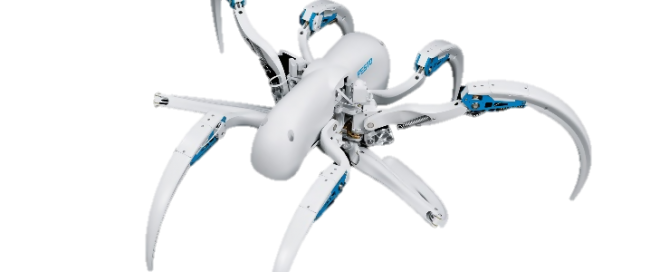
Bionic WheelBot

If you fear spiders and the robot revolution, then skip the WheelBot altogether. Although, for a spider, we at DIY-Robotics think it is rather cute. Based on the motion of real spiders, WheelBot walks in tripod motion, using six legs to move around. The other two legs stay wrapped up tightly against the body during the normal ambulation. However, the name WheelBot had to come from somewhere, right? In a second mode of locomotion, the legs that were just doing the walking now curl around the body of the robot forming a protective ball. The two legs that were tucked into the body in the previous mode now act as “kickers,” driving the now spherical body like a self-propelled orb. Yeah, it’s also way faster this way.

DIY Robot


Check out this video to see the Flying Fox, Wheelbot and another one of FESTO’s creations.

All images courtesy of ©Festo AG & Co. KG, all rights reserved.


Written by: B.A. Durham

Access DIY Robotics Forum

ACCESS NOW


5 Innovative Ways to Improve Your DIY Industrial Robot

Almost every industrial robot falls into one of three types: Delta, Selective Compliance Assembly Robot Arm (SCARA), and Cartesian or gantry robots. Between these three types, almost every harvesting and positioning task can be accomplished. Regardless of which type of industrial robot you or your company use, however, there are some common innovative improvements that can make your robot faster, longer-lasting, and more efficient.


1) 3D-print parts for reduced weight and increased efficiency

When 3D printers first hit the market, the company RepRap realized that customers could 3D print almost any of the machine’s parts. They embraced this capability and made the part files open source and license-free. With the ubiquity of 3D printers and affordable CAD programs, this same solution is now available to the DIY roboticist. Obviously, you can’t print motors, load-bearing parts, or parts exposed to extreme temperatures. But wire clips, mounting brackets, adapters, and similar static components can be easily printed as a cost-effective alternative to expensive, proprietary replacements.

You don’t have to wait for a part to break to make use of 3D printing, however. Boost the efficiency of your industrial robot by 3D printing parts before they even need to be replaced. Print replacement parts right now to reap the benefits of lighter-weight and more efficient components. 3D printed parts can reduce motor wear and power demand.


2) Make your own motor heat sinks

Thermal resistivity is a problem, especially in heavy-duty industrial motors. Not only can it drop the voltage across your motor and decrease its power output, but it can shorten the motor’s life-span. However, there is a simple solution that can save you the headache of having to frequently pull smoked motors: custom-make your own heat sinks. With heat sinks, there’s no more need for fans or solutions that rob from your power bank. Heat sinks are passive, customizable and can easily be created with a mill, slotting saw or a die. There’s even a super simple way to make a heat sink using PCB board and screws!


3) Test in CAD

It’s not exactly innovative, but it certainly is a lesson worth repeating. Having a fully functioning CAD model of your robot lets you perform all kinds of design changes and analyze your robot’s range of motion. You can even place your design under virtual operating conditions and measure compression, torsional and tension forces. Data like this saves you time, money, and can help you engineer effective solutions. You don’t even have to shell out big bucks like you used to to get SolidWorks or AutoCAD. Free, browser-based programs like OnShape are just as powerful and allow you to collaborate in real-time with other users. Best of all, since your files are stored in the cloud you can work on them anywhere, even their mobile app.


4) Upgrade to advanced, modern robot controllers

Just a few years ago, you had to have a Ph.D. and a deep knowledge of kinematics, matrix theory, and linear algebra in order to embark on a project in robotics. With advance controllers and CPUs, more amateurs are taking part in the DIY robotics field.

Take, for instance, the Arduino family of controllers. This technology works with servomotors and drives to allow users to build robots without having to program all of the low-level details and kinematics.

VEX and National Instruments have also opened up their powerful controllers and CPUs to home enthusiasts. Resources, calculators and power charts or provided from experts and professionals to help you select the perfect parts for your industrial project. The more you look, the more you can find on the market for the amateur roboticist.


5) Intertial wheels (flywheels) and counter-weights

Talk about low-tech! Use the mechanical advantage of a counterweight or a spinning disk to reduce the current draw to a motor and yield maximum output. Let’s say you’re driving a conveyor. Every time an item is dropped on that belt, your motor has to kick it up a notch to get back up to speed. Sure, you can add encoders and PID controls into the programming, but there is a simpler solution. Add a disk with significant mass to the end of the drive motor shaft. When the belt slows down from the newly added weight, the massive spinning wheel keeps the belt moving at a nearly constant speed. If you have ever ridden a fixed-gear bike, you know this feeling well. If you try to put any resistance on the pedals while the bike is in motion, you get flung forward over the handlebars. The conservation of angular momentum resists maintains nearly constant velocity, all without the cost of more current and power from the battery.


Written by: B.A. Durham

CHECK IT OUT