window.dataLayer = window.dataLayer || []; function gtag(){dataLayer.push(arguments);} gtag('js', new Date());gtag('config', 'UA-141884085-1'); gtag('config', 'AW-761820283');

COLLABORATIVE ROBOTS VS INDUSTRIAL ROBOTS

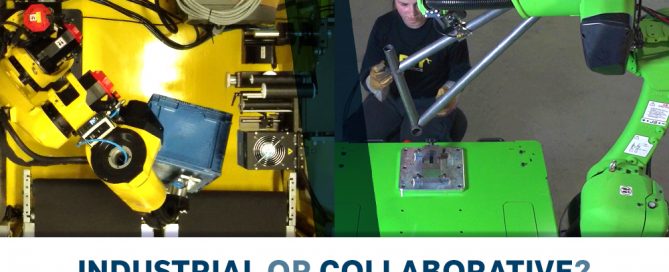
As technologies advance, manufacturing industries are looking for new and innovative ways to increase their factory production and efficiency. Robotic technology is widely used and is available for all production companies to achieve these goals. Many different kinds of robotic equipment are available to be integrated into a factory floor. They can be distinctly categorized into two groups: Industrial Robots and Collaborative Robots. Each of these options provides many benefits, however, based on the task or environment that they would be subjected to, one may prove to be a better fit over the other. 

Industrial Robots

Advantages

Industrial robots can be easily programmed or automated to perform repetitive tasks within a production workspace. This will allow employees to focus on or be reassigned to more meaningful tasks which aren’t as repetitive or dangerous. On a similar note, this also reduces any risks or hazards an employee would be subject to since industrial robots are replacing them and are often independent and require minimal human interaction.

Due to general robotic capabilities, integrating industrial robots will increase the overall efficiency of a workplace. It is well known that robots are faster, more accurate, and more consistent than human employees. Industrial robots perform their tasks away from human workers and therefore can operate at higher speeds than collaborative robots.

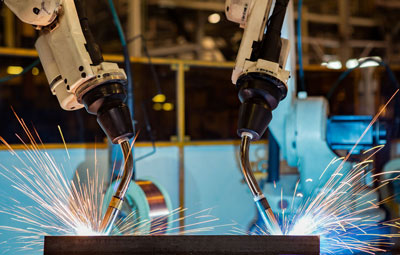
Compared to Collaborative Robots, Industrial Robots are more often designed for heavier tasks like the assembly of large products, welding, cutting, etc. This makes them ideal for factories like the automotive industry, where the parts are heavier and require unique or hazardous steps during production.

Limits

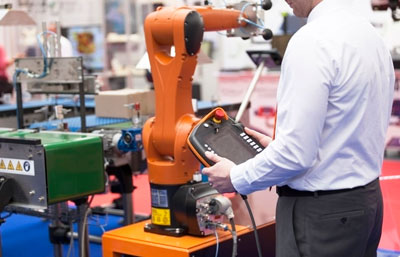
Since industrial robotics provide a more permanent solution to automated production, it is often a hassle to reassign them to other production tasks. They are commonly bolted to the ground and are programmed to focus on a specific task at the time of installation. In order to reprogram or relocate an industrial robot, a qualified employee would need to be on-site to accomplish the task properly.

As stated previously, industrial robots are meant to perform their tasks away from human workers. Their operation workspace can be dangerous due to the fast and heavy moving objects. Hence, integrating a safety cage or robotic work cell would be ideal to eliminate any hazards.

Collaborative Robots

Industrial vs CobotsAlso known as Cobots, this style of robot is designed to work along with, or close to other human workers. These robots work with lighter materials, have a limitation on their movement speed, and come equipped with safety sensors to ensure safe interaction with nearby humans. Cobots are capable of a range of tasks including but not limited to pick and place, packing, palettizing, welding, finishing, painting, etc.

Advantages

The main aspect of a collaborative robot is the ability to work closely with humans. This means that a cobot would be ideal for smaller workspaces, or for production floors where robotic equipment is limited, and human workers fill most of the tasks. Examples include robotic welding assistants, palletizing robots, etc.

Unlike industrial robots which can take days or weeks to integrate, program, or relocate, collaborative robots are simple in design and can be adapted to a production floor with ease. The movements of the cobot can be taught by moving the robot arm by hand or using the cobot’s user-friendly software. This means that the cobot can be programmed to perform a task one day, and then be easily moved and programmed to another. This is especially useful if a production role needs to be filled immediately, or if the robot is used to assist various stations.

Limits

A collaborative robot is designed to work alongside human workers; therefore, certain safety requirements must be set in place to avoid injury. The majority of collaborative robots have a speed limit requirement of 250mm/s while in the vicinity of human workers. Collaborative robots are fully capable of reaching higher speeds; however, they must be isolated from employees. Many industries achieve this by integrating a robotic work cell or adding safety scanners.

Since cobots are designed to be versatile with their applications, many are manufactured for non-strenuous tasks and are meant to handle small and medium-sized objects. Therefore, collaborative robots wouldn’t be ideal for heavy manufacturing environments.

The Right Balance

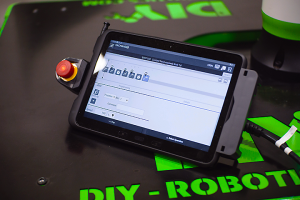
At DIY Robotics, we offer a range of robotic cell products that can be tailored to your specific needs. Our robotic cells bring all the benefits of a collaborative robot while making no compromise to its speed or functionality. Due to their mobile design, our robotic cells can be relocated and reprogramed to any workstation with ease. Our robotic cells are designed to be as simple to program as possible. This is due to the external teach pendant as well as built-in programs within the cell. This includes but is not limited to a DIY Robotics software package, scroll menus to select different programs based on the robot chosen, indicators to inform the user of any problems or steps that need to be performed, etc. Each of these are displayed on a screen outside the cell for easy analysis and manipulation of the cell’s state/environment. We also offer free support and tutorials for all our equipment and products. These benefits can save a great amount of time for an industry, which will in turn increase their revenue.

Summary

To summarize, Industrial and Collaborative robots are both capable of a range of manufacturing applications. Industrial robots provide a high-efficiency, heavy-duty way to accomplish production tasks. Collaborative robots provide a user-friendly, adaptable, and safe addition to a workspace. Depending on the tasks you need automated, one of these can provide the necessary solution. DIY Robotics offers a range of robotic products to satisfy your automation needs. For more information regarding our robotic equipment, or if you would like a product recommended, please feel free to visit our product page: https://diy-robotics.com/products/.

That concludes this week’s blog post on Collaborative and Industrial Robots. If you have any questions regarding the topics and information presented here, feel free to contact us and we will provide you with an expert on the topic: https://diy-robotics.com/contact/.

References

HOW DIY ROBOTICS CELLS CAN GROW WITH YOUR BUSINESS

The application of robotic technologies is seen throughout the world. They provide huge benefits to any production floor while still being cost-effective. But as market opportunities and demand increase, industries are looking for more ways to improve upon existing robotic solutions. There are many technologies available to increase the efficiency of robotic equipment, one of which is the use of robotic cells.

A robotic cell is defined as a set of machines or robots that are organized within a closed workspace to achieve an efficient and safe automation process. These cells can have pre-installed robots within them, or come empty to integrate your own robotic equipment. DIY Robotics has a wide range of mobile and modular robotic cells available to grow with any business; by installing a robotic cell, a company can deliver many benefits to its industrial processes.

Benefits to DIY Robotics Cells

Customizable

customizable DIY RoboticsOur robotic cells come in a range of sizes with customizable panels. Depending on your needs, our experts can develop and design the cell to ensure the robot will operate correctly and effectively. In other words, your robotic cell comes tailored to your specific robotic functions. An example would be adding passages for a conveyor to better incorporate it to your production floor. Our robotic cells also have the capability to house multiple industrial robots or machines, and can also be installed with your own robots in the case where your company is comfortable with a specific robotic brand.

Adaptable

As processes change or improve on a production floor, equipment may need to be installed, altered, or relocated. In the case of robotic equipment, Efficient DIY Roboticsthey are traditionally bolted to the ground and meant to focus on one task. To relocate the robot, it would consume a large amount of time and therefore increase downtime. Thankfully, DIY Robotics cells are completely mobile and can account for simple or complex changes in facility disposition. Due to this benefit, it is possible to add new cells to a production line at any moment based on a factory’s needs.

DIY Robotic cells also give the possibility to change the configuration of a cell at any time to match the needs of a changing work environment. This could involve changing the EOAT (end of arm tool) to directly change the function of a robot, or replacing the panels of the cell to incorporate new equipment (a sliding door, a conveyor, etc.). This means that you can use the same robotic cell for various applications.

Safety

Adaptable DIY RoboticsRobotic cells provide a closed environment for the robot to operate within. This means no human intervention is possible without disabling the robot. According to the accessories added to the DIY Robotics cell (conveyor, drawer, vibrating bowl, etc.), it can also come equipped with additional security components. Robotic cells provide a closed environment for the robot to operate within. This means no human intervention is possible without disabling the robot. According to the accessories added to the DIY Robotics cell (conveyor, drawer, vibrating bowl, etc.), it can also come equipped with additional security components.

Efficient

As stated above, a robotic cell can be customized to fulfill every need of the robot so it can perform its job effectively and consistently. Since the cell is also a closed system and limits human intervention, a robot can operate at higher speeds which in turn will increase production rates, and therefore improve OEE (Overall Equipment Effectiveness).

Conclusion

DIY Robotic cells are an excellent addition to any manufacturing environment. Efficiency will be greatly increased, hazards from the robot will be eliminated, and each cell can be customized to fulfill a production floor’s needs while still being adaptable to changes throughout its industrial lifespan. As your company grows and changes, your equipment can help facilitate its growth. If you have any inquiries regarding our robotic cells, please visit our product page. If you have any other questions, feel free to contact us and we will put you in touch with one of our experts.

References

The Differences between FANUC LR MATE and FANUC CR ROBOT

Each year, around 1.6 million twins are born around the world. Some are identical and some are not. But even identical twins are not completely identical. The same could be stated regarding the FANUC CR robots and the LR Mate series robots. They may look like twins because they share similar physical designs with very little differences, but they are both quite different in many aspects. The major difference can be noted in their working speed, environment, and safety.

To better understand the FANUC LR MATE and CR Robots, we should review their capabilities, similarities and differences.

FANUC LR MATE SERIES

The LR Mate Series is a robot the size of a human arm and has a load bearing capacity of maximum 14kg weight across its range. It is compact and used for quick maneuvers and part processing in various industries ranging from food to automotive.

They can come with different options tailored to the work they do, altered according to the client’s requirements. We will now look at the specifications and major characteristics of the LR Mate Series:

  • Floor, Ceiling, Wall and angle mounting robots
  • Can work alongside other robots in close proximity due to its smaller work envelope
  • Sensors, camera, and other attachment options
  • Reaches up to 911mm
  • Internal cable routing
  • Short cycle times (speed up to 4000 mm/s)
  • Work envelope remains constant irrespective of mounting
  • 5 and 6 axis robots

The FANUC LR Mate Series is used for applications such as dispensing, pick and place, assembly, machine-tending, welding, painting, and many others depending on its field of application. Due to their high speed and accuracy, they increase the precision and throughput of the production. All these above-mentioned reasons have increased the popularity of the LR Mate Series among various industries. So far, they have shown remarkable usage growth in the metal and food industries as well.

FANUC CR ROBOTS

The name CR itself stands for Collaborative Robots. So, the FANUC CR is basically the LR Mate Series turned collaborative with some modified features. Therefore, the FANUC CR Robot is capable of safely working alongside humans in a production line. The highlight features of the CR Robots are as follow:

  • From 550 mm to 1813 mm in reach capacity
  • Maximum speed up to 1000 mm/s
  • Less floor space occupancy
  • Devoid of safety fences due to
  • Customizable settings for speed and safety
  • Compatible with a wide range of attachments like cameras, sensors, etc.
  • Highly reliable
  • Only comes in 6 axis variant for more control

The FANUC CR Series is equipped with a safe contact stop sensor technology which enables it to stop immediately when the robot is in contact with a person or an unidentified object. This makes it highly safe for humans to work around it without any safety fences. Moreover, for extra safety, we can manually regulate the speed and safety settings. The FANUC Teach Pendant gives access to a step by step process to set up CR robots for new and acquainted users.

FANUC CR Robots can safely handle tasks like palletizing, pick and place, applying sealants, painting, lifting/placing heavy components, assembling, quality checks, and machine-tending.

Now that we have seen the features of both the FANUC LR MATE and the FANUC CR robots let’s compare them to see the differences:

FANUC LR MATEFANUC CR ROBOT
Non-Collaborative robotsCollaborative robots
Come in 5 and 6 axes modelOnly come in 6 axes model
±0.01mm repeatability rate±0.03mm repeatability rate
Cannot work in close proximity with humansCan work alongside humans without causing any harm
Need safety fencesDo not require safety barriers
Light in weightHeavy in weight compared to LR Mate
Auto stop option not availableAuto stops when in contact with a person or any fixed object
Speed up to 4000 mm/sSpeed up to 1000 mm/s
Reach up to 911 mmReach up to 911 mm

These features and limitations of the FANUC LR MATE and the FANUC CR Robots make things really clear when manufacturers need to select the correct model according to their requirements. The wide range of products provided by FANUC thanks to its LR Mate and CR robots makes it easier to spend exactly on what is required and get customized accessories to cater to their needs. The new trend around collaborative robots tends to make them attractive, but their performances are less effective than traditional robots.

Therefore, before opting for a cobot, take the time to figure out if a collaborative application is really needed or if an industrial robot in one of our pre-secured robotic cells could do the job with a better output. Discover more about our Collaborative Robotic Cells and Modular Robotic Cells on our product pages.

References

What are The Industrial Robotic Trends in 2021 And After?

The future of industrial robots looks very bright as many companies are looking to automate their production lines, especially with the COVID-19 pandemic. According to a report from Reportlinker from November 2020, industrial robotics which is the top segment in robotics, is about to experience a compound annual growth of 18.2% with revenues growing to $176.8 billion in 2025 from $76.6 billion in 2020.

Here are the top 5 emerging trends in industrial robotics in 2021 and after.

1 | Smart Industrial Robots

Smart industrial RobotsIndustrial robots are now able to communicate with each other without any human support. With the increased digitization of robots by harnessing the power of the internet, robots can now be programmed to independently communicate with each other which increases the efficiency and speed of manufacturing. Manufacturers are also able to leverage real-time data analytics to improve production and help in making business decisions as well.
2 | Robots to Work in Small Factories

While we are accustomed to big specialized robots in assembly lines, they are expensive to install and are not suited for small factories. The future calls for small robots connected to the same network and AMRs (Autonomous Mobile Robots), which are easier to fit in small factories. They are equipped with navigation technology, making them mobile and more flexible than traditional industrial robots.

Once they are done with their tasks, you can reprogram them for other uses instead of dismantling them. This encourages new markets to automate their processes, such as in the food and beverage industry. Companies like DIY-Robotics offer predesigned, modular, and mobile robotic cells that can be integrated into any production line and moved to the next when needed. These robots are very different from traditional industrial robots that were huge, expensive, and needed to be built on sight thus requiring a lot of effort during installation.

3 | Robots That Reduce the Carbon Footprint

With the growing sensitivity towards climate change, investments in robotic technologies that leave a smaller carbon footprint will be expected to grow. The robots of today and the future are more energy-efficient,  and therefore require less energy to perform similar tasks to other energy-consuming industrial robots. They also have a higher precision rate which produces fewer rejects and below standard goods that have to be disposed of.

4 | Collaborative Robots

Collaborative Industrial Robot

The focus on industrial safety is one of the trends in 2021. This is especially key when it comes to collaboration with humans working hand in hand with industrial robots on the same assembly line without the need for safety barriers. Human-robot collaboration has been improved by the advancement of software, sensory capabilities, and end-of-arm tooling (EOAT) which give industrial robots the capability to detect changes on the line and respond quickly and safely.

These collaborative robots are known as Cobots and are one of the fastest-growing trends in industrial robotics. This is because they are not only collaborative and safe but also easy to program, quick to set up and allow for flexible automation.

5 | Industrial Robots Securing the Supply Chain

The COVID-19 pandemic has not started any trends in robotic technology, it has just accelerated their use beyond what was thought possible. The future of industrial robots belongs in helping fix and stabilize the supply chains that have been severely exposed by the pandemic. Automation of processes will only increase especially in markets in high-wage countries. Doing so will increase their flexibility in the production lines as well as ensure stability and security during uncertain times.

Conclusion

The robot revolution has just begun and we expect to see more investment and attention in this area in the future. Automation of many mundane processes in the assembly line will have to occur to not only increase speeds and efficiency but also reduce costs of production. Gradually, humans will rely on robots for manufacturing even more which is a trend that has already begun in 2021.


Redirection Deburring Cell Page

What You Should Know About Cartesian Robots

If you read the DIY-Robotics blog or other robotics newsyou know that the number of factories incorporating robots is rising. Industrial robots streamline workflow by accelerating cycle times and eliminating bottlenecks. Task automation gets more straightforward with every successive generation of robots. End-users no longer need a degree in computer science to configure the robot’s features. The newest models boast unparalleled levels of user-friendliness with negligible backend-programming requirements. So, with the entire robotics industry booming, it’s essential to know what distinguishes one type of robot from another.  In this article, we’re going to look at Cartesian robots, where you might find one, and what makes them an excellent choice for some companies 

What is a Cartesian Robot? 

Machines that operate on Cartesian coordinate systems have been staples in factories for decades. 3D printers, laser-cutters, and CNC machines are examples of devices that use the same principle as Cartesian robots. What sets these robots apart from others is their construction. Cartesian robots are boxy, open, and their primary X-Y directional motion is regulated from above by a rectangular gantry. A lead screw or other linear actuator controls movement in the vertical, Z-direction. All Cartesian robots have this rectangular configuration, and as a result, they are sometimes called rectilinear robots or gantry robots. 

The Benefits: Strength, Precision, and Accuracy.  

Thanks to their rigid structure and boxy configuration, Cartesian robots can carry heavy loads. They are excellent at performing pick-and-place tasks, loading and unloading, material handling, and even high precision operations. 

When it comes to accuracy, howeverseveral factors determine how well a Cartesian robot will perform over time. If the drive system uses a rubber belt, for example, it may stretch or underperform with loads above a certain weight. Motor encoders, servos, and stepper motors improve travel accuracy as long as the material components are regularly checked or calibrated. Under optimal conditions, a Cartesian robot will exhibit superb accuracy in addition to its other qualities. However, do your due diligence before making a purchase and ensure the materials will withstand regular use.  

Work Envelope of a Cartesian Robot 

Cartesian robot’s work envelope is defined by its rectangular structure. Often there is a plate or work area within the boundaries of the X-Y plane. The operational height is bound by the vertical ceiling and the plate or work area. Within this area, there are no “dead zones.” The Cartesian robot has access to every part of the payload that is within this operational cube. 

The footprint of a cartesian robot is rectangular and compact. SCARA robots and six-axis robots have oblong work envelopes that create a lot of unusable space around them. Thanks to the predictable, measurable, and well-defined boundaries of the Cartesian robot, factories can incorporate them easily into their existing infrastructure without having to do a lot of calculating first. 

Whats the price of a Cartesian Robot? 

Due to their simplistic design, primary motor controller, and minimal moving parts, Cartesian robots provide savings over articulated robots. You will also save money by reducing downtime associated with start-up, programming, and troubleshooting. However, articulated robots are more flexible in the long-run. So while you’ll see a lower sticker-price on some Cartesian models, that discount comes at the cost of versatility.

For more information about Cartesian robots or any other types of robots, check out the DIY-Robotics forums and join a community of industrial robotics specialists and enthusiasts. Feel free to reach out to the team for a free consultation and a custom-tailored cost projection.  

Want to know more about Cartesian robotsJoin the DIY-Robotics forum for free and ask the community!

What You Need to Know About Articulated Robots

Articulated robots are the iconic mechanical denizens of the futuristic factory-floor. For decades, this image has seeped its way into our collective cultural consciousness and pervaded everything from cartoons to movies and even stock images. Also, though we’ve moved beyond the basic articulated design to some stunning, cutting edge machines, the image is so ingrained in our memories that the industrial robotics manufacturers continue to produce them to this day. But image alone isn’t enough to keep this reliable, not-yet-antiquated, style of robot around. What are the benefits provided by articulated robots? Why do so many factories choose to rely on this classic, iconic workhorse?

What’s an Articulated Robot?

Articulated robots are the most common types of industrial robots. Their resemblance to a human arm is perhaps one of the reasons they stand out so much in our minds. However, the mechanical benefits of this design are the real reason for their ubiquity and longevity. The arm design combines an extensive range of rotation motion and linear reach with the advantages of precision movement. Articulated arms are ideal for welding, material handling, pick-and-place operations, and dispensing. Their numerous axes and degrees of freedom mean that there is virtually no point in their work envelope that they cannot reach. This makes articulated robots one of the most versatile, flexible, and compact designs on the market.

Articulation of the Robot

The secret to the motion of articulated robots is their rotary joints. Joints can range from a two-axis configuration to something as complicated as ten or more axes. Articulated robots with six-degrees of freedom are the most common. Servo motors powering the joints act like bezel gears, changing the direction of motion by up to ninety-degrees while offering dial-in stops for precision programming and movement.

Work Envelope of an Articulated Robot

With any industrial robot, the work envelope is a significant factor in assessing its usefulness. Articulated arm robots can use a majority of their work envelope, which is one of their greatest advantages. The only part of the envelope they can’t use is the back where the cables are located. However, some modern designs feature internally routed power and data cables that eliminate this problem and let the articulated arm take advantage of its entire sphere of reach.

Regardless of how the cables are routed, even the most basic articulated robot can maximize the usable space for its footprint on the factory floor. This is a major advantage to factories that have to consider production flow, safety, and floor space.

Speed of an Articulated Robot

One of the drawbacks of articulated robots is their speed. They are not as efficient as other types of robots that can accomplish very high-speed tasks. Articulated robots, due to their numerous joints and degrees of freedom, require complex kinematics to govern their motion. They also have higher component mass, so there is an inertial barrier to overcome at every change in direction. If speed is a crucial component of a factory’s cost-benefit-analysis, then articulated robots may not be the ideal choice.

What’s the price of an Articulated Robot?

So, what will an articulated robot cost you? As with any factory upgrade, there are a few ways to answer this question. First, there is the upfront cost: what is the price of the actual unit? Then, there are operational and maintenance fees—these address the costs to operate and maintain the machines every month. However, if you also look at where you’ll see savings, you’ll get a better overall picture of your return on investment. Over time, the benefits of an articulated robot offset the upfront cost. For instance, factory automation improves the health and safety of workers by minimizing repetitive stress and limiting time in hazardous zones. Additionally, your company will produce products of more consistent quality. The result is increased productivity, which means that your investment will pay for itself down the road.

With so many factors constituting the “real cost” of robot upgrades, it’s best to consult the experts on DIY-Robotics.com for a full cost breakdown. In the meantime, you can build your own miniature/prototype robot and familiarize yourself with the mechanics and programming.

If you’d like to boost your factory’s productivity with a robot that is flexible, agile, and has a sizable work envelope, you should consider an articulated robotic arm. For more information about articulated robots or any other types of robots, check out the DIY-Robotics forum and join a community of industrial robotics specialists and enthusiasts. While you’ll find pricing for DIY-Robotics cells online, feel free to reach out to the team for a free consultation to better custom-tailor a cost projection.

Everything you Need to Know About SCARA Robots

Robots are evolving into an essential purchase for manufacturers. They can easily boost your productivity and simplify your automation processes. SCARA Robots, in particular, are popular. In this article, we’ll look at what SCARA robots are and why they may be one of the best choices for your facilities.

What is SCARA?

SCARA stands for Selective Compliance Articulated Robot Arm. They are robotic arms that have a versatile range of motion in the X-Y plane. The arms can move vertically as well, but the position of the vertical axis remains fixed. Thanks to the combination of rigid and dynamic axes, SCARAs are well suited to tackle a variety of material handling operations. They excel at pick-and-place tasks and rapid transportation processes. SCARA robots are at their best, however, when they are used to perform assembly applications. This includes anything from semiconductor handling to bio-med applications and packaging.

Articulation

The number of joints a robot has, combined with the number of axes in each joint, determines its degree of freedom. SCARAs are four-axis robots, with motion in the X-Y and Z planes, and 360-degree rotational movement about the Z-axis. Inverse kinematics and data interpolation allow the robot to move dynamically, quickly, and intelligently.

Work Envelope and Footprint

The work envelope (the area of space that a robot can physically reach) is a significant consideration. Often, when choosing between SCARA, Delta, or six-axis robots, the work envelope is the deciding factor. Due to their full rotation about the fixed Z-axis, SCARA robots have a cylindrical work envelope. In some applications, a SCARA’s work envelope is limited to the front and side. The rear may not be useable if cables and pneumatic hoses exit from the back. Still, having the ability to work in all, or mostly all, of their reach allows SCARA robots to maintain a minimal footprint while maximizing workspace.

Speed

Speed is an essential factor when choosing a robot. SCARAs are one of the fastest on the market. With four axes, they have fewer moving joints than their six-axis counterparts. Additionally, the reduction in joints simplifies inverse kinematic calculations, requiring less computational time. When cycle time is critical, SCARA robots present an ideal package.

So, How Much Should you Expect to Pay?

While Delta robots may be faster, SCARA robots are less expensive. When considering the cost per operation, SCARA robots are a better deal than most other configurations. Companies can expect to pay about $45,000 for a medium to large SCARA robot, but the price may vary depending on the number of extras and payload capacity. They can range from $25,000 and go up to $400,000.

So is the SCARA robot the right type for you? Hopefully, you now have a better idea of how they may meet your needs and expectations. They have many advantages, including if you are limited in space and need the maximum work-envelope to footprint ratio. For more information on SCARA and other robots, check out DIY-Robotics forum and join a community of industrial robotics specialists and enthusiasts.

The Top Six Types of Industrial Robots in 2020

The ubiquity of robots in factories and industry has led to a familiarity with robots as a tool of automation. Rapid technological advancements have allowed many manufacturing sectors to rely on robots for everyday tasks. PricewaterhouseCoopers estimates that up to 45% of work activities can be successfully automated. The impact robots can have on a company’s operation is well-established. By now, many executives have heard of SCARA or Polar robots, and they are aware that these advanced machines can increase their performance and production. What other robots are out there, and how can they benefit your business? In this article, we’ll take a look at the top six types of industrial robots currently on the market.

What are the Major Types of Industrial Robots in 2020?

All robots perform the same standard functions: They use sensors to detect changes in their environment and manipulators to interact with their surroundings. Robots typically perform two primary tasks: harvesting and positioning. How they do this, though, is as varied as the tasks to which they are assigned.

Articulated Robots

Articulated robots are the most common types of industrial robots. They comprise a mechanical configuration that resembles a human arm. With the use of articulated joints with multiple degrees of freedom, the arm provides a large range of movement. Articulated robots with six degrees of freedom are the most common. Other types may only have four degrees of freedom or even fewer.

Advantages: High speed, large work envelope for minimal floor space. Easy to align with multiple planes.

Disadvantages: Requires a dedicated robot controller, complicated programming, complicated kinematics.

Learn more about Articulated Robots >>

Cylindrical Robots

Cylindrical robots have at least one rotary joint at the base and at least one prismatic joint connecting the links.  With their pivoting shaft and extendable arm, they can move vertically and horizontally by sliding. They offer both linear movement and rotary movement about the vertical axis. The compact design of the effector allows the robot to reach tight workspaces without any loss of speed. Cylindrical robots are mostly used in simple applications, like pick-and-place, where rotary motions must be incorporated.

Advantages: Simple operation and installation. Minimal assembly. Robots can reach in 360-degrees from base. Requires minimal floor space and can handle heavy payloads.

Disadvantages: Doesn’t do well with obstacles. Low accuracy in direction of rotary motion.

Cartesian Robots

Cartesian robots are also called rectilinear or gantry robots and have a rectangular configuration. These types of industrial robots deliver linear motion by sliding on its three perpendicular axes (X, Y, and Z). Due to their rigid structure and configuration, they can carry heavy loads. They can also be used to perform pick-and-place tasks, loading and unloading, material handling, and even high precision operations. Most 3D printers operate on gantry systems.

Advantages: Provides high accuracy with simple operation. Easy to program offline and highly customizable. Able to handle heavy loads. Relatively inexpensive.

Disadvantages: Requires large operational and installation area. Complex assembly. Movement limited to only one direction at a time.

SCARA Robots

SCARA stands for Selective Compliance Assembly Robot Arm. These robots consist of two parallel joints that provide motion in one isolated plane. The rotary shafts are positioned vertically, and the end effector moves horizontally. SCARA robots excel in jobs that require precise lateral movements, and they are ideal for assembly applications. SCARA robots are suited to pick-and-place or assembly operations where high speed and high accuracy are required. SCARA robots move quickly and integrate into existing infrastructure more easily than cylindrical and cartesian robots.

Advantages: High speed, excellent repeatability, large workspace.

Disadvantages: Requires a dedicated robot controller, limited to planar surfaces, hard to program offline.

Learn more about Scara Robots >>

Polar Robots

Polar robots are the veterans of the robot world. They are one of the first types of robots developed and are still popular today. The axes of the robot are combined to form a polar coordinate system, which allows the robot to have a spherical work envelope. Polar robots are commonly used for die casting, injection molding, welding, and material handling.

Advantages: 360-degree range of motion. Large work volume. Require minimal floor space.

Disadvantages: Short vertical reach, low accuracy, and low repeatability in the direction of rotary motion. They require a sophisticated control system.

Delta Robots

Delta robots are also called parallel-link robots. They consist of parallel joint linkages connected to a common base. Delta robots are especially useful for direct control tasks and high maneuvering operations (such as fast pick-and-place jobs). Delta robots make clever use of the mechanical advantage of four-bar linkage systems.

Advantages: Very high speeds are attainable. High operational accuracy.

Disadvantages: Complicated operation and requires a dedicated robot controller.

As you can see, many industrial robot options exist on the market. In addition to the autonomous models listed, you might find collaborative robots fit your automation needs better. Collaborative robots come in the same basic types included in this article, but are designed to work directly with human operators.

The most important thing is to know before selecting your robot is what tasks you need it to perform, and how you want it to integrate into your existing infrastructure. For help selecting the best robot for you, check out some of our other articles on DIY-Robotics.com. Our robotic integrators will help you choose the right automation tools for your company.

The Top 3 Best Robotic Automation Process Tools

Robotic process automation (RPA) provides numerous benefits over using humans to perform similar tasks. Among the advantages are improved standardization of workflow, reduced error rate, and superior management of repetitive tasks. Several RPA tools number among the best and most reputable on the market. So, how do you know which one to choose? Let DIY-Robotics walk you through some of the top robotic automation process tools and help you decide on the right one for your operational needs.

Another Monday

When you need complete automation from beginning to end, Another Monday is one of your best bets. This RPA tool features an intuitive, easy to navigate user interface built around the Muse drag and drop workflow configuration. This highly accurate analyzation tool minimizes information loss between the process user and the analyst. Another Monday features quick scaling that pulls tasks from a database and collects data along the way. With little idle time, Another Monday promises reliable, consistent process automation that no human workforce can match. Free up resources, eliminate errors, and preserve information integrity with one of the most trusted names on the market.

Linx

Linx is your top choice if you need automation quickly and with little setup. This no-code RPA is perfect for those who want an integrated development environment designer that can speed up development. With over 100 pre-built actions and automations, you’ll find Linx to be an out of the box solution. The cloud-based service is crucial for speedy deployment on any device. Easily integrate databases and systems, automate tasks and workflows, even create and host APIs. Develop apps that require triggering and processing requests from multiple systems. Build applications that require storing, querying and manipulation of data stored in NoSQL databases. Linx is fast, simple, and instantly deployable with the click of a button.

WinAutomation

WinAutomation turns your Windows desktop into an automation juggernaut. The Macro Recorder is a virtual autopilot that allows WinAuto to automate any repetitive task on your computer. Versatile, dynamic, and intuitive, WinAutomation reliably automates even web-based tasks. This RPA is fully compatible with Internet Explorer, Firefox, and Chrome. It boasts over 300 pre-build actions to help you get set up quickly and with no fuss. Send, receive, and process email automations; WinAutomation supports SMTP/IMAP exchange server protocols. If you want compatibility, user-friendliness, and a program you know will work with your existing workstation infrastructure, WinAutomation is your clear winner.

Robotic process automation is essential for companies looking to take the burden off of their human task force while simultaneously increasing productivity and eliminating errors. Put your most valuable resources where you need them the most, and leave the repetitive, menial tasks to the machines. Save time and money by automating ongoing processes with the software that is easy to set up, works with your software architecture, and makes the most sense for your company. Using the tools discussed here, you’re in the right direction to start programming your bot. Download our ebook to get started with your own RPA cell.

What kind of tasks can an industrial robotic arm do?

Industrial robotic arms are becoming more versatile with each successive generation. Major advances in encoders and motors and simplified programming environments let users task their robots with delicate motions and increased payloads, all while in smaller and more compact spaces. If you’re wondering how a robot could contribute to daily production in your company, then you need to keep reading to find out what an industrial robotic arm can do for you.

Tasks attributed to industrial robotic arms

welding task industrial robotic arm

Pick-and-drop is the most common task a robot will perform. However, this is almost an underuse of your robot’s potential. Modern units come ready to be tasked with welding, cutting, routing and milling, assembly, machine tending, packaging and working with an injection press. In fact, if you look at the robot profiles on FANUC’s site, you’ll see the numerous tasks they have been designed to perform.

Modern robotic arms can perform complex and delicate tasks

Robots are helpful when it comes to simple, repetitive tasks. However, they now come programmed and designed to tackle complex tasks that would take a human a long time, pose a hazard, or require high torque in small spaces. Modern robots are capable of in-mold labeling, overmolding, insert loading, laser cutting. They are extremely versatile in material application and can handle everything from primer to plasma, and foam to tape. Precision, versatility, agility, and power allow these modern robots to outperform their progenitors by exponential bounds.

Reuse your robot to perform multiple tasks and extend its life

One of the biggest advantages of modern robotic arms is that they can be used for more than one task. You no longer have to purchase single-function robots that anchor to one place and are there virtually permanently. Nowadays, you have cobots and robotic cells that allow robots to be moved into other stages in the assembly process. Cells can be programmed to be useful for multiple tasks. Best of all, they are easy to move and even easier to integrate.

Freeing up personnel for parallel tasking

industrial robotic arm does parallel tasking

Robots eliminate or minimize the manual labor required of your staff. This is a significant benefit of having a reliable, versatile robotic arm in your assembly process. Humans are now free to accomplish other tasks and increase your overall productivity. Allowing robots and humans to parallel task ensures that all resources, human or mechanical, are in the optimal places on the factory floor. Humans do some tasks better, while others are carried out most efficiently by a robot. Having the best man/bot in the right place for the job will streamline your production line and cut down on interruptions, delays, and mistakes.

DIY-Robotics cells can do anything you want them to because you design them! Before you start building your cell, learn more about our process by consulting our Ultimate Guide to Build Your Own Industrial Robotics Cell.

add robots to your production line

DOWNLOAD NOW