As more industries are moving into Industry 4.0, they are looking for new innovative ways to improve their production through the use of robotics. However, for industries which already possess robotic equipment, there are a few solutions available to further improve their efficiency. One of these solutions is through the use of robotic cells.
Robotic Cells
Also known as a work cell, a robotic cell is defined as a closed workspace where one or more robots are installed. The purpose of these cells is to increase the efficiency of the robot while still maintaining a safe work environment for nearby employees. This is accomplished by ensuring no employee can interact physically with the robot unless the system is shut down, to which the doors of the cell would unlock. When a robot is confirmed to present no hazards to nearby human workers, speed restrictions can be lifted to allow the robot to work faster and provide high productivity.
There are a range of robotic cells which are available to any industry. Cells can be integrated alongside individual or multiple robots in a production atmosphere. This could be as simple as ordinary barriers around an entire robotic collection, or specialized cells with controls and programming capabilities. Each industry or production floor will have certain constraints for acceptable robotic cells; this is dependent on the size, weight, or type of robots used. Therefore, it is important to select one capable of supporting the robotic equipment you plan to use with it.
DIY Robotic Cells & Their Benefits
At DIY Robotics, robotic cells are our specialty. We offer a range of robotic cells each with its own benefits and types of robots it can house (based on weight and size), as specified on our product page. Our cells can be categorized into two groups, collaborative and modular cells.
Collaborative cells are designed to work with or close to human workers. These cells have speed limitations to ensure the robot does not harm an employee and are great at performing various tasks. Collaborative robots are an excellent addition to small and medium industries looking for an adaptable robot. Our modular cells provide a closed workspace and are well suited for working with other machines or robots. All of our cells each have the benefits stated above, along with a few unique ones:
Customizable
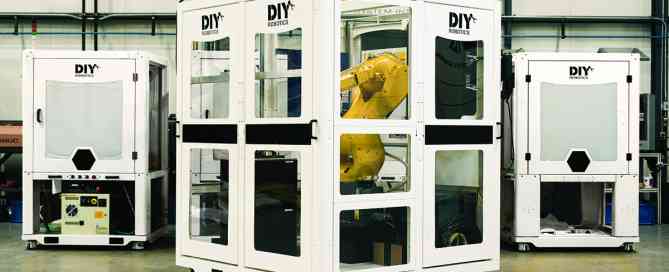
Each of our cells has the potential to be completely customizable to match your workspace layout. This includes offering customizable panels (the walls of the cell) which are specifically tailored to integrate with your surrounding production equipment, as well as the capability to house your own robotic arms. Each of our cells can come equipped with a FANUC robot, or you can use your own.
Mobile
Our cells are designed to be mobile around a workspace. This means that a robot can easily be relocated to any station in the case where a production floor’s layout was to change, or if a problem were to occur with the robot. Traditional robotic equipment is usually bolted to the floor and can result in lengthy installation/removal of the equipment. Our robotic cells will not have that problem. This is accomplished by the industrial-grade locking wheels that are installed onto the robotic cell.
Durable
Our cells are constructed with welded and folded sheet metal to ensure a strong frame for any robot. Our cells make no compromise on the robot’s acceleration and speed due to the strong materials the cell is made of. Due to the strong frame and industrial locking wheels, vibrations or jolts from the robot are not a concern for our cells. All materials the cell is composed of are also scratch and rust-resistant.
Conclusion
Robotic cells bring many benefits to any work environment. Collaborative cells create a safe workspace for humans to interact closely with the robots without harm. Modular robotic cells remove any hazards to which a human worker would be subject to due to the closed workspace, and allows the robot to work faster which will increase efficiency. DIY robotics has a wide range of robotic cells available, each with its own benefits and specifications on the robots it can be integrated alongside. Please feel free to visit our product page to begin customizing your robotic cell for your workspace: https://diy-robotics.com/products/. If you have any other inquiries, please feel free to contact us and we will put you in touch with an expert: https://diy-robotics.com/contact/
References
Robotic Cell Finder: Products: DIY-Robotics. DIY Robotics. (2022, May 12). Retrieved June 12, 2022, from https://diy-robotics.com/products/
As technologies advance, manufacturing industries are looking for new and innovative ways to increase their factory production and efficiency. Robotic technology is widely used and is available for all production companies to achieve these goals. Many different kinds of robotic equipment are available to be integrated into a factory floor. They can be distinctly categorized into two groups: Industrial Robots and Collaborative Robots. Each of these options provides many benefits, however, based on the task or environment that they would be subjected to, one may prove to be a better fit over the other.
Industrial Robots
Advantages
Industrial robots can be easily programmed or automated to perform repetitive tasks within a production workspace. This will allow employees to focus on or be reassigned to more meaningful tasks which aren’t as repetitive or dangerous. On a similar note, this also reduces any risks or hazards an employee would be subject to since industrial robots are replacing them and are often independent and require minimal human interaction.
Due to general robotic capabilities, integrating industrial robots will increase the overall efficiency of a workplace. It is well known that robots are faster, more accurate, and more consistent than human employees. Industrial robots perform their tasks away from human workers and therefore can operate at higher speeds than collaborative robots.
Compared to Collaborative Robots, Industrial Robots are more often designed for heavier tasks like the assembly of large products, welding, cutting, etc. This makes them ideal for factories like the automotive industry, where the parts are heavier and require unique or hazardous steps during production.
Limits
Since industrial robotics provide a more permanent solution to automated production, it is often a hassle to reassign them to other production tasks. They are commonly bolted to the ground and are programmed to focus on a specific task at the time of installation. In order to reprogram or relocate an industrial robot, a qualified employee would need to be on-site to accomplish the task properly.
As stated previously, industrial robots are meant to perform their tasks away from human workers. Their operation workspace can be dangerous due to the fast and heavy moving objects. Hence, integrating a safety cage or robotic work cell would be ideal to eliminate any hazards.
Collaborative Robots
Also known as Cobots, this style of robot is designed to work along with, or close to other human workers. These robots work with lighter materials, have a limitation on their movement speed, and come equipped with safety sensors to ensure safe interaction with nearby humans. Cobots are capable of a range of tasks including but not limited to pick and place, packing, palettizing, welding, finishing, painting, etc.
Advantages
The main aspect of a collaborative robot is the ability to work closely with humans. This means that a cobot would be ideal for smaller workspaces, or for production floors where robotic equipment is limited, and human workers fill most of the tasks. Examples include robotic welding assistants, palletizing robots, etc.
Unlike industrial robots which can take days or weeks to integrate, program, or relocate, collaborative robots are simple in design and can be adapted to a production floor with ease. The movements of the cobot can be taught by moving the robot arm by hand or using the cobot’s user-friendly software. This means that the cobot can be programmed to perform a task one day, and then be easily moved and programmed to another. This is especially useful if a production role needs to be filled immediately, or if the robot is used to assist various stations.
Limits
A collaborative robot is designed to work alongside human workers; therefore, certain safety requirements must be set in place to avoid injury. The majority of collaborative robots have a speed limit requirement of 250mm/s while in the vicinity of human workers. Collaborative robots are fully capable of reaching higher speeds; however, they must be isolated from employees. Many industries achieve this by integrating a robotic work cell or adding safety scanners.
Since cobots are designed to be versatile with their applications, many are manufactured for non-strenuous tasks and are meant to handle small and medium-sized objects. Therefore, collaborative robots wouldn’t be ideal for heavy manufacturing environments.
The Right Balance
At DIY Robotics, we offer a range of robotic cell products that can be tailored to your specific needs. Our robotic cells bring all the benefits of a collaborative robot while making no compromise to its speed or functionality. Due to their mobile design, our robotic cells can be relocated and reprogramed to any workstation with ease. Our robotic cells are designed to be as simple to program as possible. This is due to the external teach pendant as well as built-in programs within the cell. This includes but is not limited to a DIY Robotics software package, scroll menus to select different programs based on the robot chosen, indicators to inform the user of any problems or steps that need to be performed, etc. Each of these are displayed on a screen outside the cell for easy analysis and manipulation of the cell’s state/environment. We also offer free support and tutorials for all our equipment and products. These benefits can save a great amount of time for an industry, which will in turn increase their revenue.
Summary
To summarize, Industrial and Collaborative robots are both capable of a range of manufacturing applications. Industrial robots provide a high-efficiency, heavy-duty way to accomplish production tasks. Collaborative robots provide a user-friendly, adaptable, and safe addition to a workspace. Depending on the tasks you need automated, one of these can provide the necessary solution. DIY Robotics offers a range of robotic products to satisfy your automation needs. For more information regarding our robotic equipment, or if you would like a product recommended, please feel free to visit our product page: https://diy-robotics.com/products/.
That concludes this week’s blog post on Collaborative and Industrial Robots. If you have any questions regarding the topics and information presented here, feel free to contact us and we will provide you with an expert on the topic: https://diy-robotics.com/contact/.
Solution Robotiq Pour palettisation. Robotiq. (n.d.). Retrieved March 22, 2022, from https://robotiq.com/fr/solutions/palettisation
What is a Cobot?: The Ultimate Collaborative Robot Guide. WiredWorkers. (2022, March 22). Retrieved March 22, 2022, from https://wiredworkers.io/cobot/
Welcome to Part Two of a collaborative blog with DIY Robotics and Exact Automation. In Part One, we touched on some topics and questions regarding an automation investment. If you are interested in Part One, please feel free to visit the page here: https://exact-usa.com/future-evolution-of-an-automated-production-line/
In this part, we will answer frequent questions about robotic cells and explain how robotic equipment is an excellent solution to increase the overall efficiency of a workplace. There are a wide range of products, models, and equipment available to automate a production procedure. However, integrating robotic equipment onto a product floor is not an easy or straight-forward task. Many steps and precautions need to be taken before choosing the right equipment for the job. It is important to ensure you have correct information to ensure great fit for the automated equipment on your production floor. At DIY Robotics, we provide detailed product pages, an easy contact service, as well as an online forum to provide all the knowledge our customers may inquire about our products.
Frequently Asked Questions
Is our product more durable than other mobile products?
Other mobile products are often constructed using aluminium to ensure a lightweight mobile product. Some products also provide full customizability at the expense of its stability and structure. Although easily moveable, these cells shake during the movement of the robot and are not strong enough for full speed industrial applications. Thankfully, our robotic cells are crafted with durable materials to ensure our product is robust and avoids vibrations and movements caused by the robot. We have a variety of cells available for different sizes of robots, each constructed to provide the necessary stability the robot requires in order to operate at its maximum speed.
Why is modularity/mobility a benefit?
In terms of modularity, our robotic cells can be configured by our experts according to your needs. Since a robotic cell would be interacting with other equipment or stations, it is incredibly important to ensure its composition is compatible with its surroundings. Examples include adding passages for a conveyor, openings to take products from a molding machine, doors for easy maintenance, etc. On a similar note, our cells can also be re-customized to work at another station or with another machine.
With regards to mobility, processes and layouts of production floors change often. Equipment may need to be altered, relocated, or installed. Traditional robotic equipment is bolted to the ground and may consume large amounts of time to install or move. Since our cells are completely mobile and preassembled, it takes a fraction of the time. This saved time can be reinvested into an earlier production which will increase efficiency. Similarly, if more cells need to be added to an assembly line, the installation time would be minimal.
Is it just a box around a robot?
DIY Robotics cells provide so much more than that; our cells are equipped with essential components like e-stops, control panels, tower lights, etc. As stated above, our cells are completely mobile and modular and provide a huge range of benefits for any industry. In other words, our cells are specifically designed to grow and adapt to any business. Depending on the selected product or model, our cells can accommodate a range of robot sizes, come equipped with dependable robots, or provide other features required by your projects. Moreover, each DIY Robotic Classic or Advanced cells come with a program base to ease their integration into a production line.
INCLUDED PROGRAMS
Background logic programs for alarms, lights, locking sequence and timers for the general work of the robotic cell;
Two HMI pages; one for the general work of the cell and one for the product selection;
10 programs associated to the product selection HMI page;
The cell is programmed to be operated with 3 buttons (stop, reset, start). It starts the main program that calls the selected product;
DIY Robotics offers a range of robotic cells each with its own workspace capable of supporting different robots and payloads. Each of our models on our website displays the cell dimensions to allow our customers to ensure they find the right cell capable of working with their products. The cell walls are also customizable to better interact with external equipment within your production floor.
Aren’t the wheels too fragile for such a large weight?
Each of our robotic cells is equipped with industrial-grade wheels capable of supporting a load much larger than the cell, robot, and payload combined. Based on the model chosen, the following list displays the load capacities of each cell:
Model
Average Weight
Overall Capacity
Astro-33
261 kg (575 lbs)
500 kg (1102 lbs)
Astro-53
750 kg (1650 lbs)
500 kg (1102 lbs)
Astro-66
2250 kg (4950 lbs)
1100 kg (2425 lbs)
Comet-33
340 kg (750 lbs)
500 kg (1102 lbs)
Comet-44
590 kg (1330 lbs)
500 kg (1102 lbs)
Satellite-55
1111 kg (2450 lbs)
600 kg (1322 lbs)
Satellite-66
1293 kg (2850 lbs)
600 kg (1322 lbs)
Will the cell move when the robot operates at high speeds?
Our robotic cells are carefully designed and constructed to negate vibrations and movement during a robot’s operation. This is due to the rigid and strong characteristics of the cell’s frame as well as the secure leveling pads. Effectively, the robotic cell acts as if it is bolted to the ground.
Is robotics only for big industries?
Robotic equipment can be seen in any sized industry which is looking to increase its production efficiency. At DIY Robotics, our aim is to facilitate all industry sizes. In fact, our robotic cells are well suited for medium to small industries that are looking to integrate robotic equipment for the first time or want to increase their robotic arsenal. This is due to the affordability as well as the modularity and mobility of our cells. As stated above, our cells can be relocated, customized, and reprogramed to perform any automated task without the hassle of a full uninstall.
How much time/money can a DIY cell save me in my project vs. standard robotics?
Standard robotics are often open systems which have limits to their movement speeds due to the hazard they present to their surroundings. Therefore, they often require fencing, or large amounts of floor space just to operate effectively and safely. By creating a private workspace for a robot via a DIY Robotics cell, it can operate at higher speeds without risking human injury. This increases the overall efficiency of a production floor better than a standard robot. Hence, time and money will be better utilized by a robot with a work cell.
For companies and industries who are integrating robotic equipment to their production floors for the first time, or reworking their production layouts will have to plan a shutdown in order to achieve a smooth installation. This process can be incredibly lengthy. If it is not performed correctly, the amount of time, money, and effort will be unexpectedly large due to the halt in production. Standard robotic equipment is traditionally installed by bolting it directly to the ground for a more permanent solution. If the equipment needs to be moved or replaced, it would need to be uninstalled similarly. This process is much longer than the installation of a robotic cell. DIY Robotics cells come pre-built and are completely module. These aspects reduce installation time greatly and allow the robot to be moved with ease in the case of unexpected errors, or if the equipment is needed elsewhere. This allows factories to produce their products sooner which in turn will save them a great deal money.
How do I manage external interaction with the DIY cell in my project?
External interaction can be effectively managed on both the hardware and software sides of our robotic cells. As stated above, the modularity of our cells allows for customization of the robot’s environment. Unique doors and openings can be added to allow external devices like conveyors, other robots, and CNC machines to be installed alongside the robotic cell in a safe and effective manner. Our cells are equipped with Euromap connectors to allow communication with external machines (like injection molders) for a joint custom application. Our DIY Classic and DIY Advanced options also come equipped with a FANUC or ABB robot which is fully compatible with CNC programming via the teach pendant, or installed software.
Conclusion
To conclude, our robotic cells provide an excellent solution or addition to any automated production floor. This equipment increases overall efficiency and can save an industry a large sum of money, allowing for a quick return on investment. As stated above, this blog is Part Two of a collaborative blog with Exact Automation. If you would like to view Part One, please visit this website: https://exact-usa.com/future-evolution-of-an-automated-production-line/. This blog post also only covered a few questions regarding our robotic cells. If you have any other inquiries about our products and their capabilities, please feel free to visit our product page for more specific information, or contact us and we will put you in touch with an expert on the subject.
Throughout history, humans have discovered and developed ways to manipulate materials in order to create and build the world around them. As technology progressed, our understanding of these materials has led to breakthroughs in production and sustainability, which has benefited society greatly. Therefore, a strong understanding of materials is essential for any manufacturing environment to operate. Whether the results are structural or product-based, each industry must comply with and meet specific requirements to deliver a safe and reliable product. Hence, the use of Strength of Materials is a key aspect of all manufacturing processes.
Strength of Materials
Strength of Materials refers to the mathematics used to calculate stresses and strains in a working material. In other words, it is the process used to determine if a product or structure will fail during its use. When designing structures or products, architects and engineers carefully choose their working materials based on the forces which the product/structure would be subject to during its lifetime. Strong and durable materials should be chosen to ensure a long product lifespan and resistance to general wear and tear. Metal is one of the most common materials used in industries due to its diverse capability to sustain loads and forces. It is great for structural components (beams, trusses, etc.) and products under a heavy workload.
By designing and developing a product to incorporate the correct and strong materials, a manufacturer can reap many benefits. Damage, as well as wear and tear, can cause considerable costs for an industry. The cost to repair a structure or piece of equipment can often be higher than building it with the correct materials in the first place. This will save a company a great deal of cash which can be used on other investments. In a commercial scenario, selling a customer a reliable structure or piece of equipment will give the company a good reputation, often attracting more customers. Good materials make good products. On the other hand, there are many consequences if a manufacturer utilizes cheap materials in production. It is a company’s responsibility to ensure a product is capable and long-lasting in its field of application or run the risk of failures, customers complaints and returns, or worst of all casualties.
Materials in Robotics
In industrial robotics, engineers have made it their purpose to ensure a robot is equipped with and composed of strong materials and a reliable framework. Industrial robots are subjected to many hazardous tasks which involve repeated motions, heavy payloads, etc. These robots (along with all engineered products and structures) have a Factor of Safety that guarantees that their structure will stay intact under a certain payload or force. However, a section that is often not discussed is the strength and reliability of a robot’s environment. Due to a large number of quick linear or rotary motions, an industrial robot must be equipped with a strong anchoring system or robotic cell which is capable of withstanding vibrations and the accelerations of the robot’s movement.
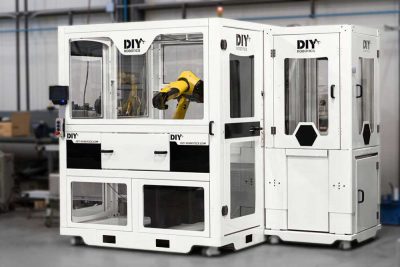
At DIY Robotics, we take pride in our well-structured robotic cells. Each cell has been carefully constructed with welded and folded sheet metal to provide a strong frame without the use of aluminium or extruded metals. These cells have full capability of housing an industrial-sized robot and make no compromises to the robot’s acceleration and speed due to the strong and reliable materials the cell is composed of. Despite the strength provided, each cell is still light enough to be mobile around workstations. In other words, our cells are perfectly balanced between lightweight and heavyweight to handle all manufacturing processes while still being moveable. The cell’s metal components are also rust and scratch protected due to the long-lasting powder coating. Depending on the model of the cell chosen, transparent polycarbonate panels may also be equipped to provide a shatter-proof and scratch-resistant barrier from its workspace (a huge advantage over glass or polymer). If you would like more information regarding our robotic cells or would like to browse all available options, please feel free to visit our product page: https://diy-robotics.com/products/.
Conclusion
In summary, the selection of strong materials is essential for the construction of great products. Doing so will establish a reputation of reliable equipment with customers. In the case of robotics, it is crucial to integrate long-lasting, strong equipment due to the complexity and expense of industrial automation. Failure to do so may result in unexpected failures and expenses which would easily be avoided. This concludes this week’s blog on Materials in Industrial Robotics. If you have a question regarding any of the stated material or have an inquiry about our products, please feel free to contact us: https://diy-robotics.com/contact/.
Engineers Edge, L. L. C. (n.d.). Strength of materials basics and equations: Mechanics of Materials. Engineers Edge – Engineering and Manufacturing Solutions. Retrieved April 1, 2022, from https://www.engineersedge.com/strength_of_materials.htm
As companies upgrade their production floors to be on track with Industry 4.0, so does the demand for automated equipment. By integrating automation, industries can increase their overall production and efficiency, while lowering costs and hazards. The best way industries can achieve automated production is through the use of robots. In today’s world, robotic equipment fulfills a wide range of applications within the manufacturing industry. This could be as simple as pick and place robots, or as complex as automotive robotic welders. One of the most common applications for robotic technologies is product assembly.
Assembly Robots in Industry
Assembly robots are commonplace within any manufacturing environment. They are capable of performing mundane and repetitive tasks with ease. Due to the accuracy of a robot’s EOAT, assembly robots are also perfect for constructing products that require a delicate or precise touch. Such products could involve anything with electronics or compact components. Assembly robots are also capable of working with awkward and heavier parts which a human would find hazardous. In modern assembly lines, almost all nodes within the line are operated by robots or some sort of automated equipment. This ensures that a consistent and accurate construction process is maintained.
An automotive factory is a great example of an industry that utilizes these concepts. Vehicles consist of hundreds of complex parts which vary in size and their installation method. Due to the amount of unique maneuvering required to install the components of a vehicle, it would be best suited for a robotic arm to perform these tasks. Hence, automotive assembly lines mainly consist of robotic assemblers. These robots work in cohesion to produce completed vehicles at a consistent rate. Heavier objects like the motor and vehicle frame can be installed easily without endangering workers.
Benefits
Efficient
Assembly robots perform instructions and tasks at greater speeds and with greater precision than human workers. Assembly robots are also able to provide a better-quality product since they are more consistent and precise in their assembly process. Robotic assembly installations are also capable of operating 24/7, with the exception of occasional maintenance breaks. As a result, productivity can be maximized which will increase production rate in a smaller timespan and increase profits.
Cost Effective
As stated above, robotic assemblers are extremely efficient at performing their tasks. Increased productivity leads to increased profits. Installing robotic equipment in the place of human workers will also allow a production floor to significantly reduce labor costs and replace them with a lower powering cost. This will lead to a quick return on investment.
Hazard Reduction
Due to the ability to work with heavy, awkward, and dangerous materials or parts, assembly robots can reduce hazards to which a human worker would be subject to. In other words, a robot is more capable and adaptable to hazardous work environments. This in turn can save money which would have been used to provide workers with PPE, safety equipment, etc.
Restrictions
High investment
Robotic equipment can often have a high investment value. This includes the initial cost of the robot, as well as installation and maintenance. This cost can often exceed that of a worker’s annual wage. However, as stated above, the cost-effectiveness of a robot in long-term use results ini a quick return on investment.
Personnel Expertise
Due the complexity of robotic installations and processes, it is important to have access to personnel who are familiar with the robotics field. Companies with a mass number of robotic installations should ensure a member of staff with this expertise is on-site in the case of unexpected errors or downtime. The labor costs of this employee may be large, but the benefits that countless robotic installations provide easily out-ways this disadvantage. DIY Robotics has an advantageous support program for all of our robotic cells; that combined with the large robotic knowledge base our specialists possess provides all the expertise you require.
Maintenance
For production floors with any quantity of robotic equipment, performing frequent and correct maintenance is extremely important to keep efficiency high, and prevent unexpected errors and downtime. This mainly includes safety inspections, system analyses, cleaning, and upkeep (if a machine has a consumable resource or disposable parts). As stated above, it would also be necessary to have an employee with the expertise to perform this maintenance correctly.
Conclusion
In summary, robotic assemblers provide a necessary benefit to all manufacturing environments. Despite having a large initial cost, this robotic installation can increase efficiency and safety while keeping product consistency. If you have any questions regarding robotic assemblers or have a general inquiry about a certain subject or our products, do not hesitate to contact us and we will put you in touch with an expert: https://diy-robotics.com/free-consultation/.
More and more industries are turning towards industry 4.0 with the use of automation and robotics. To ensure an industry is leading in a manufacturing climate, they must ensure their robotic equipment is effective and of top-grade quality. Therefore, is it crucial to be well educated and informed on the variety of equipment and technology available. Often, it is hard to acquire such knowledge or satisfy any questions from websites and manuals alone. It is important to view and work with robotic equipment physically before confirming that you wish to integrate it. Companies could plan a showcase of their products; however, these can be time consuming and might not deliver the answers and information a customer is looking for. Robotic trade shows are an excellent solution to this.
What are Robotic Trade Shows?
Also known as trade exhibitions or a robotics fair, a robotics trade show is a scheduled public event where companies and industries can showcase their products, technology, and research at a booth. They provide an excellent and effective form of marketing for both buyers and sellers. During these shows, customers who are be interested in robotic products have a chance to ask questions about any aspect of robotics, as well as spectate the workings of different equipment. This provides an opportunity for customers to receive first hand experience and knowledge, as well as give option to purchase or close deals. However, due to the great opportunity companies have to showcase their products, these trade shows are often clustered and can be quite overwhelming since each exhibitor wants your attention. It is important to have an effective strategy before attending these shows to ensure you acquire the maximum value in your visit.
Effective Strategies
A robotics trade show is likely to have a wide variety of technology available, some of which might not even relate to the field you wish to inquire about. Before attending these events, it is important to know what it is you are looking for in order to plan your time effectively. These events often have a member list along with a location of their booth on a floor plan. This can be found on the show website or during the event. When you arrive, you can simply visit their location and avoid the unnecessary booths.
Depending on the organization of the exhibition, companies with similar technology would be grouped together, giving visitors a categorized experience similar to a superstore. Upon arrival at a booth, it is also important to have a list of requirements or expectations available for the vendor. This will allow the vendor to provide the best solution they have for your company. Similarly, you can visit other booths within the show who may satisfy these requirements more appropriately.
Due to the popularity of these events, it can often be hard to receive a vendor’s full attention because of other potential customers. Establishing your intentions or informing a company of your visit will allow them to prepare a presentation. Certain companies will even schedule appointments during these events to provide a more personal, hands-on display of their products.
To summarize, robotic trade shows provide an excellent way for a company to acquire knowledge and information regarding new equipment, technology, and research. It is important to know what you are looking for before attending these shows since it is often a busy event. Plan which booths you wish to visit, as well as a list of requirements your company needs for equipment. Thank you for reading this week’s post on Robotic Trade Shows. If you have any questions, please feel free to contact us and we will provide you with the knowledge you require: https://diy-robotics.com/contact/.
References
Tow, H. (n.d.). What is a trade show? (everything you need to know). Learn Hub. Retrieved April 27, 2022, from https://learn.g2.com/trade-show
Automation has been an essential part of manufacturing environments over the years. Around the globe, industries have been upgrading their workspaces to incorporate robots in order to be on track with industry 4.0. This involves integrating new robotic systems or adding to pre-existing robotic assemblies. The robot equipment does not always have to be bought new. In fact, many companies are purchasing second-hand robots in order to satisfy their automation requirements.
Second-Hand Robots
The second-hand market represents the sale of used or old equipment and merchandise. Automated equipment is a sector within this market, and is a viable option for manufacturers to invest in. Due to supply chain disruptions and the closure of boarders from the COVID-19 pandemic, second-hand robots provide a necessary and adequate way to substitute for late or cancelled robot shipments. There is also a range of advantages and disadvantages when acquiring and utilizing second-hand robots.
Advantages
The second-hand market continues to grow; many reasons contribute to the popularity of used robots, however, the main benefits are as follows:
Consistent
Often, the type and style of an industrial robot are crucial in order to achieve a production requirement. This could involve a custom application, or other machines being dependent. A manufacturer who has already integrated robotic equipment into their production floor may need a replacement of the same model. Depending on how old the equipment is, it may have become obsolete and new robots are not available. A newer robot also may not be compatible with older programs or power sources; therefore, a company would have to invest more money having to upgrade their robotic system to accommodate for one machine. In these cases, the second-hand market would be the only option.
Reliable
When an item has been labelled as ‘second-hand’, a common thought is that it is damaged, or of poor quality. However, that is not always the case. Industrial robots have an incredibly high lifespan, and used robots often still have years of lifespan remaining. If the second-hand robot was pre-owned by a respectable company who ensured maintenance was conducted regularly, the robot would still have a long operating life. Second-hand robots can also be refurbished to operate just as well as newer ones. Depending on the popularity of a used robot, spare parts may also be widely available in the case of future grievances.
Affordable
Newly designed robots can often be incredibly expensive and may be a dealbreaker for companies with tight budgets. Used robots are a fraction of the price of a new robot, while still delivering all automation needs. By spending less on robotic equipment, companies not only have a quicker ROI (return on investment), but could also use the savings to purchase more robots, or invest back into other manufacturing operations.
Disadvantages
Despite the already stated benefits, the second-hand automation market does have disadvantages and inconveniences to be aware of:
Quality
When acquiring a second-hand robot, it is crucial to ensure that it is in working condition. Be sure to be aware of the total working hours as well as reliability with its previous owner. As stated above, be sure the previous owners are of a respectable company who conducted maintenance regularly and ensured the robot operated within its specifications. Another option is to perform diagnostics to check if the robot is in an ideal working condition (ex. FANUC Pro Diagnostic). Doing so will ensure the robot does not perform poorly or have any mechanical errors like backlash, vibration, motor failure, etc.
Technology
A second-hand robot may not be equipped with the latest robotic features. Newer robots are usually more efficient, faster, and more accurate than older models. Not to mention, integration with the IIoT (Industrial Internet of Things) or production monitoring may be easier with newer models. For those who want complex robotic equipment, a newer model may be the best choice.
Conclusion
To summarize, second-hand robots provide an excellent solution for integrating automation into a production floor. They provide a cost-effective and consistent way to revolutionize a workspace. DIY Robotics offers a range of robotic cells well suited for second-hand robots. These cells are mobile and modular which allows the robot to adapt to any work environment, and facilitate a need on a production floor. For more information regarding DIY Robotics cells, please visit our product page.
Please stay connected for more posts addressing robotic industrial applications. If you have any questions regarding the second-hand market or have another inquiry, feel free to contact us and we will put you in touch with an expert.
As the world becomes more and more futuristic, industries have been upgrading their machine floors to become more efficient and productive. Automation is seen throughout the manufacturing world and is essential for any business to be on track with Industry 4.0. Many factory processes incorporate automation, one of which includes inspection installations. Automated inspection installations come in different forms, each with their own advantages and disadvantages. The most common inspection technologies include vision systems, measurement sensors, and optical comparators.
This post is part 2 of 3, where we will highlight Measurement Sensor technologies, along with their applications in the industry. The final topic (optical comparators) will be addressed in a final third post. If you are interested in vision systems and their applications, please feel free to visit part one of this series.
Measurement Sensors
A measurement sensor is a device that determines a distance or dimensions of an object based on the readings and signals from an electronic element. Depending on the type of electronic element, a measurement sensor can have several types. These include but are not limited to ultrasonic sensors, contact sensors, laser & optical sensors, and inductive displacement sensors.
Ultrasonic Sensors
One of the more well-known measurement sensors, the ultrasonic sensor uses high-frequency sounds waves to determine the distance to an object. This is accomplished by emitting the sound waves towards the object and starting a timer. The sound waves are then reflected back, the receiver picks it up and stops the timer. The distance is then calculated based on time of travel and speed of sound (constant value in a standard medium). Ultrasonic sensors usually consume minimal power and can be used to measure objects that other sensors could not, such as liquid or transparent surfaces. However, ultrasonic sensors have a low detection range and accuracy compared to other measurement sensors.
Contact Sensors
As the name suggests, this sensor measures the distance of an object by directly contacting it. Contact sensors are usually used for detecting the height, thickness, or profile of an object since it works in one dimension. These sensors are also very durable due to the constant physical movements they are subjected to. They transmit high-precision data, often with a resolution in the micrometers. Contact sensors are especially useful in environments which are subject to water or oil since the sensor relies on a magnetic sensing method.
Laser & Optical Sensors
Laser and optical sensors contain the bulk of measurement sensors; therefore, we will address three technologies in this section. First is the Laser Profiler. This technology uses a sensor and special lensing to produce a laser line rather than a single laser point. This allows for 2D and 3D measurements like height, width, angle, and profile to be recorded using triangulation. This process can be completed at high speeds which makes it an ideal choice for fast-paced environments like a factory assembly line.
Next is the laser displacement sensor. Unlike the laser profiler, the laser displacement sensor concentrates its triangulation to convene at a single point, which results in an extremely accurate reading. A laser displacement sensor is more accurate than a laser profiler, but if a two-dimensional measurement is required, the displacement sensor won’t be as efficient (since it would need to measure the object point by point).
Finally, there is the optical micrometer. This sensor generates a beam of light that encompasses the entire object. As the object moves through the beam, light is blocked from the receiver and it records the measurement of the ‘shadow’. In other words, this sensor would be able to generate the cross-sectional area of an object as it passes through the beam. From there, specific details about the object would be recorded. This includes detecting defects (like cracks or dents), creating a 2D representation, etc. This technology is extremely accurate and is often seen in many manufacturing settings.
Inductive Displacement Sensors
An inductive displacement sensor is a non-contact proximity sensor used for the detection of metal objects. This sensor uses electromagnetic induction to determine the distance of the magnetic object; therefore, non-ferrous metals (which are less magnetic) will not be as effective in sensing. An inductive displacement sensor is made up of a galvanometer which defects its position when a magnet is moved closer to it. Once the magnet is stationary the galvanometer is returned to its original position. When the magnet is pulled away, it defects in the opposite direction. Hence, the sensor will know when the object is moving closer or further away from it. Once the magnet has been calibrated with real-world measurement units, displacement sensing is accomplished.
This concludes the week’s post about robotic inspection installations. Please stay connected for the third and final post where we will address Optical Comparators and their applications in the robotic industry. If you have any questions regarding the material addressed, feel free to contact us and we will put you in touch with one of our experts.
The application of robotic technologies is seen throughout the world. They provide huge benefits to any production floor while still being cost-effective. But as market opportunities and demand increase, industries are looking for more ways to improve upon existing robotic solutions. There are many technologies available to increase the efficiency of robotic equipment, one of which is the use of robotic cells.
A robotic cell is defined as a set of machines or robots that are organized within a closed workspace to achieve an efficient and safe automation process. These cells can have pre-installed robots within them, or come empty to integrate your own robotic equipment. DIY Robotics has a wide range of mobile and modular robotic cells available to grow with any business; by installing a robotic cell, a company can deliver many benefits to its industrial processes.
Benefits to DIY Robotics Cells
Customizable
Our robotic cells come in a range of sizes with customizable panels. Depending on your needs, our experts can develop and design the cell to ensure the robot will operate correctly and effectively. In other words, your robotic cell comes tailored to your specific robotic functions. An example would be adding passages for a conveyor to better incorporate it to your production floor. Our robotic cells also have the capability to house multiple industrial robots or machines, and can also be installed with your own robots in the case where your company is comfortable with a specific robotic brand.
Adaptable
As processes change or improve on a production floor, equipment may need to be installed, altered, or relocated. In the case of robotic equipment, they are traditionally bolted to the ground and meant to focus on one task. To relocate the robot, it would consume a large amount of time and therefore increase downtime. Thankfully, DIY Robotics cells are completely mobile and can account for simple or complex changes in facility disposition. Due to this benefit, it is possible to add new cells to a production line at any moment based on a factory’s needs.
DIY Robotic cells also give the possibility to change the configuration of a cell at any time to match the needs of a changing work environment. This could involve changing the EOAT (end of arm tool) to directly change the function of a robot, or replacing the panels of the cell to incorporate new equipment (a sliding door, a conveyor, etc.). This means that you can use the same robotic cell for various applications.
Safety
Robotic cells provide a closed environment for the robot to operate within. This means no human intervention is possible without disabling the robot. According to the accessories added to the DIY Robotics cell (conveyor, drawer, vibrating bowl, etc.), it can also come equipped with additional security components. Robotic cells provide a closed environment for the robot to operate within. This means no human intervention is possible without disabling the robot. According to the accessories added to the DIY Robotics cell (conveyor, drawer, vibrating bowl, etc.), it can also come equipped with additional security components.
Efficient
As stated above, a robotic cell can be customized to fulfill every need of the robot so it can perform its job effectively and consistently. Since the cell is also a closed system and limits human intervention, a robot can operate at higher speeds which in turn will increase production rates, and therefore improve OEE (Overall Equipment Effectiveness).
Conclusion
DIY Robotic cells are an excellent addition to any manufacturing environment. Efficiency will be greatly increased, hazards from the robot will be eliminated, and each cell can be customized to fulfill a production floor’s needs while still being adaptable to changes throughout its industrial lifespan. As your company grows and changes, your equipment can help facilitate its growth. If you have any inquiries regarding our robotic cells, please visit our product page. If you have any other questions, feel free to contact us and we will put you in touch with one of our experts.
The manufacturing environment is defined by its ability to manufacture goods using assembly lines and machines. Factories should have the main intent to reduce costs, increase production efficiency, and reduce hazards. This can be achieved by integrating robotic automation within their production process. In order to achieve true automation, however, a robot needs to know what it is working with, along with its physical measurements in order to perform its instructed tasks. Such applications include but are not limited to identification, measurement, positioning, flaw detection, etc. This can be done through the use of robotic inspection, or machine vision. Machine vision uses sensors and software algorithms to complete visual tasks and guide the equipment during product assembly.
There are different technologies available for automated measuring/inspection installations. Each of them with its own advantages and disadvantages based on the environment they are subject to. It is important to understand that the technology chosen is dependant on the material/object under inspection. Below is a list of the most commonly used inspection technologies:
Vision Systems
Measurement Sensors
Optical Comparators
This week’s post will be part 1 of 3, where we will highlight the capabilities of Vision Systems and their applications in the industry. The remaining topics will be discussed in posts to come.
Vision Systems
Vision systems use your typical sensors to detect if an object is present. If the sensor is triggered, a camera will capture an image. Then, depending on the machine’s software, it will determine whether or not machine instructions will take place based on the reference image captured. Depending on the application, manufacturers have two choices with regards to vision systems: 2D or 3D.
2D machine vision uses a camera to capture images of an object and can detect variations in contrast. Applications that involve 2D vision systems can include label orientation, barcode reading, defect detection, pattern or color inspection, etc. 2D vision systems are well known in the automation industry for their simple and effective inspection capabilities. As you would expect, 2D machine vision limitations include ambient lighting, contrast variations, and parallax.
3D vision systems are capable of sensing the height of an object. This type of vision system has multiple ways to create a 3D image. These include the use of multiple cameras which splice images together, structured light projectors which sense optical patterns and captures an ideal image, and laser triangulation to follow the profile of an object and create a digital geometry. Recently, manufacturers have begun to use 3D machine vision more due to its more accurate dimensional data. By using 3D vision, a robot can also sense variations in its physical environment and adapt accordingly. This feature is extremely useful for bin picking robots where objects are in random poses located in a container like a box. Hence, the majority of industrial robots work in the three-dimensional world.
Vision Systems are very capable of performing robotic guidance. By using the processes stated above, guidance systems can locate the position and orientation of a part, and compare it to a tolerance that takes into account the contrast, lighting, scale, rotation, etc. In other words, 2D and 3D systems can locate an object anywhere within the vision range of the camera, and perform programmed robotic instructions accordingly.
A few benefits vision systems present are listed below:
Reduced Defects Vision systems have the capability to notice when there are errors or discrepancies between products. This could include incorrect physical structure (damaged or manufactured wrong), mislabeling of the products, etc. These errors cost manufacturers money when needing to replace or recall product.
Increased Production
Some manufacturing environments still rely on human inspection of products. With automated vision systems, products can be accurately inspected. This will save time and money while still maintaining a strict schedule. Vision systems can also increase efficiency by analyzing products as they move down production lines. An example could be as a product comes off the assembly line, it may be in different position orientations. Through machine vision, and the correct software, a machine would know where to grab or position the product to correctly manufacture or package it.
That concludes the content for this week’s post on Robotic Inspection Installations. In later posts, we will touch on the remaining two topics stated above. Please feel free to contact us regarding any of the stated material, or if you have questions about our products: https://diy-robotics.com/contact/.


 Customizable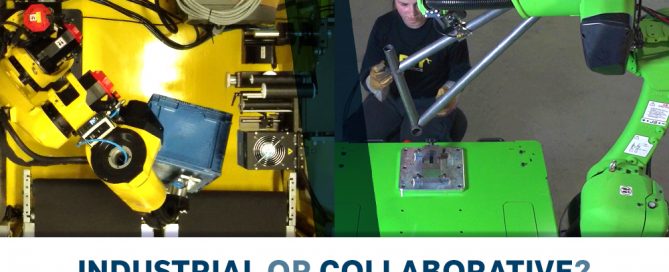
 Also known as Cobots, this style of robot is designed to work along with, or close to other human workers. These robots work with lighter materials, have a limitation on their movement speed, and come equipped with safety sensors to ensure safe interaction with nearby humans. Cobots are capable of a range of tasks including but not limited to pick and place, packing, palettizing, welding, finishing, painting, etc.
 In terms of modularity, our robotic cells can be configured by our experts according to your needs. Since a robotic cell would be interacting with other equipment or stations, it is incredibly important to ensure its composition is compatible with its surroundings. Examples include adding passages for a conveyor, openings to take products from a molding machine, doors for easy maintenance, etc. On a similar note, our cells can also be re-customized to work at another station or with another machine.
 At DIY Robotics, we take pride in our well-structured robotic cells. Each cell has been carefully constructed with welded and folded sheet metal to provide a strong frame without the use of aluminium or extruded metals. These cells have full capability of housing an industrial-sized robot and make no compromises to the robot’s acceleration and speed due to the strong and reliable materials the cell is composed of. Despite the strength provided, each cell is still light enough to be mobile around workstations. In other words, our cells are perfectly balanced between lightweight and heavyweight to handle all manufacturing processes while still being moveable. The cell’s metal components are also rust and scratch protected due to the long-lasting powder coating. Depending on the model of the cell chosen, transparent polycarbonate panels may also be equipped to provide a shatter-proof and scratch-resistant barrier from its workspace (a huge advantage over glass or polymer). If you would like more information regarding our robotic cells or would like to browse all available options, please feel free to visit our product page:

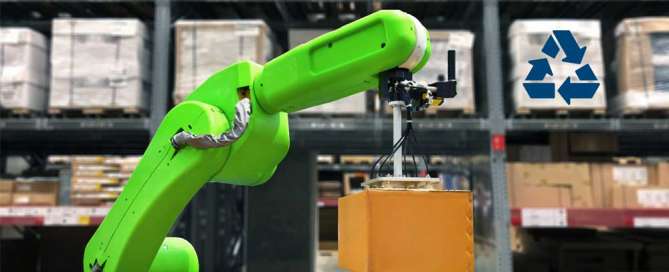
 Often, the type and style of an industrial robot are crucial in order to achieve a production requirement. This could involve a custom application, or other machines being dependent. A manufacturer who has already integrated robotic equipment into their production floor may need a replacement of the same model. Depending on how old the equipment is, it may have become obsolete and new robots are not available. A newer robot also may not be compatible with older programs or power sources; therefore, a company would have to invest more money having to upgrade their robotic system to accommodate for one machine. In these cases, the second-hand market would be the only option.
 When acquiring a second-hand robot, it is crucial to ensure that it is in working condition. Be sure to be aware of the total working hours as well as reliability with its previous owner. As stated above, be sure the previous owners are of a respectable company who conducted maintenance regularly and ensured the robot operated within its specifications. Another option is to perform diagnostics to check if the robot is in an ideal working condition (ex. FANUC Pro Diagnostic). Doing so will ensure the robot does not perform poorly or have any mechanical errors like backlash, vibration, motor failure, etc.
 A measurement sensor is a device that determines a distance or dimensions of an object based on the readings and signals from an electronic element. Depending on the type of electronic element, a measurement sensor can have several types. These include but are not limited to ultrasonic sensors, contact sensors, laser & optical sensors, and inductive displacement sensors.
 Next is the laser displacement sensor. Unlike the laser profiler, the laser displacement sensor concentrates its triangulation to convene at a single point, which results in an extremely accurate reading. A laser displacement sensor is more accurate than a laser profiler, but if a two-dimensional measurement is required, the displacement sensor won’t be as efficient (since it would need to measure the object point by point).
 Our robotic cells come in a range of sizes with customizable panels. Depending on your needs, our experts can develop and design the cell to ensure the robot will operate correctly and effectively. In other words, your robotic cell comes tailored to your specific robotic functions. An example would be adding passages for a conveyor to better incorporate it to your production floor. Our robotic cells also have the capability to house multiple industrial robots or machines, and can also be installed with your own robots in the case where your company is comfortable with a specific robotic brand.
 they are traditionally bolted to the ground and meant to focus on one task. To relocate the robot, it would consume a large amount of time and therefore increase downtime. Thankfully, DIY Robotics cells are completely mobile and can account for simple or complex changes in facility disposition. Due to this benefit, it is possible to add new cells to a production line at any moment based on a factory’s needs.
 Robotic cells provide a closed environment for the robot to operate within. This means no human intervention is possible without disabling the robot. According to the accessories added to the DIY Robotics cell (conveyor, drawer, vibrating bowl, etc.), it can also come equipped with additional security components. Robotic cells provide a closed environment for the robot to operate within. This means no human intervention is possible without disabling the robot. According to the accessories added to the DIY Robotics cell (conveyor, drawer, vibrating bowl, etc.), it can also come equipped with additional security components.
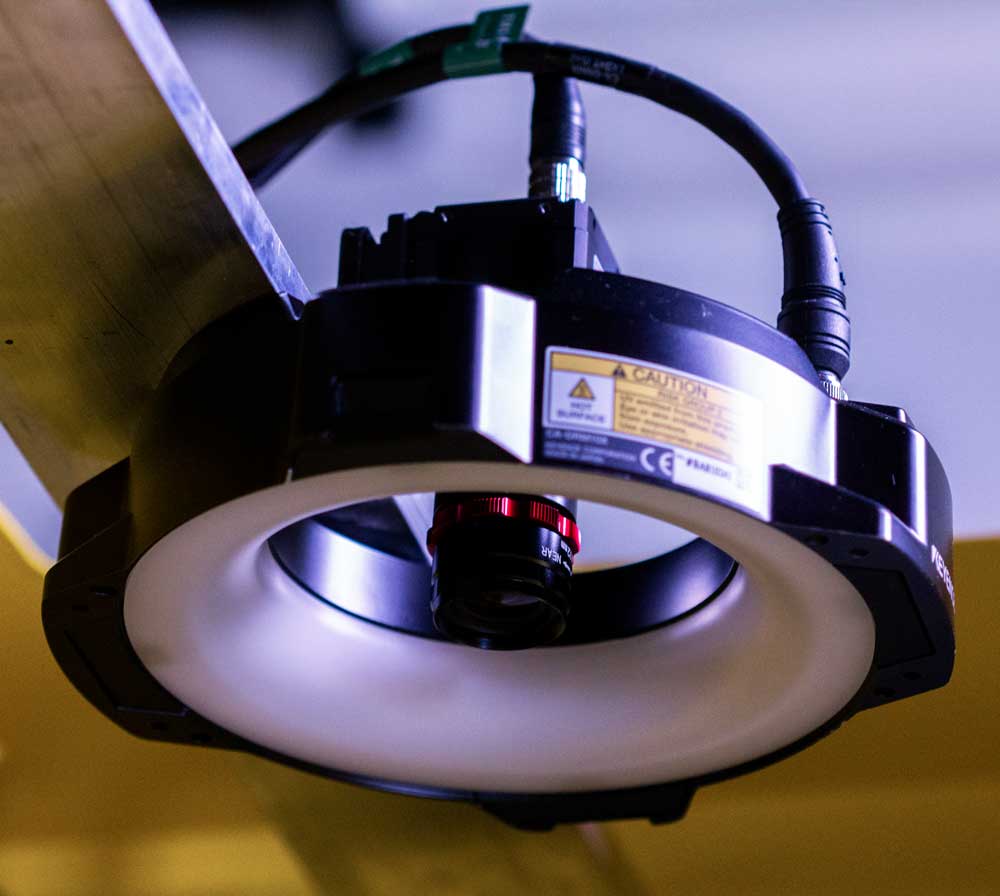 increase production efficiency, and reduce hazards. This can be achieved by integrating robotic automation within their production process. In order to achieve true automation, however, a robot needs to know what it is working with, along with its physical measurements in order to perform its instructed tasks. Such applications include but are not limited to identification, measurement, positioning, flaw detection, etc. This can be done through the use of robotic inspection, or machine vision. Machine vision uses sensors and software algorithms to complete visual tasks and guide the equipment during product assembly.
 3D vision systems are capable of sensing the height of an object. This type of vision system has multiple ways to create a 3D image. These include the use of multiple cameras which splice images together, structured light projectors which sense optical patterns and captures an ideal image, and laser triangulation to follow the profile of an object and create a digital geometry. Recently, manufacturers have begun to use 3D machine vision more due to its more accurate dimensional data. By using 3D vision, a robot can also sense variations in its physical environment and adapt accordingly. This feature is extremely useful for bin picking robots where objects are in random poses located in a container like a box. Hence, the majority of industrial robots work in the three-dimensional world.
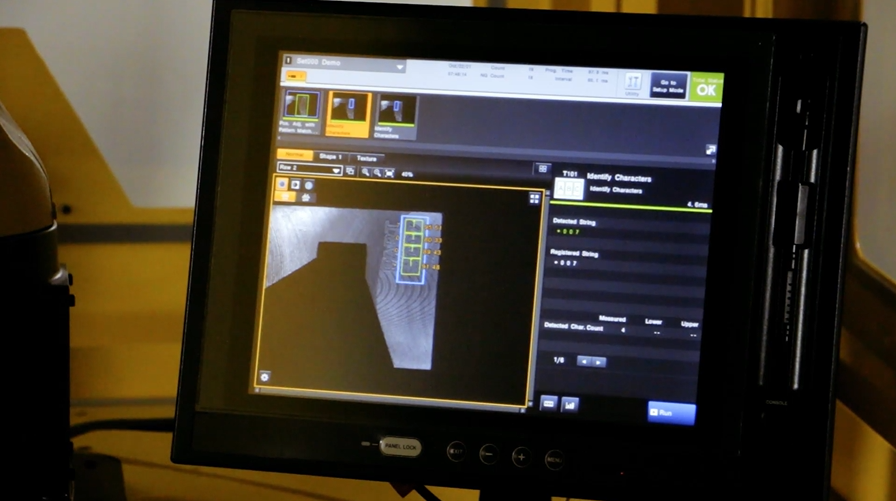 Vision systems have the capability to notice when there are errors or discrepancies between products. This could include incorrect physical structure (damaged or manufactured wrong), mislabeling of the products, etc. These errors cost manufacturers money when needing to replace or recall product.