window.dataLayer = window.dataLayer || []; function gtag(){dataLayer.push(arguments);} gtag('js', new Date());gtag('config', 'UA-141884085-1'); gtag('config', 'AW-761820283');

Blog

The Differences between FANUC LR MATE and FANUC CR ROBOT

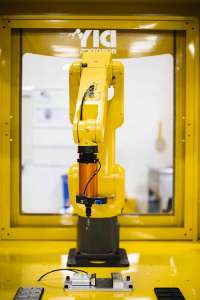
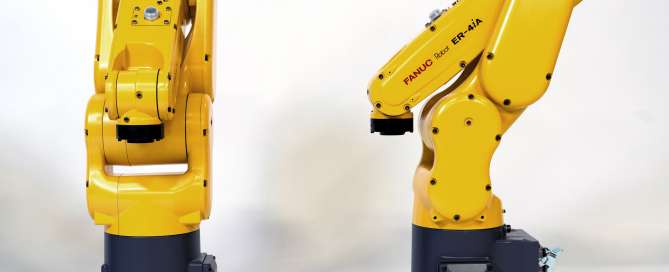
Each year, around 1.6 million twins are born around the world. Some are identical and some are not. But even identical twins are not completely identical. The same could be stated regarding the FANUC CR robots and the LR Mate series robots. They may look like twins because they share similar physical designs with very little differences, but they are both quite different in many aspects. The major difference can be noted in their working speed, environment, and safety.

To better understand the FANUC LR MATE and CR Robots, we should review their capabilities, similarities and differences.

FANUC LR MATE SERIES

The LR Mate Series is a robot the size of a human arm and has a load bearing capacity of maximum 14kg weight across its range. It is compact and used for quick maneuvers and part processing in various industries ranging from food to automotive.

They can come with different options tailored to the work they do, altered according to the client’s requirements. We will now look at the specifications and major characteristics of the LR Mate Series:

  • Floor, Ceiling, Wall and angle mounting robots
  • Can work alongside other robots in close proximity due to its smaller work envelope
  • Sensors, camera, and other attachment options
  • Reaches up to 911mm
  • Internal cable routing
  • Short cycle times (speed up to 4000 mm/s)
  • Work envelope remains constant irrespective of mounting
  • 5 and 6 axis robots

The FANUC LR Mate Series is used for applications such as dispensing, pick and place, assembly, machine-tending, welding, painting, and many others depending on its field of application. Due to their high speed and accuracy, they increase the precision and throughput of the production. All these above-mentioned reasons have increased the popularity of the LR Mate Series among various industries. So far, they have shown remarkable usage growth in the metal and food industries as well.

FANUC CR ROBOTS

The name CR itself stands for Collaborative Robots. So, the FANUC CR is basically the LR Mate Series turned collaborative with some modified features. Therefore, the FANUC CR Robot is capable of safely working alongside humans in a production line. The highlight features of the CR Robots are as follow:

  • From 550 mm to 1813 mm in reach capacity
  • Maximum speed up to 1000 mm/s
  • Less floor space occupancy
  • Devoid of safety fences due to
  • Customizable settings for speed and safety
  • Compatible with a wide range of attachments like cameras, sensors, etc.
  • Highly reliable
  • Only comes in 6 axis variant for more control

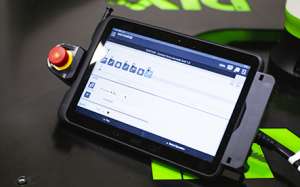
The FANUC CR Series is equipped with a safe contact stop sensor technology which enables it to stop immediately when the robot is in contact with a person or an unidentified object. This makes it highly safe for humans to work around it without any safety fences. Moreover, for extra safety, we can manually regulate the speed and safety settings. The FANUC Teach Pendant gives access to a step by step process to set up CR robots for new and acquainted users.

FANUC CR Robots can safely handle tasks like palletizing, pick and place, applying sealants, painting, lifting/placing heavy components, assembling, quality checks, and machine-tending.

Now that we have seen the features of both the FANUC LR MATE and the FANUC CR robots let’s compare them to see the differences:

FANUC LR MATEFANUC CR ROBOT
Non-Collaborative robotsCollaborative robots
Come in 5 and 6 axes modelOnly come in 6 axes model
±0.01mm repeatability rate±0.03mm repeatability rate
Cannot work in close proximity with humansCan work alongside humans without causing any harm
Need safety fencesDo not require safety barriers
Light in weightHeavy in weight compared to LR Mate
Auto stop option not availableAuto stops when in contact with a person or any fixed object
Speed up to 4000 mm/sSpeed up to 1000 mm/s
Reach up to 911 mmReach up to 911 mm

These features and limitations of the FANUC LR MATE and the FANUC CR Robots make things really clear when manufacturers need to select the correct model according to their requirements. The wide range of products provided by FANUC thanks to its LR Mate and CR robots makes it easier to spend exactly on what is required and get customized accessories to cater to their needs. The new trend around collaborative robots tends to make them attractive, but their performances are less effective than traditional robots.

Therefore, before opting for a cobot, take the time to figure out if a collaborative application is really needed or if an industrial robot in one of our pre-secured robotic cells could do the job with a better output. Discover more about our Collaborative Robotic Cells and Modular Robotic Cells on our product pages.

References

Possible robotic applications for the metal industry

The metal industry is one of the biggest revenue-generating industries in today’s economy. It impacts various end-user applications and caters to a vast range of sectors: agriculture, automotive, medical, aerospace, construction, electronics, and many more. As it is such a huge industry, it needs automation to meet the standards and production rate of the demanded supply.

Robots accomplish various jobs in the metal industry. These tasks can vary from part handling to welding, assembly, painting, and cutting.

Let’s delve into some of the automation possibilities that robots can handle in the metal industry:

Part Handling:

This is one of the most common, yet one of the most necessary usages of robots in the metal industry. Part handling is basically picking either raw material or a finished product from one spot and placing it in another designated spot. It can also involve the robot operating with another machine like a forming press, a CNC, etc. Tasks included are, but are not limited to

  • Selection of parts
  • Reorienting
  • Sorting
  • Operating with classic metal industry machine (Press, Laser cutting, Plasma cutting, etc)

It allows the handling of large, heavy, and dangerous objects safely on a large scale and at a fast pace. Moreover, it provides high repeatability and efficiency with minimal changeover time between products.

Robotic Deburring:

Deburring is a necessary and important step in the metal industry as this makes the product more client-ready. This means high repeatability is needed for products to be consistent. When done by humans, errors increase and repeatability decreases. Automation helps manufacturers yield higher profits in a medium to long-term perspective. Robotic deburring also improves the quality of the produced part thanks to the fact that the robot’s settings and toolings can be customized according to each of the part’s requirements and be compliant with some part variations. This helps minimize defects.

Have a look at our DIY-Robotics Deburring Cell Bundle, developed in partnership with ATI Automation and RoboDK.

DeburringCell_Blog_MetalIndustry

Robotic Painting:

Metal painting has always been a health hazard for humans as it involves toxic components. Thankfully, robotizing this task helps reduce risks for workers. Also, robots have more consistency and precision than humans when applying paint.

In the automotive industry, some robots are used for paint jobs. GM motors and Volkswagen are good examples of this. Robots can do the initial primer, electrostatic, and final coat of paint in a short amount of time. They offer high flexibility, high quality, more control over the process, and all the while, decrease paint and material costs.

Robotic Welding

Welding is an operation where precision and consistency are both very much required. Due to this demand for precision, robotic welding has been a part of the metal industry for a long time.

Robotic welding guarantees high quality and high quantity welding with accuracy and repeatability. There are different types of robotic welding: laser, plasma, arc, TIG, MIG, and others. This technology saves industries both time and money. On top of that, it also helps reduce waste. All this makes it an expensive, but necessary investment. This is especially true for industries with small to medium-scale productions which have suffered a shortage of workers in recent years.

Welding_Blog_MetalIndustry

Some alternative solutions like the Robotic Welding Assistant have a better ROI for smaller productions that would like to automate more. It’s a collaborative solution that saves industries from hidden costs and it is ready to install and start-up.

Robotic Cutting:

Robotic cutting allows for high precision and higher quality cuts, irrespective of the complexity of the cutting blueprints. Some of the technologies used for robotic cutting are laser, plasma, waterjet, and others. Robotic cutting helps workers avoid working with high temperatures cutting and they even accelerate the process.

Robotic cutting is currently used mostly in the automotive, electronics, and sheet metal industries.

Robots are contributing more and more to the industrial revolution by doing mundane and repetitive work. In this blog, we only discussed a few Robotic Applications. There are many other robotic possibilities for the metal industry such as assembly, machine-tending, and quality checks. That last one is especially pertinent in a manufacturing industry of the automotive sector. With the development of Artificial Intelligence (AI), robot’s capabilities are increasing. The horizon is still expanding and there is still much more to go until we can maximize the usage of robots.

References

Part Entry Accessories for Robotic Cells – part 2

Thanks to the first section of this blog, we know that part-entry accessories are a great complement to an industry’s automation because they make it more profitable.

Next, we will look at part entry accessories when bulk feeding is not an option, and when a feeding mechanism is not restricted by the shape and size of the parts. So let’s get into it:

The Drawer:

We know what a drawer is in our kitchen house, and this drawer system is based on the same principle. An operator opens the drawer, feeds the part in before closing it to give it to the robot. Then, the robotic arm from the other side of the drawer collects the part, processes it, and puts it back. Drawers can be used for parts of all shapes and sizes. It is a perfect solution for offline productions that require the loading of parts by one or many operators.

Drawer_By_DIYRobotics

It is important to consider the robotic process before choosing this option. Multiple drawers can allow more efficiency and reduce downtime. That kind of configuration allows the robot to work on one drawer while the other is in the loading process by the operator.

Benefits:

  • Can house a vast range of products
  • Multiple customizable options (single or double)
  • Allows operator to work simultaneously on different drawers
  • Allows uninterrupted continuous production
  • Isolates the operator from the machine’s working space
  • Isn’t dependant on the parts’ geometrical symmetries

Some of the industries that use this feeder are metal, plastic, automotive, electronics, and pharmaceutical. Both single and double options are well known among industries.

Get a drawer for your DIY Robotics cell with the Lightbeam add-on.

The Rotative door:

This Rotative door allows operators to add or remove parts from the robot’s secure working space. These doors are helpful as they give operators uninterrupted access to the machine and can allow them to work simultaneously with the robot each on their own side of the door. This makes the part entry really quick and efficient. The selection of this part entry accessory depends on factors like operator safety, part shape and size, and production cycle time.

Benefits:

  • Used across variable part dimensions
  • Allows simultaneous work for both operator and machinery
  • Efficient and cost-effective solution
  • Safe for operators

All this makes it ideal for machinery maintenance and ensures secure access for the operator. Rotative doors are used in the automotive industry, metal industry, plastic industry, and many more.

Get a rotative door for your DIY Robotics cell with the Orbit add-on.

The Conveyor:

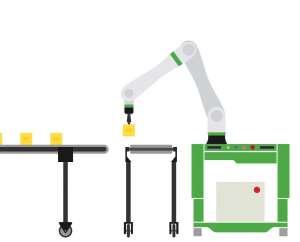
Conveyors are long moving tracks made of various materials (belt, roller, o’ring, air, etc.) that transfer parts from point A to B. The belts can be made of rubber, metal, plastic and can even be slotted. The selection of this accessory depends on the job the conveyor does and the requirement of the part. For example, if a certain number of finished parts need to be packed, a cleat conveyor can drop the finished parts from the slot into the packaging material. If any raw material needs to be taken to another level, a rubber conveyor could be chosen for better traction, a metal conveyor for spiral inclination, or a slotted one to separate the parts. The most important advantage of this part-feeding technology is that it can be used for any part irrespective of its shape, structure, orientation, weight, or material. This makes it popular across a vast array of industries.

Benefits:

  • High-speed feeding system
  • Compatible with most robots and machines
  • High accuracy and durability
  • Low, easy maintenance
  • Orientation does not affect feeding
  • Low-cost material handling

This technology is used in a wide range of applications such as, marking and coding, packaging, material handlingrobotics, assembly, rubber, and many more. 

SMEs can use these part-entry accessories for their changing production lines and gain a competitive advantage over larger industries.

SMEs should consider investing in part-entry accessories as it allows them to utilize their labor force more efficiently and increase their production throughput by automation. This one-time investment can help gain long-term profits and reduces the ROI time slab.

Contact us for more information about the part-entry accessories that best suit your needs.

References

Part Entry Accessories for Robotic Cells – part 1

According to the RIA (Robotic Industry association), in 2016, 34,606 robots were installed in North America alone. The main purpose of having robots in an industry is to reduce laborious, repetitive, and dangerous tasks. But to perform what they are intended to do, robots need material and parts to be fed in. This is where part entry accessories come into play. Automating this step helps industries utilize their workforce in other, more productive work.

What is a part entry accessory?

Part_entry_accessories_FeederBowl

As the name suggests, part entry accessories are used to enter raw materials into the assembly line and fetch the finish parts. They are mainly used for inline production to present parts in a specific orientation to the automated machine.

These robot accessories are required when the robot uses bulk parts that need to be presented in a specific orientation. Using these accessories reduces downtimes, the risks for operators, and part mishandling.

Let’s go through some of the most common part entry accessories:

Vibratory feeder bowls:

These vibratory feeder bowls are self-sufficient feeder systems customized according to the supplied part. They comprise a bulk hopper, vibratory mechanism, feeder bowl, a controlling system, and a vibrating track to present the parts to the robot. Parts are fed into the bowl via a hopper and moved across the outfeed track to the part outlet. They can usually sort and process up to 45 to 60 parts per minute. It is used in assembly lines to feed a machine with small randomly sorted individual parts oriented in a particular direction.

Before choosing this option, it’s important to consider the size, the mechanical structure, and the behavior of the parts that will be handled. The reason for this is that vibratory feeder bowls are best suited for symmetrical geometry parts to ensure a specific alignment. When in function, the part moves from the bulk hopper to the bowl, and then, the part to be fed passes through the outlet and is delivered to the desired location.

Benefits:

  • Cost-effective
  • Variable feed rate
  • Customizable bowl
  • Different working mechanisms to suit the requirements
  • Fewer product damages
  • High efficiency and repeatability
  • Bulk part possible
MA-DIY_bol_vibrant

This makes it popular in various industrial sectors: automotive, pharmaceutical, electronics, metal works, and many more, and for products such as screws, nuts, food packets, raw material for glass, etc.

Flexibowl:

The name itself reveals a lot about the feeding system. Instead of using a vibratory method, the Flexibowl segregates the parts using a servomotor that can go in both directions, and an impulse generator. It is perfect for irregular parts irrespective of their dimensions. When separated, parts are collected by the robot using a vision system to locate the parts.  The Flexibowl allows three simultaneous activities: dropping, sorting, and picking. It can feed up to 80 parts per minute and it is perfect for production lines with quick products changes.

Before choosing this part-entry solution, it’s important to consider the dimension and the geometry of the parts, the material, and the resistance

Benefits:

  • High throughput
  • Reliable and efficient
  • Low maintenance
  • Quick product changeover possible
  • Easy to install
  • Bulk feeder allows multiple parts feeding
  • Possibility of having 2 different parts in the same bowl

This type of feeder accessory is ideal for non-rigid materials, electrical components, and irregular parts. It is widely used in industries like cosmetics, automotive, and medical.

Flexible Feeding System (vibrating table):

This system is basically a table or a disc that, unlike vibratory bowls or Flexibowls, vibrates in all three directions to re-orient the parts. After that, a robotic arm fitted with a camera picks up the correctly oriented parts from the vibrating table and places them in the desired place. This part feeding system is compatible with 99% of parts irrespective of their complex structural geometry or materials. This flexible feeding system works on the principle of 3-axis vibration technology allowing a high efficiency, a maximum orientation change, and minimum damage to the parts.

Even if this solution is really versatile, it’s important to consider the size and the geometry of the parts to handle before choosing a vibrating table.

Benefits:

  • Accurate part identification
  • Easily configurable
  • Organized part orientation

This accessory is widely used in various industries from electronics to watchmaking and medical.

Even though the part entry accessories discussed above are in one way or another dependent on the mechanical structure of the part they feed, they increase the production throughput and allow better time management. Thus, even if these above-mentioned part-feeding accessories are famous in the industry, there are various kinds of part feeders available on the market. The ones named in this blog are just a few.

Stay connected to be the first to read our Part Entry Accessories for Robotic Cells  – part 2 in a few weeks.

References

Why a machine-tending robot?

Sometimes it’s better to break down complex words to understand their meaning. Let’s do that with the word: Machine-Tending. The first part of the term is Machine. We probably all know what the definition of a machine is. As for the second part of the term, tending refers to the act of carefully providing for someone or something. So, those two words together and in the context of industrial automation, refer to the loading or unloading of parts or material on a machine.

Robotic Machine-tending:

Machine-tending is one of the most basic automation required by any job, shop, or manufacturing unit. Traditionally, operators feed in or remove the parts or material from machines. Though most of the industries are currently using humans as their machine-tending tools, that is changing. Thus, machine-tending robots will replace these operators and make them available to do more complex work.

robot machine tending

On top of basic loading/unloading of parts or raw materials, machine-tending robots are also capable of doing more complex work: picking up parts from a supply area and placing them on a designated machine, but also performing secondary applications, such as assembly, cutting, and inspection.

Applications:

With a wide array of parts that can be handled, ranging from a tiny pin to a large refrigeration system, there are various applications where machine-tending can be used:

Machine Tending Application
  • Loading products in a CNC, milling machine
  • Holding parts for welding operations
  • Grinding, stamping, and punching

Benefits:

Due to their wide range of applications and working capacities, machine-tending robots offer many benefits.

  • Can reduce strain and accidental injuries to operators due to repetitive, dangerous work
  • Increases production, quality, production rate, and consistency
  • Fast change over between products
  • Lower operation costs with a quick ROI
  • Customizable with various robot grippers, enabling it to work in continuously changing product ranges
  • Capability to work secondary operations
  • Increases system and manufacturing line uptime
  • Round the clock manufacturing capability as no fatigue can affect the production
  • Requires minimal maintenance and assistance
benefits

Choose Right, Choose Best:

To select the best machine-tending robot for a specific industry, certain things need to be taken into account. The selection process takes various factors into consideration :

  • Type of industry and machine on which the robot will be working
  • Investment budget
  • Shape, size, and weight of the parts to be handled
  • End effector grip tools requirement
  • Required speed for the task
  • Maximum payload of the robot
  • Vise, if needed
  • Multi-machine work capacity
  • ROI of the machine-tending robot
  • Robot limitations and work envelope

There are various companies on the market providing customizable machine-tending robots and robotic cells. Moreover, machine-tending robots help SMEs utilize their machines to their maximum capacity. It is very important to select the best suitable machine-tending robot to maximize profits. This helps SMEs gain an advantage over large-scale companies. So, by correctly choosing the machine-tending robot, companies can compete in this evolving market. It automates the industry with minimal investment and helps them maximizes their throughput.

If you have a hard time choosing the best machine-tending robot for your project, feel free to contact us.

References

What to know about pick and place robots

Haven’t most of us, during childhood, once hoped for a robot that could pick up our toys, place them back and organize them so that our parents wouldn’t scold us for making a mess? Today, it has become reality. Although robots are not yet picking and placing items in our homes, they are doing so in our factories.

Let us try to expand our horizons, by understanding pick and place robots.

What? How?

A robot that is used to pick items, place them in a desired spot, and in a desired manner is called a pick and place robot. Commonly used in modern manufacturing environments, pick and place robots automate and speed up the process of picking up and placing items in their location. Pick and place robots accomplish all repetitive tasks and help in increasing the production rate.

Types:

There are several types of pick and place robots. They vary depending on their arm extension and the work that they are supposed to accomplish:

Articulated

This is one of the most common varieties of pick and place robots. They come in two different variations: 5-axis and 6-axis. 5-axis robots do not have complete freedom, whereas 6-axis robots do. This allows them to efficiently accomplish complex tasks and easily orientate parts in different axes.

Cartesian

The Cartesian robot is also known as the Gantry robot. It comes with three prismatic joints and axes that coincide with the cartesian coordinates. They are easy to program, easy to use, and have a cubical workspace. Due to their high speed, they are one of the most famous industrial pick and place robots.

Collaborative Robots

Collaborative robots are safe for humans and thus, can share a workspace. Their safety sensors, safety features, rounded edges, limited speed and force make them safe for humans to be around. They can do simple tasks such as pick and place or complex tasks such as material sorting with different payloads.

Delta

With its state-of-the-art vision sensors that identify and sort objects, this is one of the most advanced types of pick and place robots. These robots achieve high speeds thanks to their unique dome-shaped workspace envelope. They are usually mounted over conveyors for better positioning and mobility.

Scara Robots

Selective Compliance Articulated Robot Arm (SCARA) move in all three dimensions (X, Y, and Z) and even have rotatory motion. They are four axes robots and lack the twist and swing from the six axes robots. They have a cylindrical workspace, mostly contained in the front and the sides, with some exceptions on the backside. They are one of the fastest types of robots and therefore used when the reduced cycle times are critical. Best used for pick and place, but also very useful for screw driving and dispensing applications.

Why and where to use Pick and Place Robots?

Pick and place robots are used for different applications and, as they are flexible, can be changed from one station to another on the production line within no time. Some of their applications are:

icone_Assembly
Material sorting
Inspection

Assembly

Packaging

Material sorting

Inspection 

The main reasons to use pick and place robots are to reduce laborious and repetitive tasks for humans, and speed up the production process. As per a study by OSHA (Occupational safety and health Administration), pick and place robots help in overcoming musculoskeletal disorders that account for nearly 33% of all work injuries.

With only minor changes, the same robot can be used to perform various operations. This being said, their dimension, movement, and product handling end effector do limit them. Thankfully, they require minimal maintenance despite their sophisticated technology. As they are more cost-effective than other automation technologies on the market, pick and place robots enable companies to gain a competitive advantage and maximize productivity.

References

Why a Robotic Welding Assistant?

As it is rightfully said, “You may design something in steel but to make it, you need to know how to manipulate the material. On a sheer technical end, you have to know how to weld steel.” – Brian Slocum

What Is welding

Welding is a fabrication process in which materials such as metals or thermoplastics are joined. It uses heat to melt the joints of the desired parts. The cooling that ensues causes fusion. Welding is different from brazing or soldering where the base material does not melt. There are different types of welding. All of which can be clubbed under two broad categories such as Manual welding and Robotic welding.

What is Robotic Welding?

Robotic Welding

Automated welding, also known as Robotic welding, is the process of fusing two materials thanks to mechanized programmed tools. The many advantages of Robotic welding are: Weld quality, waste reduction, high efficiency, quick lead times, superior repeatability, and high output. This being said, there are disadvantages too. Robotic welding has a high initial cost, necessitates more advanced programming skills, can lack flexibility, and requires more space. Also, this type of welding causes a huge change in floorplans and is not suitable for production lines that require frequent changes. Over and above, automatic welding processes require the built and use of a mechanical jig specific to the shape of the product, therefore limiting the flexibility of the cell. These downsides have led automation welding to be concentrated mostly in large-scale industries.

An accessible solution

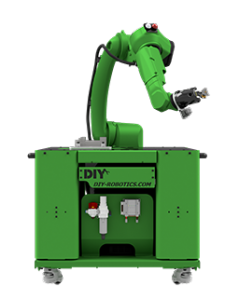
The Robotic Welding Assistant (RWA) by DIY-Robotics can help small and medium-scale industries in automating their plants by overcoming the disadvantages of automated welding. It is easy to program, cost-effective, faster, and consistent. Overall, it increases productivity. Now, let us see what the future holds in terms of automated welding for small and medium-scale industries.

Symbiosis Relation

As the name suggests, the RWA assists the welder. It does the work of a JIG and a human. It not only helps the welder with symmetrical parts, but it also helps with asymmetrical or irregular surface welding. This symbiosis relation makes for a safe environment in which humans can work with robots.

Third Arm

Third Robotic ArmThe RWA is a plug-and-play robotic cell that acts as a third arm. It holds the part in a fixed position, as the operator welds. Moreover, Fanuc robots’ 360° maneuverability helps in optimizing the work and safely prioritizes a horizontal welding position for the welder.
Budget-Friendly Solution

Traditional robotic welding equipment setup typically costs over 100 000 USD.  Adding to that, let’s not forget that this number blows up when associated costs such as labor, energy, material, factory setup, and installation are taken into account. The Robotic Welding Assistant however, starts at 74 000 USD and requires minimal programming skills.

Versatility

Small-scale industries deal with a large variety of customers and small quantities of products. The right solution for these industries needs to not only be budget-friendly but also flexible to fit and change from product to product in less time and with less floor space. On top of offering some of the features a huge welding robot would, the RWA has other features:Robotic Welding Assistant

  • Joystick control for easy movement control
  • Safe Human-centric design, horizontal welding position
  • Consistent results with 100% accuracy
  • Versatile ergonomic welding capability
  • Compact Design architecture; fits in the current factory floorplan
  • Variable payload capacity

A great solution for SMEs

The Robotic Welding Assistant by DIY-Robotics is a go-to solution for any small to medium-scale industry. With minimal investment, this solution answers all your welding requirements without imposing any major changes in your current factory floorplan.


References

  • A. T. &. Machine, “What are the Pros and Cons of Robotic vs Manual Welding?,” AAA Tool & Machine, 08 09 2019. [Online]. Available: https://aaatoolandmachine.com/what-are-the-pros-and-cons-of-robotic-vs-manual-welding/.

  • C. E. Bennett Brumson, “Robots For Small Business: A Growing Trend,” automate, 31 10 2003. [Online]. Available: https://www.automate.org/industry-insights/robots-for-small-business-a-growing-trend.
  • D. Robotics, “ROBOTIC WELDING ASSISTANT,” DIY Robotics, 20 05 2021. [Online]. Available: https://diy-robotics.com/robotic-welding-assistant/.

  • F. F. /. T. Knell, “How does laser welding work? Costs, advantages & disadvantages,” maschinenmarkt international, 24 08 2019. [Online]. Available: https://www.maschinenmarkt.international/how-does-laser-welding-work-costs-advantages-disadvantages-a-857309/.

  • O. S. Amar Chinchane, “Robotic Welding Market,” 30 11 2019. [Online]. Available: https://www.alliedmarketresearch.com/robotic-welding-market.
  • Wikipedia, “Welding,” 15 05 2021. [Online]. Available: https://en.wikipedia.org/wiki/Welding.


Cobots: Pushing the Boundaries

The benefits of 3D printing in robotics

With 3D printing, Complexity is free. The printer doesn’t care if it makes the most rudimentary shape or the most complex shape, and that is completely turning designing and manufacturing on its head as we know it.

— Avi Reichental (CEO of 3D systems)

What is 3D printing?

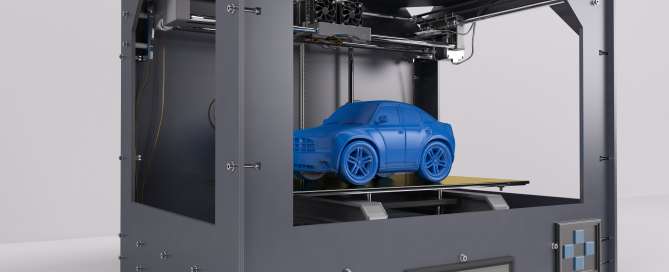
Additive manufacturing, also known as 3D printing, turns digital files into 3D physical objects by adding material in a layer-by-layer process. Each layer can be seen as a very thin sliced cross-section of the object. Unlike the subtractive manufacturing method where a piece of plastic or metal is cut out, 3D printing gives everyday consumers the power of manufacturing.  

Now, let’s dig deep into the benefits of using 3D printing in Robotics:

On a broader level, 3D printing aids prototyping, tooling, fabrication, and lowers cost and time to market. It is of great use for robotic engineers to achieve their goals. It accelerates product design, and reduces cost and waste. In doing so, it increases the flexibility to create more complex designs. This technology enables us to mass-produce customized products for customers.

3D Printing exemple

Speed:

The time frame for designing, manufacturing, and testing parts used to take months. 3D printing reduced that to a few days. It enables the user to design any kind of complex part without the need of a warehouse and expensive machinery. This modern production method easily reduces long lead times for the outsourcing of complex manufacturing projects, as well as the constraints of the minimum order for customized parts and products. As per the EY39% of companies in the manufacturing and Robotics industry now prefer 3D printed tools to enhance their products.

Cost:

Unlike traditional methods of CNC and injection molding, 3D printing reduces trial and error in designing, the cost of expensive machinery, and labor. Also, creating a product from the ground up, instead of carving it out from the block of material, reduces waste.

Ergonomic Designing:

Ergonomic Design - 3D Printer

Using the same 3D printer, designs can be produced irrespective of the part dimension or complexity. This allows the designing and manufacturing geometries impossible for the traditional methods such as parts within parts as a single structure and hollow cavity inside a solid joint free part. (No other way to say this?) It allows anyone with very little know-how of CAD to work and edit designs as per their needs. They can also work with multiple materials in the same object, giving them the chance to mix the mechanical properties and textures.

Tangible Product Quality check:

The life cycle of product manufacturing is reduced, thanks to the low cost and high-speed production rate of additive manufacturing. A physical prototype can be tested for flaws, corrected, and printed immediately the next day allowing for quick product improvements. This helps in getting accurate feedback from potential investors and consumers. This step-by-step production guarantees faster enhancement in the production design and better quality parts or products.

Consistency:

With 3D printing, parts are manufactured in succession. Each part can be monitored and real-time faults can be checked. The result is less waste and failed parts during production. Increasing the consistency of best quality parts by testing product prototypes beforehand reduces the risk of potentially disastrous investments.

Consistency in 3D printing

Accessibility and Sustainability:

3D printing is almost entirely automated. It requires little or no additional staff to operate, supervise, and manage the process, rendering it far more accessible than other manufacturing processes. As a result, contrary to the conventional production setup, its setup is quite cost-efficient.

In Conclusion, by developing better tooling, leveraging design freedoms, customizing robots, accelerating time to market, and being user-friendly, additive manufacturing enables the robotics industry to, like others, take advantage of producing volumes with fewer upfront costs and more efficiency gains. This, along with the multitude of applications 3D printing can provide to the robotics industry, makes for a very innovative future.


What makes FANUC Robots a Good Choice for DIY solutions?

The arrival of the first robots in this world was inspired by Mother Nature and different species of animals including humans. There are 30 different kinds of muscles in a human hand, and many complex functioning goes behind a simple task such as lifting a cup of water. However, we laymen don’t need to understand the mechanics of the hand to get all the complex work done with them. The same goes for FANUC robots as for a DIY solution.

Think of the FANUC robot as the muscles and DIY-Robotics as your hand. You do not need to know how the FANUC robot is programmed to get your desired work done. Let us identify the benefits of using FANUC robots in DIY solutions at the existing factory setup:

1 | Easy to Operate

Operating FANUC robots can be as easy as moving a hand. As they come preprogrammed, we don’t need to worry about its coding to operate it. You can also modify it to do different tasks at the assembly line with just some easy minor changes in the hardware and software. FANUC Robots are easy to fit in within the current footprints and factory layouts helping any business, whether it is automotive, packing items, or precision work such as watchmaking to have:

FANUC CRX Controler

  • Less downtime
  • Increased productivity
  • Better support and services
  • Deliver targeted product goals with precision
  • Low maintenance
  • Application-specific options
  • Range of payload and reach capacity

Today’s world is all about getting more productivity in less amount of time, money, and space. Choosing FANUC can fulfill all these aspects for your benefit.

2 | Flexibility

It is always said that work done by yourself gives you the best output and flexibility. Here is where the flexibility of FANUC robots helps to get the best whether it is saving money, saving time, or getting high production with quality outputs. With over 250 specialized software functions available, FANUC makes the customization easier, and along with our DIY-Robotics modular cells, gives you the option to make your design by choosing the modular panels that fit your needs.

3 | Compatibility

Sixty years since its foundation and, with more than 4.4 million CNC controls and 680,000 robots installed worldwide and still counting; FANUC has become the leading global manufacturer of factory automation. FANUC’s diverse reach in the global market makes it more feasible to connect to a DIY-Robotics cell. This makes your modification process quick and joint-free, giving the flexibility, payload, and reach capacity range as per your needs. FANUC Robots are compatible with almost all the other tools present in the market, making them the most accessible in terms of installation by yourself. Plugging and playing around with FANUC is just like playing with LEGO toys. FANUC Robots can plug and play with the existing factory design giving maximum output optimization in minimum changes made. These robots can do various applications, which includes as under but is not limited to:

FANUC Compatibility

  • Pick and place
  • Assembly
  • Cutting
  • Material application
  • Inspection
  • Palletizing
  • Dispensing and sealing
  • Material removal

I think this section should focus on the fact that FANUC controllers are very present in various industries, whether on a CNC machine or an injection molding machine, making it all the easier to connect to a DIY-Robotic cell.

4 | Lifetime Reliability Guaranteed

In addition to DIY-Robotics offering unlimited free support for their products, FANUC also offers lifetime support for their product throughout its life cycle no matter how old the robot is. FANUC being the only robot manufacturer to design and manufacture all its products’ components in-house also helps in giving superior quality products, functional reliability, and availability of products at the highest levels. With over 20 parts centers in Europe itself and a worldwide network of its parts store, they ensure 24/7 parts dispatch, limiting downtimes in your operations and giving guaranteed 100% performance service.

FANUC

FANUC IconThe name itself sells the product. It is very easy to find integrators for FANUC, being the leading brand in the robotics market. DIY-Robotics is not only an Authorized FANUC System Integrator but can also get you in contact with various integrators with different specialties around the world. Everything your robotic project requires, from FANUC robots to Certified Integrators, and custom components for your needs, is available at a one-stop solution platform called DIY-Robotics.

Choose Wise — Choose FANUC — Choose DIY-Robotics