
window.dataLayer = window.dataLayer || []; function gtag(){dataLayer.push(arguments);} gtag('js', new Date());gtag('config', 'UA-141884085-1'); gtag('config', 'AW-761820283');

Blog

What are The Industrial Robotic Trends in 2021 And After?

The future of industrial robots looks very bright as many companies are looking to automate their production lines, especially with the COVID-19 pandemic. According to a report from Reportlinker from November 2020, industrial robotics which is the top segment in robotics, is about to experience a compound annual growth of 18.2% with revenues growing to $176.8 billion in 2025 from $76.6 billion in 2020.

Here are the top 5 emerging trends in industrial robotics in 2021 and after.

1 | Smart Industrial Robots
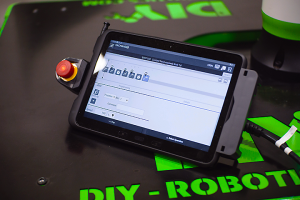
Smart industrial RobotsIndustrial robots are now able to communicate with each other without any human support. With the increased digitization of robots by harnessing the power of the internet, robots can now be programmed to independently communicate with each other which increases the efficiency and speed of manufacturing. Manufacturers are also able to leverage real-time data analytics to improve production and help in making business decisions as well.

2 | Robots to Work in Small Factories

While we are accustomed to big specialized robots in assembly lines, they are expensive to install and are not suited for small factories. The future calls for small robots connected to the same network and AMRs (Autonomous Mobile Robots), which are easier to fit in small factories. They are equipped with navigation technology, making them mobile and more flexible than traditional industrial robots.

Once they are done with their tasks, you can reprogram them for other uses instead of dismantling them. This encourages new markets to automate their processes, such as in the food and beverage industry. Companies like DIY-Robotics offer predesigned, modular, and mobile robotic cells that can be integrated into any production line and moved to the next when needed. These robots are very different from traditional industrial robots that were huge, expensive, and needed to be built on sight thus requiring a lot of effort during installation.

3 | Robots That Reduce the Carbon Footprint

With the growing sensitivity towards climate change, investments in robotic technologies that leave a smaller carbon footprint will be expected to grow. The robots of today and the future are more energy-efficient,  and therefore require less energy to perform similar tasks to other energy-consuming industrial robots. They also have a higher precision rate which produces fewer rejects and below standard goods that have to be disposed of.

4 | Collaborative Robots
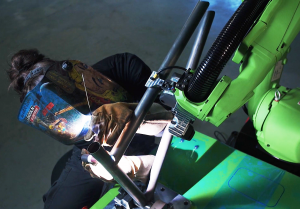
Collaborative Industrial Robot

The focus on industrial safety is one of the trends in 2021. This is especially key when it comes to collaboration with humans working hand in hand with industrial robots on the same assembly line without the need for safety barriers. Human-robot collaboration has been improved by the advancement of software, sensory capabilities, and end-of-arm tooling (EOAT) which give industrial robots the capability to detect changes on the line and respond quickly and safely.

These collaborative robots are known as Cobots and are one of the fastest-growing trends in industrial robotics. This is because they are not only collaborative and safe but also easy to program, quick to set up and allow for flexible automation.

5 | Industrial Robots Securing the Supply Chain

The COVID-19 pandemic has not started any trends in robotic technology, it has just accelerated their use beyond what was thought possible. The future of industrial robots belongs in helping fix and stabilize the supply chains that have been severely exposed by the pandemic. Automation of processes will only increase especially in markets in high-wage countries. Doing so will increase their flexibility in the production lines as well as ensure stability and security during uncertain times.

Conclusion

The robot revolution has just begun and we expect to see more investment and attention in this area in the future. Automation of many mundane processes in the assembly line will have to occur to not only increase speeds and efficiency but also reduce costs of production. Gradually, humans will rely on robots for manufacturing even more which is a trend that has already begun in 2021.



Redirection Deburring Cell Page

Why are Robotic kits profitable for businesses?

With an estimated average of 3 million industrial robots in use by the end of 2020, it is clear that more and more businesses are continuously embracing robots within their processes. This is according to IFR Statistics. With the dynamic technological advancements on the rise, we only anticipate even more use of robotic kits both for simple and complex functions.

Today we take a deep dive into why robotic kits are essentially a better option for you and why they are more profitable. In a nutshell, a robotic kit is a compilation of robot essentials which are used to build robots, then programmed to serve different functions. Here are some of the reasons why they are the better option for you.

1 | Low Cost Initial Outlay

Unlike buying a complete robot, robotic kits are way much cheaper to buy and install. We all know that at the end of the day, the objective of every business is to keep the costs as low as possible and therefore, this option will definitely leave you with a bigger chunk of the revenue. Depending on the complexity of the functions performed, robotic kits cost as low as $3800 and other marketplaces. In addition, extra costs such as shipping and installation, including the time is reduced considerably as all the parts come together and are assembled at your premise. and other marketplaces. 

2 | Customized Functionality

DIY_Robotics_3D_Builder

Once you have the robotic kit installed, depending on your need(s), you are able to connect with experts whose aim is to understand your end goals, then develop a customised program to allow your robot serve appropriately. This is magically impressive as you are able to fully service your needs, saving you a lot and ultimately increasing your profits. This aspect of robotic kits ensures that the robot fully serves the purpose.

Arrow_Profitability_Robotic_Kit

3 | Increased Efficiency

This is a sure factor for profitability. The use of robotic kits by far improves the production process as it eliminates the human error. As a result, businesses are able to increase their output, reduce wastage and hence, increase profits. This is one of the major reasons behind robots, as they are programmed to do what human beings do, just by much, more efficiently.

4 | Continued Expert Support

DIY-Robotics_Kits

The biggest problem especially when dealing with complex technology such as robotics is that of support. After you buy and install your robotic kit and it is functional, just like any other piece of technology, problems arise which can lead to huge losses. Therefore, having expert support is key to ensuring that you quickly troubleshoot your robot and get it back to work in the shortest time possible. This can take the form of a live online chat with your supplier and/or community forums such as DIY-Robotics’,  where you can instantly get help from experts and peers.

Clearly, you can now see that indeed robotic kits are here to help you with your production and day-to-day processes, which ultimately leads to increased profits for you. If you haven’t considered robotic kits yet, it is about that time you got in touch with an expert and come on board.


The New Robotic Deburring Cell


Robotic_Deburring_Cell

DIY-Robotics brings you cutting-edge deburring technology with our new Robotic Deburring Cell. Our newest product bundles a high-caliber FANUC robot with an ATI-compliant deburring tool. The programming is simple, intuitive, and powerful thanks to innovative software from RoboDK. This cell brings your factory one step closer to a turnkey solution. The new Robotic Deburring Cell lives up to the quality you expect from a partnership between FANUC, RoboDK, ATI, and DIY-Robotics.

What is the cell?

The newest addition to the DIY-Robotics family is a plug-and-play deburring cell. This state-of-the-art unit combines an ATI Industrial Automation Compliant Deburring Blade with a robust and reliable FANUC robot. The entire unit is packaged in a rugged, modular cell engineered by DIY-Robotics: one of FANUC’s largest system integrators.

Benefits of the Robotic Deburring Cell

Like all of DIY-Robotics’ products, the Robotic Deburring Cell is mobile and modular. It can be reused for multiple applications with a simple setup change. It is a plug-and-play product that is simple to program and easy to operate. Thanks to RoboDK’s celebrated programming environment, even novice operators can program complex paths without a lot of coding skills. The RDC can move in all axes with extraordinary flexibility, allowing it to house a wide range of robotic cutting tools. The unit runs quiet and smooth, making it the ideal multi-purpose robotic cell for any automated factory.

ATI- compliant parts improve the deburring process

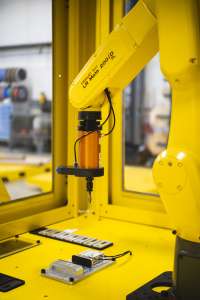
Robotic Deburring BladeWith routine operations like deburring, improvements are measured by two factors: 1) ease of use and 2) improved production speed and throughput. In other words, how well can the machine overcome the element of human error, and how much faster is it than other models? This is where the new Robotic Deburring Cell excels, thanks to our partnership with ATI. ATI’s Compliant Deburring Tools are engineered for robotic use. The Compliant Deburring Blade and Radially-Compliant Deburring Tool accept a variety of standard industrial media and feature robust components and built-in compliance. This compliance enables the cell to overcome feeding misalignment and can be adjusted to suit a variety of finish requirements. ATI Compliant Deburring Tools enable more consistent processing and streamline programming needs in robotic material removal applications. Finally, forget about time-consuming issues like reach limits, joint limits, and singularities. The Robotic Deburring Cell virtually eliminates complications caused by mechanical stops and limits.
Other Advantages

Robotic_Deburring_Cell_angleThe Robotic Deburring Cell can be integrated into an existing automation infrastructure for a turnkey solution. Nearly every element was designed for ease-of-use and versatility. An optional, pneumatically-controlled tool-change system makes adjustments quick and simple. RoboDK’s intuitive programming environment seamlessly blends simulations and real-world operations inside of one user-friendly application. You’ll have access to an extensive robotics library comprising over five-hundred file samples. Along with that, you’ll get access to plugins for several of the most common CAD/CAM software programs.


The Robotic Deburring Cell from DIY-Robotics is at the forefront of the next generation of robots. It offers the hallmark versatility, simplicity, and efficiency on which we pride ourselves. Get a significant return on investment with faster throughput and amazing precision. Save time with practical and easy-to-learn programming and a plug-and-play unit that takes the worry out of integration. For more information on our newest product: https://diy-robotics.com/robotic-deburring-cell/


Redirection Deburring Cell Page


The Top 10 Robotics Forums: Ranked by DIY-Robotics

There are many robotics forums on the internet, and it may be hard to know which ones are most reliable. Where is the best place to post your questions, ideas, or thoughts? Which ones are going to get you the most accurate answers? And which ones do the professionals trust? DIY-Robotics came up with a 5-point ranking system and rated a large sample of available forums on their activity, feedback, and user experience. In this article, we are proud to feature our picks for the top ten robotics forums.

#1 Robot Forum


Robot-Forum_Logo

Robot Forum is one of the best sites for engineers and programmers working with industrial robots. This forum brings together a worldwide network of roboticists to form a supportive and collaborative community. Robot Forum is a very active network known for providing high-quality, accurate answers and giving users a top-notch experience. Their site offers support for industrial robotics, Robot Math, and cobot help. They also have an extremely active discussion board. This versatile resource features a marketplace for robotic parts, and even provides resources for schools and education programs.


Activity and feedback level: 4.5/5

User experience: 4.5/5

Number of existing threads:
50,000 posts


#2 RoboDK Forum


Forum_RoboDK

RoboDK is perfect for any robotics enthusiast, no matter what your experience level. If you’re a beginner or a veteran, you’ll find a niche in this forum. You can participate in discussions and find answers to all of your RoboDK questions. If you’re unfamiliar with RoboDK, their simulation software and offline programming environment are among the best available. You can build a testbed to virtually program and run nearly any industrial robot. If you have questions about RoboDK software, industrial robotics, or robot programming, RoboDK forums are perfect for you.

Activity and feedback level: 4/5

User experience: 4.5/5

Number of existing threads: Over 4,000 posts


#3 RobotShop Community

RobotShop has created a community built around electronics, programming, robotic kits, and drones. An outstanding balance of fun, educational, and challenging resources are available through their online forum. Over a thousand members keep this community thriving and help answer questions ranging from the basic to the advanced.


Activity and feedback level: 4.5/5

User experience: 3.5/5

Number of existing threads: Over 36,000 posts


#4 ROBOTC Forum

ROBOTC is an innovative, C-based programming environment that was created at Carnegie-Melon University. Their program is fully integrable with Arduino, Hi-Technics, and even the LEGO Mindstorms platforms. Since ROBOTC was designed for education, you can expect their forums are packed with helpful tutorials, resources, and friendly moderators.


Activity and feedback level: 4/5

User experience: 3/5

Number of existing threads: Over 32,000 posts


#5 Robot Reviews

Robot Reviews has a massive community of over 250,000 unique visitors every month. Like most forums, you can get your questions answered, discuss breaking news, and interact with like-minded enthusiasts. But what makes Robot Reviews unique is how much the user can do on their site. Users can create their own blogs, message boards, and submit user-written articles. You can contribute to the world’s largest Robot Wiki, or even write features that may end up on the site’s front page!


Activity and feedback level: 4/5

User experience:
4.5/5

Number of existing threads: Over 149,000 posts


#6 Trossen Robotics Community

Trossen Robotics features one of the best-known and most respected communities of roboticists online. The Trossen Robotics Community (TRC) comprises an international network devoted to sharing and discussing questions, solutions, projects, and more. TRC is perfect for those who want to discuss humanoid robots, mechbots, construction robots, as well as Arduino and DIY projects.


Activity and feedback level: 4/5

User experience: 4/5

Number of existing threads: Over 70,000 posts


#7 – Society of Robots

If you want to build a robot or have some experience that could help others, the Society of Robots is a terrific resource. The Society of Robots’ forum features real-time chat, a question-answering AI, and the largest robot-building community on the web. Great for beginners who want to know where to start.


Activity and feedback level: 4/5

User experience:
2.5/5

Number of existing threads: Over 122,000 posts


#8 – RobotStudio Forum

ABB is a highly-regarded leader in the robotics industry. Well known for its robotics and automation solutions, ABB is a trusted stakeholder in the production of sustainable technology. ABB’s forum, RobotStudio, features high-tech simulations, programming environments, and troubleshooting resources. From their robot controllers to their various SDKs, RobotStudio brings ABB’s innovative tech to thousands of registered users.


Activity and feedback level: 3.5/5

User experience:
4.5/5

Number of existing threads: Over 10,000 posts


#9 DF Robot

For support with Arduino, Vortex, 3D Printing, and numerous visual programming languages, DFRobot’s Forums is a fantastic resource. This community caters to DIY hobbyists but is still a great place to find support and answers for engineering-related questions. The DFRobot Maker Community is a perfect introduction to the robotics community for beginners and home enthusiasts.

Activity and feedback level: 4/5

User experience: 3/5

Number of existing threads: Over 17,000 posts


#10 VEX Forum

VEXVex_Robotics_Logo is a well-established professional, educational, and hobbyist resource. Their selection of motors, controllers, hardware, and educational materials are trusted by professionals and students alike. One of the FIRST Robotics program’s primary sponsors, VEX is committed to providing clear, accurate, and updated resources on their forum. You can expect quick replies from knowledgeable professionals who are ready to help with any level of problem.
Activity and feedback level: 5/5

User experience: 4.5/5

Number of existing threads: Over 17,000 posts


Of course, DIY-Robotics should also be your primary stop for your robotics questions. Our forum, too, is among the best on the web. We invite you to see what our network of professionals and engineers has to offer.


The newest cobots on the market: The FANUC CRX 10iA series

FANUC has once again raised the bar for cobots with the launch of their new CRX series. The new pair of CRX models, the CRX 10iA and the CRX 10iA/L have established themselves as the new leaders in the field of automation. With several cobot models available, what distinguishes this lineup from other units on the market?

Astro FANUC CRXKey Features

FANUC already featured the most extensive line of cobots available. The CRXs offer all the same advantages as the other FANUC cobots, but with a few crucial upgrades and distinctions. Here are just some of the features that set the CRX models apart from their competitors.

Manual Manipulation

Say goodbye to complex matrices and advance programming kinematics. The CRX line can be manipulated by hand and guided to “teach points” so that the human operator can quickly and easily position and pose the robot. By moving it exactly to where it needs to be, the operator can use the robot’s tablet to take a snapshot of that configuration. FANUC’s software takes over from there, making sure the robot gets from point A to point B via the most efficient path. And since it features FANUC’s contact stop function, it is safe for humans to work in this close proximity environment.

Astro CRX Manual ManipulationThe Teach Pendant

The CRX models come with the brand new Teach Pendant Tablet. This sleek, modern touchscreen device features drag-and-drop programming and a quick and straightforward setup. It easily connects to third-party grippers and devices. Plus, it comes loaded with FANUC’s top-of-the-line software like iRPickTool, iRVision, and more!

Small Footprint, Powerful Arm

Although they have smaller footprints than a CR-15, both the CRX 10iA and the 10iA/L can handle a 10kg payload capacity. While they start compact, with a minimal profile, they boast 1249 mm and 1488 mm reaches, respectively.

Out of the Box

What else can you expect right out of the box? For starters, FANUC CRX cobots offer quick setup and a lightweight and compact design. The sleek and smooth surfaces make the units easy, comfortable, and safe to handle. There are no messy wires or sharp corners to frustrate operators during the unboxing or operation.

Astro FANUC CRX by DIY-roboticsOnce the CRX is out of the box, you’ll find several features that may not make the “top features” list, but which will still make converts out of even the most skeptical consumer. Both models of the CRX operate on standard 120V power. That means you can insert them anywhere in your assembly line as long as you have a standard outlet nearby. Both CRX models easily connect to numerous grippers and vision tools, making it a breeze to get your cobot into your assembly line and working with various third-party hardware. When combined with DIY-Robotics’ mobile Astro cells, the CRX 10iA and the CRX 10iA/L become even more versatile.
DIY-Robotics is a proud FANUC integrator. Check out the list of all of our supported robots and cobots at DIY-Robotics.com/products. While there, take a look at our Payload Calculator, see what our robotic workcells can handle, and decide which ones are the best fit in your factory.


How Could a Robotic Cell Improve Your Manufacturing Business?

Robotic cells are streamlined, efficient, highly complex machines capable of providing advanced technical solutions. Each cell is tailored to a company’s unique production needs. They are customizable and easy to integrate into your workflow at many different insertion points. Robotic Work cells may be one of the best improvements you can make to your manufacturing business.

What Is a Robotic Cell?

Robotic Work cells, or just robotic cells, contain all of the tools and end-effectors required to perform a specified task or series of tasks. Think of them as automated, fully-housed robots pre-loaded with precisely what they need for each stage of your automation process. Work cells are designed and equipped to handle tasks at numerous points in your assembly line. Robotic cells can be fitted with sensors, grippers, conveyors, and various safeguarding measures like fencing and emergency stop controls.

What Are the Assets of a Robotic Cell?

Work cells are set up to allow robots to operate at peak efficiency and performance. Everything is designed so that the robot can do its job as quickly as possible and with a high level of consistency. Enhanced speed and throughput translates to higher productivity and less down-time.

Safety is also an important asset of a robotic cell. Cells can come equipped with light curtains, e-stops, fencing, and other safeguards to keep employees safe while working within the robot’s vicinity. Speed barriers cease to be necessary because the robot is safely housed within a cellular compartment. The increase in speed equates to an increase in productivity and up-time.

Versatility

Robotic Work cells may only contain one robot. However, this is far from the limit of their capacity. Robotic cells are capable of housing multiple industrial robots. Since Work cells can accommodate various components of differing sizes, weight, and configuration, there are many possible automation solutions achievable by each unit. And while conventional thinking might suggest that adding more tools and sensors would take up more space, the robotic cell maintains the same footprint even when tooling or tasks are added or changed.

Conventional industrial robots are often fixed in place with a security perimeter. Consequently, they are typically dedicated to a single task and location. Conventional industrial robots have large footprints and create downtime when moved in the assembly line.

DIY-Robotics cells, on the other hand, offer swift and straightforward retasking. You can quickly move our robotic cells in and out of your production line. With a simple change in the tooling, you can use the same unit for multiple applications. That is the definition of versatility.

Reduce Direct Labor Costs

The cost of hiring and retaining a person to handle multiple manufacturing operations can add up over the years. A robotic cell, however, provides savings in a relatively short time. Not only does this reduce the cost of human labor, but it can also free up workers to take over higher-order processes such as programming and engineering.

What are the Operations a Robot Cell Can Do?

The most frequent task assigned to robotic cells is pick-and-place. However, this says more about industry need than the robot’s capabilities. Robotic cells can be equipped to handle numerous tasks and provide an enormous variety of automation improvements. Some of the primary tasks a robotic Work cell can handle are:

  • Sorting
  • Assembling
  • Deburring
  • Painting
  • Finishing and polishing
  • Welding (arc welding, spot welding, etc.)
  • CNC machine tending

Pick-and-place operations are easy to notice, as they are often placed at the beginning or end of assembly lines. But don’t be fooled into thinking that’s all robotic cells can do. Work cells can handle a significant number of your automation needs, more than what’s included in the list above.

Conclusion:

The purchase of a robotic cell might seem to be a costly investment for some small to medium-sized businesses. However, if we look at the numerous advantages that robotic cells bring to production, we realize that the return on investment makes it a worthwhile purchase. A robot cell is a guarantee of fast and seamless improvements to your automation processes. For more information on robotics cells, check out our product page at DIY-Robotics.com. You can also test-drive our virtual “FANUC Build Your Own Cell” configurator to create the ideal cell for your business.


What You Should Know About Cartesian Robots

If you read the DIY-Robotics blog or other robotics newsyou know that the number of factories incorporating robots is rising. Industrial robots streamline workflow by accelerating cycle times and eliminating bottlenecks. Task automation gets more straightforward with every successive generation of robots. End-users no longer need a degree in computer science to configure the robot’s features. The newest models boast unparalleled levels of user-friendliness with negligible backend-programming requirements. So, with the entire robotics industry booming, it’s essential to know what distinguishes one type of robot from another.  In this article, we’re going to look at Cartesian robots, where you might find one, and what makes them an excellent choice for some companies 

What is a Cartesian Robot? 

Machines that operate on Cartesian coordinate systems have been staples in factories for decades. 3D printers, laser-cutters, and CNC machines are examples of devices that use the same principle as Cartesian robots. What sets these robots apart from others is their construction. Cartesian robots are boxy, open, and their primary X-Y directional motion is regulated from above by a rectangular gantry. A lead screw or other linear actuator controls movement in the vertical, Z-direction. All Cartesian robots have this rectangular configuration, and as a result, they are sometimes called rectilinear robots or gantry robots. 

The Benefits: Strength, Precision, and Accuracy.  

Thanks to their rigid structure and boxy configuration, Cartesian robots can carry heavy loads. They are excellent at performing pick-and-place tasks, loading and unloading, material handling, and even high precision operations. 

When it comes to accuracy, howeverseveral factors determine how well a Cartesian robot will perform over time. If the drive system uses a rubber belt, for example, it may stretch or underperform with loads above a certain weight. Motor encoders, servos, and stepper motors improve travel accuracy as long as the material components are regularly checked or calibrated. Under optimal conditions, a Cartesian robot will exhibit superb accuracy in addition to its other qualities. However, do your due diligence before making a purchase and ensure the materials will withstand regular use.  

Work Envelope of a Cartesian Robot 

Cartesian robot’s work envelope is defined by its rectangular structure. Often there is a plate or work area within the boundaries of the X-Y plane. The operational height is bound by the vertical ceiling and the plate or work area. Within this area, there are no “dead zones.” The Cartesian robot has access to every part of the payload that is within this operational cube. 

The footprint of a cartesian robot is rectangular and compact. SCARA robots and six-axis robots have oblong work envelopes that create a lot of unusable space around them. Thanks to the predictable, measurable, and well-defined boundaries of the Cartesian robot, factories can incorporate them easily into their existing infrastructure without having to do a lot of calculating first. 

Whats the price of a Cartesian Robot? 

Due to their simplistic design, primary motor controller, and minimal moving parts, Cartesian robots provide savings over articulated robots. You will also save money by reducing downtime associated with start-up, programming, and troubleshooting. However, articulated robots are more flexible in the long-run. So while you’ll see a lower sticker-price on some Cartesian models, that discount comes at the cost of versatility.

For more information about Cartesian robots or any other types of robots, check out the DIY-Robotics forums and join a community of industrial robotics specialists and enthusiasts. Feel free to reach out to the team for a free consultation and a custom-tailored cost projection.  

Want to know more about Cartesian robotsJoin the DIY-Robotics forum for free and ask the community!

What You Need to Know About Articulated Robots

Articulated robots are the iconic mechanical denizens of the futuristic factory-floor. For decades, this image has seeped its way into our collective cultural consciousness and pervaded everything from cartoons to movies and even stock images. Also, though we’ve moved beyond the basic articulated design to some stunning, cutting edge machines, the image is so ingrained in our memories that the industrial robotics manufacturers continue to produce them to this day. But image alone isn’t enough to keep this reliable, not-yet-antiquated, style of robot around. What are the benefits provided by articulated robots? Why do so many factories choose to rely on this classic, iconic workhorse?

What’s an Articulated Robot?

Articulated robots are the most common types of industrial robots. Their resemblance to a human arm is perhaps one of the reasons they stand out so much in our minds. However, the mechanical benefits of this design are the real reason for their ubiquity and longevity. The arm design combines an extensive range of rotation motion and linear reach with the advantages of precision movement. Articulated arms are ideal for welding, material handling, pick-and-place operations, and dispensing. Their numerous axes and degrees of freedom mean that there is virtually no point in their work envelope that they cannot reach. This makes articulated robots one of the most versatile, flexible, and compact designs on the market.

Articulation of the Robot

The secret to the motion of articulated robots is their rotary joints. Joints can range from a two-axis configuration to something as complicated as ten or more axes. Articulated robots with six-degrees of freedom are the most common. Servo motors powering the joints act like bezel gears, changing the direction of motion by up to ninety-degrees while offering dial-in stops for precision programming and movement.

Work Envelope of an Articulated Robot

With any industrial robot, the work envelope is a significant factor in assessing its usefulness. Articulated arm robots can use a majority of their work envelope, which is one of their greatest advantages. The only part of the envelope they can’t use is the back where the cables are located. However, some modern designs feature internally routed power and data cables that eliminate this problem and let the articulated arm take advantage of its entire sphere of reach.

Regardless of how the cables are routed, even the most basic articulated robot can maximize the usable space for its footprint on the factory floor. This is a major advantage to factories that have to consider production flow, safety, and floor space.

Speed of an Articulated Robot

One of the drawbacks of articulated robots is their speed. They are not as efficient as other types of robots that can accomplish very high-speed tasks. Articulated robots, due to their numerous joints and degrees of freedom, require complex kinematics to govern their motion. They also have higher component mass, so there is an inertial barrier to overcome at every change in direction. If speed is a crucial component of a factory’s cost-benefit-analysis, then articulated robots may not be the ideal choice.

What’s the price of an Articulated Robot?

So, what will an articulated robot cost you? As with any factory upgrade, there are a few ways to answer this question. First, there is the upfront cost: what is the price of the actual unit? Then, there are operational and maintenance fees—these address the costs to operate and maintain the machines every month. However, if you also look at where you’ll see savings, you’ll get a better overall picture of your return on investment. Over time, the benefits of an articulated robot offset the upfront cost. For instance, factory automation improves the health and safety of workers by minimizing repetitive stress and limiting time in hazardous zones. Additionally, your company will produce products of more consistent quality. The result is increased productivity, which means that your investment will pay for itself down the road.

With so many factors constituting the “real cost” of robot upgrades, it’s best to consult the experts on DIY-Robotics.com for a full cost breakdown. In the meantime, you can build your own miniature/prototype robot and familiarize yourself with the mechanics and programming.

If you’d like to boost your factory’s productivity with a robot that is flexible, agile, and has a sizable work envelope, you should consider an articulated robotic arm. For more information about articulated robots or any other types of robots, check out the DIY-Robotics forum and join a community of industrial robotics specialists and enthusiasts. While you’ll find pricing for DIY-Robotics cells online, feel free to reach out to the team for a free consultation to better custom-tailor a cost projection.

Everything you Need to Know About SCARA Robots

Robots are evolving into an essential purchase for manufacturers. They can easily boost your productivity and simplify your automation processes. SCARA Robots, in particular, are popular. In this article, we’ll look at what SCARA robots are and why they may be one of the best choices for your facilities.

What is SCARA?

SCARA stands for Selective Compliance Articulated Robot Arm. They are robotic arms that have a versatile range of motion in the X-Y plane. The arms can move vertically as well, but the position of the vertical axis remains fixed. Thanks to the combination of rigid and dynamic axes, SCARAs are well suited to tackle a variety of material handling operations. They excel at pick-and-place tasks and rapid transportation processes. SCARA robots are at their best, however, when they are used to perform assembly applications. This includes anything from semiconductor handling to bio-med applications and packaging.

Articulation

The number of joints a robot has, combined with the number of axes in each joint, determines its degree of freedom. SCARAs are four-axis robots, with motion in the X-Y and Z planes, and 360-degree rotational movement about the Z-axis. Inverse kinematics and data interpolation allow the robot to move dynamically, quickly, and intelligently.

Work Envelope and Footprint

The work envelope (the area of space that a robot can physically reach) is a significant consideration. Often, when choosing between SCARA, Delta, or six-axis robots, the work envelope is the deciding factor. Due to their full rotation about the fixed Z-axis, SCARA robots have a cylindrical work envelope. In some applications, a SCARA’s work envelope is limited to the front and side. The rear may not be useable if cables and pneumatic hoses exit from the back. Still, having the ability to work in all, or mostly all, of their reach allows SCARA robots to maintain a minimal footprint while maximizing workspace.

Speed

Speed is an essential factor when choosing a robot. SCARAs are one of the fastest on the market. With four axes, they have fewer moving joints than their six-axis counterparts. Additionally, the reduction in joints simplifies inverse kinematic calculations, requiring less computational time. When cycle time is critical, SCARA robots present an ideal package.

So, How Much Should you Expect to Pay?

While Delta robots may be faster, SCARA robots are less expensive. When considering the cost per operation, SCARA robots are a better deal than most other configurations. Companies can expect to pay about $45,000 for a medium to large SCARA robot, but the price may vary depending on the number of extras and payload capacity. They can range from $25,000 and go up to $400,000.

So is the SCARA robot the right type for you? Hopefully, you now have a better idea of how they may meet your needs and expectations. They have many advantages, including if you are limited in space and need the maximum work-envelope to footprint ratio. For more information on SCARA and other robots, check out DIY-Robotics forum and join a community of industrial robotics specialists and enthusiasts.

The Top Six Types of Industrial Robots in 2020

The ubiquity of robots in factories and industry has led to a familiarity with robots as a tool of automation. Rapid technological advancements have allowed many manufacturing sectors to rely on robots for everyday tasks. PricewaterhouseCoopers estimates that up to 45% of work activities can be successfully automated. The impact robots can have on a company’s operation is well-established. By now, many executives have heard of SCARA or Polar robots, and they are aware that these advanced machines can increase their performance and production. What other robots are out there, and how can they benefit your business? In this article, we’ll take a look at the top six types of industrial robots currently on the market.

What are the Major Types of Industrial Robots in 2020?

All robots perform the same standard functions: They use sensors to detect changes in their environment and manipulators to interact with their surroundings. Robots typically perform two primary tasks: harvesting and positioning. How they do this, though, is as varied as the tasks to which they are assigned.

Articulated Robots

Articulated robots are the most common types of industrial robots. They comprise a mechanical configuration that resembles a human arm. With the use of articulated joints with multiple degrees of freedom, the arm provides a large range of movement. Articulated robots with six degrees of freedom are the most common. Other types may only have four degrees of freedom or even fewer.

Advantages: High speed, large work envelope for minimal floor space. Easy to align with multiple planes.

Disadvantages: Requires a dedicated robot controller, complicated programming, complicated kinematics.

Learn more about Articulated Robots >>

Cylindrical Robots

Cylindrical robots have at least one rotary joint at the base and at least one prismatic joint connecting the links.  With their pivoting shaft and extendable arm, they can move vertically and horizontally by sliding. They offer both linear movement and rotary movement about the vertical axis. The compact design of the effector allows the robot to reach tight workspaces without any loss of speed. Cylindrical robots are mostly used in simple applications, like pick-and-place, where rotary motions must be incorporated.

Advantages: Simple operation and installation. Minimal assembly. Robots can reach in 360-degrees from base. Requires minimal floor space and can handle heavy payloads.

Disadvantages: Doesn’t do well with obstacles. Low accuracy in direction of rotary motion.

Cartesian Robots

Cartesian robots are also called rectilinear or gantry robots and have a rectangular configuration. These types of industrial robots deliver linear motion by sliding on its three perpendicular axes (X, Y, and Z). Due to their rigid structure and configuration, they can carry heavy loads. They can also be used to perform pick-and-place tasks, loading and unloading, material handling, and even high precision operations. Most 3D printers operate on gantry systems.

Advantages: Provides high accuracy with simple operation. Easy to program offline and highly customizable. Able to handle heavy loads. Relatively inexpensive.

Disadvantages: Requires large operational and installation area. Complex assembly. Movement limited to only one direction at a time.

SCARA Robots

SCARA stands for Selective Compliance Assembly Robot Arm. These robots consist of two parallel joints that provide motion in one isolated plane. The rotary shafts are positioned vertically, and the end effector moves horizontally. SCARA robots excel in jobs that require precise lateral movements, and they are ideal for assembly applications. SCARA robots are suited to pick-and-place or assembly operations where high speed and high accuracy are required. SCARA robots move quickly and integrate into existing infrastructure more easily than cylindrical and cartesian robots.

Advantages: High speed, excellent repeatability, large workspace.

Disadvantages: Requires a dedicated robot controller, limited to planar surfaces, hard to program offline.

Learn more about Scara Robots >>

Polar Robots

Polar robots are the veterans of the robot world. They are one of the first types of robots developed and are still popular today. The axes of the robot are combined to form a polar coordinate system, which allows the robot to have a spherical work envelope. Polar robots are commonly used for die casting, injection molding, welding, and material handling.

Advantages: 360-degree range of motion. Large work volume. Require minimal floor space.

Disadvantages: Short vertical reach, low accuracy, and low repeatability in the direction of rotary motion. They require a sophisticated control system.

Delta Robots

Delta robots are also called parallel-link robots. They consist of parallel joint linkages connected to a common base. Delta robots are especially useful for direct control tasks and high maneuvering operations (such as fast pick-and-place jobs). Delta robots make clever use of the mechanical advantage of four-bar linkage systems.

Advantages: Very high speeds are attainable. High operational accuracy.

Disadvantages: Complicated operation and requires a dedicated robot controller.

As you can see, many industrial robot options exist on the market. In addition to the autonomous models listed, you might find collaborative robots fit your automation needs better. Collaborative robots come in the same basic types included in this article, but are designed to work directly with human operators.

The most important thing is to know before selecting your robot is what tasks you need it to perform, and how you want it to integrate into your existing infrastructure. For help selecting the best robot for you, check out some of our other articles on DIY-Robotics.com. Our robotic integrators will help you choose the right automation tools for your company.